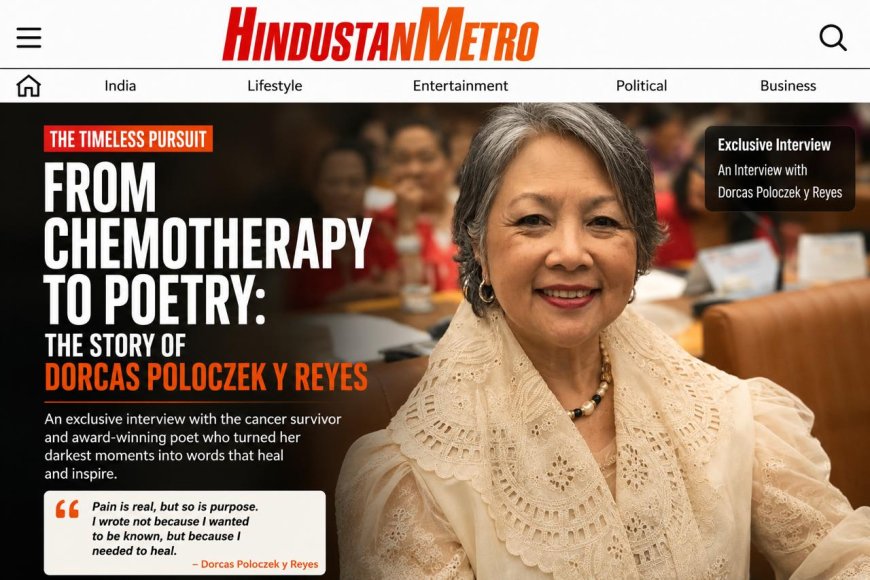
Some stories inspire because they speak of success. Others stay with us because they speak of survival. But every once in a while, a story emerges that becomes something greater than both—a story that transforms pain into purpose, hardship into art, and silence into a voice powerful enough to move people across borders.
For Dorcas Poloczek y Reyes, widely known as Dorie Reyes, life has never followed a single path. Her journey has unfolded through many identities: cultural ambassador, healthcare worker, community leader, cancer survivor, and eventually, poet. Each chapter shaped the next, creating a life story rooted in resilience, faith, service, and deep love for the Filipino identity.
Today, Dorie is recognized internationally not only for her literary achievements, but for the humanity behind her words. Her poetry does not merely describe suffering—it gives suffering meaning. It does not simply talk about healing—it becomes part of the healing itself.
In this exclusive conversation with Hindustan Metro, Dorie Reyes reflects on the defining moments that shaped her life, from representing Filipino culture in Europe to writing poetry during chemotherapy treatments, and how she ultimately transformed one of the darkest periods of her life into a source of inspiration for others.
Carrying Filipino Identity Across Borders
Long before she became known in literary circles, Dorie’s life was already centered on representing Filipino culture abroad.
“As early as 1978, I was already active in cultural dance,” she recalls warmly. “We would go to the Philippine Center in Cologne, and that was where I first expressed my love for Filipino culture.”
At a young age, she discovered that culture could become more than heritage—it could become identity, connection, and purpose. Living overseas only deepened her appreciation for her roots.
A year later, in 1979, she joined the Bundesgartenschau in Bonn, West Germany, a prestigious national garden exhibition where countries from around the world showcased their traditions and cultural artistry.
“We represented the Philippines there,” she says proudly. “It was a beautiful experience because we were showing who we are as Filipinos.”
Even then, her mindset reflected a quiet but powerful patriotism.
“I always believed that wherever you are, you carry your country with you.”
That belief would remain a constant throughout her life. Whether through dance, leadership, healthcare, or literature, Dorie consistently carried the Filipino spirit into every space she entered.
Building Communities Abroad
As the years passed, her involvement with the Filipino community expanded beyond cultural performances into advocacy and leadership.
Dorie became an active member of Babaylan Germany (Philippine Women’s Forum e.V.), an organization based in Cologne dedicated to supporting Filipino women, families, and migrant communities in Europe. Through workshops, cultural programs, and community initiatives, the organization sought to preserve Filipino identity while helping overseas Filipinos adapt to life abroad.
“When Filipinos are far from home, community becomes very important,” she explains. “Especially for women and families who need guidance, support, and friendship.”
Her dedication to service eventually led her to larger organizations such as the European Network of Filipino Diaspora (ENFID), where she would later serve in multiple leadership positions.
For Dorie, leadership was never about titles or recognition. It was about presence, compassion, and collective responsibility.
“When you serve people, especially in volunteer organizations, it should come from love,” she says. “Not from pride or competition.”
Her work within the Filipino diaspora made her a respected figure among communities abroad—not only because of her leadership, but because of her sincerity.
A Career Rooted in Compassion
Before poetry entered her life in a profound way, Dorie spent decades working in healthcare in Germany.
As a nurse specializing in intensive care, oncology, and palliative care, she encountered humanity at its most vulnerable moments. It was emotionally demanding work that required not only professional skill, but empathy, patience, and emotional endurance.
“I saw many realities of life,” she says quietly. “Not just suffering, but also hope.”
Working closely with patients facing serious illness changed her understanding of strength and human resilience. Every hospital room carried stories of fear, courage, uncertainty, and love.
Though she did not yet realize it, those experiences were shaping the emotional depth that would later define her poetry.
“All of those moments stayed with me,” she reflects. “They became part of my understanding of people and life.”
Years later, when illness would unexpectedly become personal, those experiences in healthcare would give her a unique perspective—not only as a patient, but as someone who deeply understood the emotional realities of healing.
Discovering the Artist Within
While service remained central to her life, creativity quietly continued to grow in the background.
In 2018, during an ENFID event in Paris, Dorie experienced a turning point she never expected.
“That was where I became the first Miss Tala,” she recalls with a smile.
What made the moment memorable was not simply the recognition, but the authenticity behind it. Her performance featured an impromptu poem combined with a heartfelt Kundiman song—an emotional presentation rooted in sincerity rather than preparation.
“I didn’t prepare it,” she says. “It just came naturally.”
The audience responded immediately to the honesty of her expression. It was not polished performance that moved people—it was truth.
That moment marked the beginning of her emergence as a public literary voice. Alongside her growing involvement in ENFID, she would later become a board director, continuing her advocacy while gradually finding confidence in her creative identity.
When Life Suddenly Changed
In 2019, everything shifted.
Dorie was diagnosed with breast cancer.
The diagnosis arrived like an interruption to a life built around caring for others. After years of serving patients in healthcare, she suddenly found herself confronting illness personally.
Yet even in that life-altering moment, her mindset remained grounded in courage.
“I told myself, I will face this,” she says firmly.
Still, strength did not erase fear. There were difficult days marked by uncertainty, physical exhaustion, emotional pain, and moments of vulnerability.
Cancer forced her into unfamiliar emotional territory.
But within that difficult chapter, something unexpected began to emerge.
Writing Through Chemotherapy
Dorie remembers the exact moment her writing truly began.
“January 20, 2020,” she says. “That was my first chemotherapy session. That was also when I started writing again.”
This time, poetry was no longer simply artistic expression. It became emotional survival.
“I needed a place where I could release everything I was feeling,” she explains.
Her poems became deeply personal reflections of fear, faith, healing, loneliness, and resilience. Every line carried fragments of her experience—not filtered through performance, but through honesty.
Yet even during treatment, she refused to isolate herself from the world.
Instead, she immersed herself in literary communities and organizations, joining groups such as Pentasi B, Filipino Poets in Blossoms, Own A Poem, Bigkis ng Panitik, Passion of Poetry, and Kapanulat.
“I kept participating, even during therapy,” she says.
Her dedication quickly earned recognition. She received honors in literary competitions, advanced in poetry organizations, and earned titles including Makata ng Linggo, Makata ng Buwan, Makata ng Taon, and Emperador.
Yet despite the recognition, her perspective remained humble.
“I didn’t expect awards,” she says softly. “I was simply expressing myself.”
Finding Strength in Faith and Creativity
Perhaps the most remarkable part of Dorie’s journey was not simply that she continued writing during illness—but that she continued serving others as well.
“Even if I was bald, even if I was weak, I still attended meetings,” she says. “ENFID became virtual during the pandemic, and I made sure I stayed involved.”
There were moments when treatment left her bedridden and exhausted. But she refused to surrender her sense of purpose.
“I always asked myself, what can I still do for the Filipino community?”
Her daily routine became a source of emotional strength: prayer, gospel singing, reflection, and writing.
“That became my therapy,” she says. “Talking to God, singing, and writing.”
Through those quiet acts, she slowly transformed pain into creativity.
Turning Pain Into Literature
From that deeply emotional period came her first poetry collection, Tala at Tula ni Dorie Reyes Polo, published on February 22, 2022.
“That book contains everything I experienced,” she says. “Every emotion is there.”
The collection became more than a literary milestone—it became proof that even suffering could create something meaningful.
Later, she followed it with a second collection titled Hibla ng mga Tula sa Anit ng Gunita, further establishing her place in contemporary Filipino literature.
Readers connected deeply with her work because her poetry felt lived, sincere, and emotionally unguarded. Her words resonated not because they tried to impress, but because they revealed truth.
Recognition Without Losing Purpose
As her literary presence grew, international recognition followed.
Dorie received honors including Woman of the Year in Rome (2023), recognitions in Milan, and several awards in the Philippines, including distinctions celebrating her contributions to literature and the arts.
Yet despite these accomplishments, she remains deeply grounded.
“For me, what matters most is when people feel something,” she says. “When they connect to the message.”
That emotional authenticity continues to define her work today.
A Legacy Still Being Written
Beyond poetry, Dorie remains committed to serving the Filipino community abroad.
Recently re-elected to leadership roles within ENFID, she continues advocating for Filipino migrants, cultural preservation, and community unity.
“Yes, we are abroad,” she says thoughtfully, “but we should never forget who we are.”
For her, being Filipino is not merely an identity—it is a responsibility.
“It’s okay to adapt to other cultures,” she says. “But we should never lose our own.”
As the conversation comes to a close, her reflections become quieter, but even more powerful.
“I see everything as part of a purpose,” she says. “My work, my illness, my writing—it all means something.”
From nurse to patient, from survivor to poet, Dorie Reyes has transformed every chapter of her life into something meaningful.
She did not simply survive hardship.
She turned it into poetry.