















Life, Death And Laughter — The Literary World of Uma Ranganathan

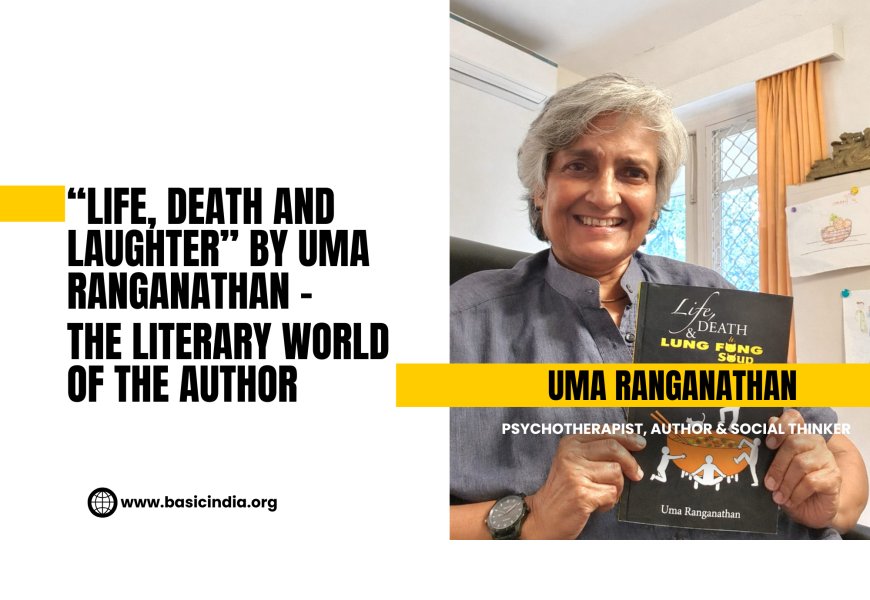
According to author Uma Ranganathan, even ordinary individuals have the capacity to lead enlightened, fulfilling lives. Her own life stands as a quietly compelling example of that truth. She is an author who defies easy categorisation, a woman whose life story reads less like a conventional literary biography and more like the kind of beautifully unruly, meaningful narrative she herself might one day choose to write. From the very first encounter with her voice, whether on the page or in person, it becomes immediately clear that Uma Ranganathan is someone who has not merely observed human life from a comfortable distance, but has lived it with her eyes wide open, her heart fully engaged, and, crucially, her sense of humour firmly and gratefully intact.

May 2, 2026 - 12:11
Life, Death And Laughter — The Literary World of Uma Ranganathan

According to author Uma Ranganathan, even ordinary individuals have the capacity to lead enlightened, fulfilling lives. Her own life stands as a quietly compelling example of that truth. She is an author who defies easy categorisation, a woman whose life story reads less like a conventional literary biography and more like the kind of beautifully unruly, meaningful narrative she herself might one day choose to write. From the very first encounter with her voice, whether on the page or in person, it becomes immediately clear that Uma Ranganathan is someone who has not merely observed human life from a comfortable distance, but has lived it with her eyes wide open, her heart fully engaged, and, crucially, her sense of humour firmly and gratefully intact.

What makes Uma’s story particularly captivating is the wonderfully eclectic constellation of inspirations that have shaped her inner world and, by extension, her writing. Her most cherished influences span a range so delightfully unexpected that they speak volumes about the kind of mind she possesses, one that refuses to be confined by convention or to draw artificial boundaries between the serious and the playful, the sacred and the absurd. Alfred E. Newman and Charlie Brown sit comfortably alongside J. Krishnamurti and her deeply revered teacher and guide, Samuel Widmer — a pairing that perfectly encapsulates Uma’s fundamental belief that wisdom need not always arrive wearing solemn robes, and that laughter and philosophical inquiry are not opposing forces but natural and deeply compatible companions. To this rich, inner circle, she adds the many cats that have frolicked through her life, as well as the friends who have joined her in exploring life’s deeper questions through the unique blend of margaritas and meditation. It is a combination that is, quite simply, unlike anything else and produces a perspective on human existence that is equally one of a kind.

Uma’s professional journey throughout has been a rich and varied tapestry of experiences, each one adding a new and essential thread to the intricate weave of understanding that would eventually find expression in her writing. She moved through a number of different fields with the curiosity and openness of someone genuinely committed to encountering life in all its forms. Her work as a freelance journalist helped to sharpen her powers of observation, honed her instinct for the telling detail, and deepened her sensitivity to the full spectrum of human experience. She also devoted a significant and deeply meaningful chapter of her life to deaf education, a field that demanded not only professional skill and dedication, but a profound quality of presence, empathy, and the willingness to meet people exactly where they are. Each of these experiences, distinct as they were, was quietly preparing her for the vocation that would ultimately come to define her professional life and also provide a rich and inexhaustible source of material for her writing.

It was in the field of counselling and therapy that Uma Ranganathan finally found her true professional home and it is here that the full depth and complexity of her understanding of human nature was most profoundly forged. As a psychotherapist, she has spent years peering into what she so vividly describes as the intricate labyrinths of the human mind, that complex interior terrain where heartache and hilarity coexist, where the poignant and the utterly absurd are often separated by the thinnest of membranes, and where life reveals itself in all its bewildering, beautiful, and frequently contradictory fullness. This work has gifted her with a quality of insight that is both clinically grounded and deeply compassionate, an ability to sit with the full weight of human suffering and struggle without ever losing her capacity for wonder, warmth, and the kind of laughter that heals rather than dismisses. It is this rare and hard-won combination that gives her writing its distinctive and deeply affecting character.

Today, Uma Ranganathan continues to channel her empathy, her professional expertise, and her philosophical curiosity into work that extends well beyond the therapy room. She devotes a significant portion of her time to facilitating community-building processes, a form of work that reflects her deepest convictions about the importance of human connection, mutual understanding, and the possibility of people learning to live alongside one another in a spirit of peace. In this role, she helps individuals and groups identify the pathways, practices, and perspectives that make harmonious coexistence not merely an abstract ideal, but a livable, daily reality. It is work that is deeply of a piece with her writing, both being at their core, expressions of the same fundamental belief that human beings are capable of far greater wisdom, compassion, and joy than the ordinary frictions and fears of daily life might suggest.

Life, Death And Lung Fung Soup” is her second book (following “Bombay To Eternity – Memoirs Of A Laidback Rebel” published by Penguin Books in 2004). It is perhaps the most perfect distillation of everything that Uma Ranganathan is, as a thinker, a therapist, a humorist, and a human being. The central revelation that Uma offers her readers is at once simple and profoundly liberating: that the best and perhaps only genuinely effective way to survive the cosmic rollercoaster ride of human existence is to let go, to throw one’s hands up in a gesture not of defeat but of exhilarating surrender, and to turn toward life with curiosity and a sense of wonder. It is the kind of insight that sounds deceptively easy to articulate but in practice is the work of a lifetime.

Uma Ranganathan is, in every meaningful sense, a writer for our times, one who understands that the human need for meaning and the human need for laughter are not in competition, but are in fact two expressions of the very same deep longing for genuine, unguarded contact with the truth of our shared experience. Her voice is warm, witty, philosophically fearless, and utterly unafraid of the absurd, which indeed is a rare and genuinely precious thing in the contemporary literary landscape. Uma writes with the authority of someone who has looked at life honestly, loved it fiercely, and found somewhere in the glorious mess of it all, truly something worth celebrating on every single page.