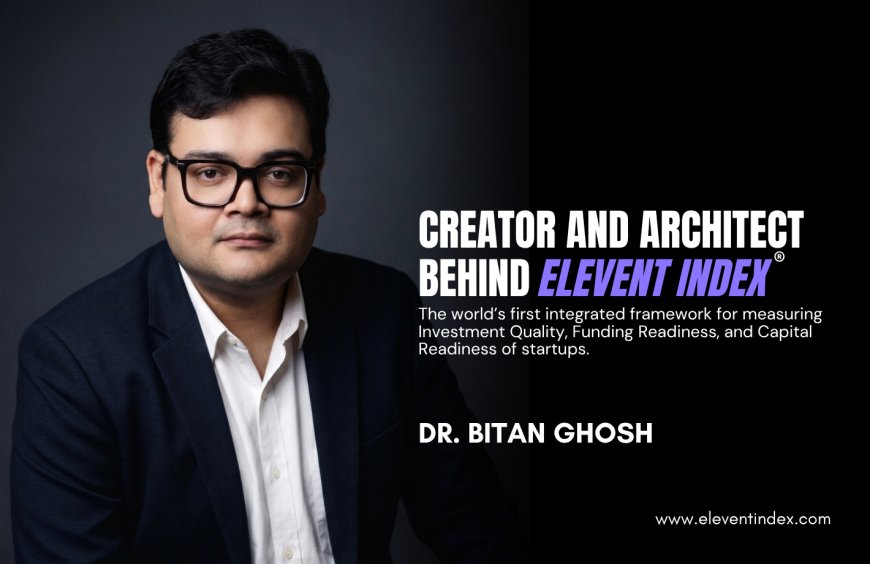
According to Dr. Ghosh, Elevent Index was not created as an academic exercise but evolved through years of practical investment discussions, founder interactions, and real-world observations.
An Idea That Started Inside Investment Meetings
The origins of Elevent Index trace back to investment committee discussions where Dr. Ghosh found himself evaluating every startup across multiple business dimensions, despite never formally documenting the process.
While presenting investment opportunities, he realized that his decision-making consistently followed a structured pattern. The turning point came when a fellow investor questioned why this internal methodology had never been written down.
Reflecting on that experience, Dr. Ghosh said, "I realised I had been applying the same thought process for years, but it existed only in my head. That question forced me to turn instinct into something structured and transparent."
The experience encouraged him to examine whether investment decisions could become more consistent if the evaluation process itself became systematic.
Conversations With Founders Shaped the Framework
As the concept developed, Dr. Ghosh began speaking directly with startup founders about their fundraising experiences. Rather than asking why companies failed to raise capital, he focused on understanding how founders perceived investor feedback.
A recurring concern emerged during those conversations. Many founders said that investment rejections were often vague and offered little insight into the actual weaknesses of their businesses.
"Several founders told me they could accept a rejection if they understood exactly what needed improvement. Clear feedback is more valuable than uncertainty," Dr. Ghosh said.
Those discussions influenced the direction of Elevent Index by encouraging a framework that could identify strengths and weaknesses through clearly defined assessment parameters rather than broad impressions.
Understanding What Elevent Index Measures
Elevent Index evaluates startups using three interconnected metrics that examine different aspects of investment readiness.
The first component, Investment Quality Score (IQS), measures the overall quality of the business itself. It examines factors including founder capability, market opportunity, product strength, business model viability, financial health, competitive positioning, customer traction, governance standards, operational readiness, investment potential, and long-term sustainability.
The second component, Funding Readiness Score (FRS), focuses on whether the company is practically prepared to raise external capital. This includes financial reporting, legal documentation, governance systems, fundraising strategy, due diligence preparation, and transaction readiness.
The third component, Capital Readiness Score (CRS), integrates both assessments into a broader view of how prepared a startup is to attract and effectively manage investment capital.
Together, these measurements seek to provide a more balanced assessment than relying solely on valuation, market momentum, or founder presentations.
Separating Business Strength From Fundraising Readiness
One of the central ideas behind Elevent Index is that business quality and fundraising readiness should not be treated as the same measure.
Many startups build innovative products and generate early customer traction but remain unprepared for institutional investment because financial reporting, governance practices, legal documentation, or investor communication have not matured at the same pace.
At the same time, some startups present polished investment materials while deeper business fundamentals remain underdeveloped.
By evaluating these areas independently, Elevent Index attempts to distinguish between companies that require operational preparation before fundraising and businesses that may need stronger commercial foundations altogether.
Industry observers note that this distinction reflects a common challenge in early-stage investing, where presentation quality can sometimes overshadow business fundamentals during fundraising discussions.
Responding to a Changing Investment Environment
India's startup ecosystem has expanded significantly over the past decade, attracting domestic and international investors across technology, healthcare, manufacturing, fintech, climate technology, and consumer businesses.
However, the investment climate has evolved alongside that growth. Investors today place greater importance on governance, financial controls, sustainable growth, and operational execution than during periods when capital was more widely available.
Analysts say structured evaluation methods can improve consistency in investment committees by creating comparable benchmarks across startups operating in different industries and growth stages.
Although no framework can eliminate investment risk, systematic assessment models may help investors identify both opportunities and warning signs earlier in the decision-making process.
Elevent Index has been positioned as one such decision-support framework rather than a replacement for investor judgment.
Built on an Interdisciplinary Professional Background
Dr. Bitan Ghosh brings together experience from engineering, finance, infrastructure consulting, business strategy, and corporate research.
He earned a Bachelor of Technology in Civil Engineering before completing an MBA in International Business and Finance. He later received a Doctor of Business Administration with research focused on corporate finance.
His professional career includes engineering assignments in Kuwait, leadership roles across technology and consulting businesses, infrastructure advisory projects, and enterprise management. He currently serves as Managing Director of Ghosh Group, where his work spans infrastructure, technology, consulting, investment strategy, and business development.
This multidisciplinary background influenced the development of Elevent Index, which combines engineering-style analytical thinking with financial evaluation and strategic business assessment.
Recognition Across Business and Industry Platforms
Over recent years, Dr. Ghosh has received recognition through several national and international publications for his work in entrepreneurship, business strategy, and research.
His professional journey has been featured by publications including Mint, Dainik Jagran, ABP News, Mid-Day, Nationwide Awards, The Telegraph, and NY Weekly, reflecting different stages of his career and the evolution of Elevent Index.
The framework also highlights Kolkata's growing contribution to business research and entrepreneurial thinking. While India's startup ecosystem is often associated with Bengaluru, Mumbai, Delhi NCR, and Hyderabad, initiatives such as Elevent Index demonstrate that research-driven innovation is emerging from other business centres as well.
A Structured Approach to Startup Evaluation
As startup funding becomes increasingly competitive, founders are expected to demonstrate more than innovative ideas or ambitious growth projections. Investors now seek evidence of operational maturity, governance standards, financial clarity, execution capability, and long-term sustainability before committing capital.
Elevent Index reflects this broader shift by encouraging a structured evaluation process that separates business quality from fundraising preparedness while combining both into an integrated assessment of capital readiness.
Whether the framework sees wider adoption among venture capital firms, angel investors, startup accelerators, and founders will depend on its practical application over time. However, its underlying objective remains clear: to support more disciplined investment decisions by replacing subjective impressions with a structured evaluation model that measures whether a startup is not only promising, but genuinely prepared for investment.
Disclaimer: This report has been prepared using information shared by the subject along with publicly available material. Readers are encouraged to conduct independent verification where necessary.