Which is precisely why what ProHobby has quietly built over the last several years feels so unusual.
Based in Delhi NCR and originally known for custom aquariums and ecological installations, the company has gradually developed what is now becoming one of the most detailed publicly accessible resources on living aquatic and hybrid ecosystems anywhere online — and then made the overwhelming majority of it freely available.
No signups. No subscriptions. No premium “expert tier.” No attempt to reduce complex ecological systems into algorithmically optimised lifestyle content.
Instead, what emerged was something far more ambitious: an interconnected ecological systems platform built around long-form environmental frameworks, habitat intelligence, structural guidance, water chemistry analysis, ecosystem stability modelling, and highly detailed operational tools spanning freshwater, planted, brackish, pond, and hybrid living systems.
At the centre of the platform is an expansive ecological knowledge archive covering nutrient cycling, lighting ecology, environmental design, biotope systems, hybrid habitats, and long-term systems behaviour. Alongside it sits an unusually comprehensive ecosystem planning toolkit featuring advanced calculators and operational frameworks designed for real-world environmental conditions rather than idealised assumptions. Together, the Knowledge Library and calculator infrastructure form the backbone of what increasingly resembles a public ecological systems platform rather than a conventional hobby website.
At first glance, the platform appears to exist within the aquarium world. In reality, it operates at a much broader intersection — ecology, environmental systems design, biophilic architecture, behavioural environments, hydrodynamics, nutrient cycling, and long-term biological stability.
That distinction matters because the broader living ecosystems industry has expanded dramatically over the last decade.
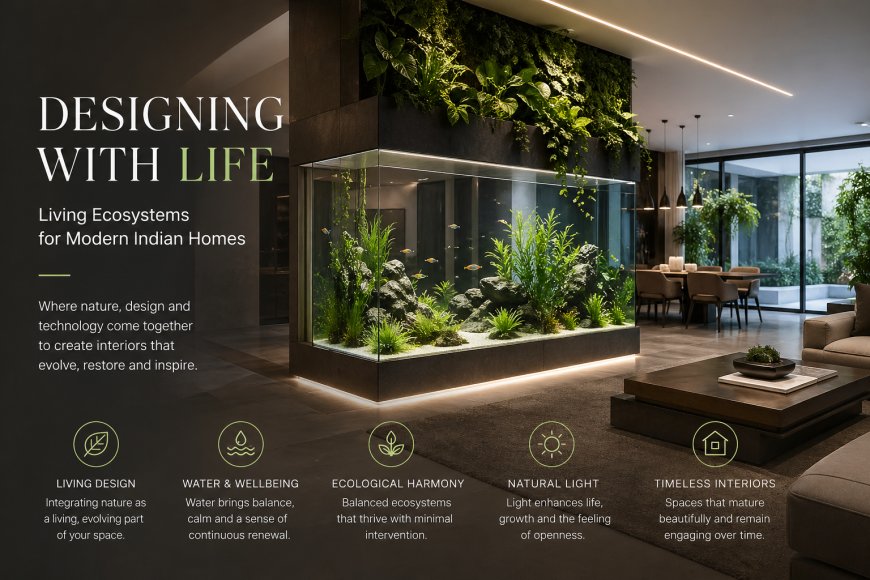
What was once considered a niche hobby now intersects with residential architecture, hospitality, healthcare environments, commercial interiors, educational spaces, and wellness-focused design. Living walls, planted aquatic systems, water features, and hybrid ecological installations are increasingly appearing not as decorative novelties, but as components of larger environmental strategies intended to reduce cognitive fatigue and reconnect built spaces with biological processes. Principles associated with biophilic design have steadily moved from architectural theory into mainstream residential and commercial planning.
Yet despite the scale of this larger industry, the underlying knowledge ecosystem remains surprisingly fragmented.
Most hobbyists — and even many professionals — still navigate a maze of conflicting forum advice, anecdotal YouTube guidance, oversimplified tutorials, and highly commercialised “beginner” content that rarely accounts for the complexity of ecosystems operating over time. Algae blooms, unstable water chemistry, filtration collapse, stocking imbalance, nutrient instability, and biological crashes are often treated as isolated problems rather than symptoms of interconnected environmental imbalance.
ProHobby’s platform appears to have emerged in direct opposition to that fragmentation.
Instead of treating ecosystems as decorative objects, the company consistently frames them as interdependent environmental systems governed by relationships rather than isolated variables. That systems-first thinking now runs throughout the website. The platform increasingly reads less like a retail catalogue and more like a continuously expanding ecological archive.
Its planning infrastructure alone is unusually ambitious.
Rather than offering simplistic single-variable calculators, the platform integrates multiple layers of ecological and operational logic simultaneously: structural tank load analysis, usable water volume modelling, bioload estimation, water-change chemistry projection, dechlorinator dosage planning, RO blending systems, salinity preparation frameworks, filtration planning, operational cost forecasting, and ecosystem stability calculations designed to model real-world conditions rather than idealised scenarios.
Many of these tools account for variables that are rarely addressed together in publicly available planning systems, particularly within the Indian environmental context. Results are generated across multiple unit systems, environmental assumptions, and operating conditions while attempting to reflect how ecosystems actually behave over time.
The long-form knowledge frameworks follow the same philosophy.
Across hundreds of detailed pages, the platform explores subjects that most hobby websites either oversimplify or avoid entirely: ecological collapse dynamics, nutrient cycling across different habitat systems, lighting ecology, environmental succession, brackish instability, biological maturity timelines, behavioural stocking relationships, habitat-faithful biotope systems, and the structural logic behind long-term ecosystem equilibrium.
The tone itself is notable. The writing avoids the exaggerated certainty common to commercial hobby content. Instead, ecosystems are consistently framed as systems governed by constraints, trade-offs, and interdependent biological relationships rather than as visual products.
That intellectual positioning is part of what makes the platform increasingly difficult to categorise.
On one level, ProHobby still designs aquariums, paludariums, indoor water features, ponds, and hybrid ecosystems across metropolitan India. But the website increasingly suggests a broader ambition: the construction of a publicly accessible systems framework around living environments themselves.
What makes the undertaking genuinely unusual, however, is not merely the breadth of the platform, but the scale of effort required to build it in the first place.
Developing even a single serious ecological planning framework demands substantial investment — not only in technical development, but in research, modelling, calibration, testing, revision, and systems understanding. ProHobby did not build one or two isolated utilities. Over time, it constructed an expanding ecosystem of interconnected planning tools, analytical frameworks, environmental references, operational systems, and ecological models spanning multiple categories of living environments.
The cumulative effort implied by that scale is difficult to overstate.
What appears on the surface as a collection of calculators and articles is, underneath, the result of years of sustained intellectual labour: thousands of hours spent studying ecological relationships, analysing system failures, refining planning logic, testing environmental variables, rewriting frameworks, expanding calculations, and attempting to translate fragmented ecosystem knowledge into structured, publicly usable infrastructure.
Most companies of comparable size would not attempt such a project at all. More importantly, even if they did, they would almost certainly monetise it aggressively.
That is what makes the final decision so surprising.
ProHobby did not place the planning system suite behind subscriptions. It did not lock advanced planning systems behind paid memberships. It did not convert the knowledge base into a lead-generation funnel disguised as education. Instead, it appears to have made a far less commercially obvious choice: to leave the overwhelming majority of the infrastructure publicly accessible.
In practical terms, this means that tools and frameworks representing years of accumulated systems development — resources that could easily have been fragmented into paid products, premium consulting layers, or gated professional utilities — were simply released into the public domain of the ecosystem and design community.
That decision fundamentally changes the character of the project.
Without the free-access layer, the platform could still be interpreted as sophisticated content marketing for an ecological design practice. With it, the undertaking begins to resemble something far rarer: a small independent company attempting to build public ecological infrastructure around living systems in a field still dominated by fragmentation, improvisation, and commercial oversimplification.
The timing may also prove significant.
As residential and commercial environments increasingly move toward biophilic and ecologically responsive design, the demand for deeper ecosystem literacy is likely to expand alongside them. Living systems cannot simply be “styled” into existence. They require calibration, environmental understanding, and long-term systems thinking. A visually successful ecosystem can still collapse biologically within months if the underlying relationships are poorly understood.
That gap between aesthetics and ecology is precisely where ProHobby appears to have concentrated much of its effort.
The platform repeatedly prioritises stability over spectacle, systems understanding over symptom-fixing, and environmental coherence over short-term visual impact. In doing so, it quietly challenges a culture that has long treated ecosystem failure as normal.
Whether the project eventually receives broader international recognition remains uncertain.
What is already clear, however, is that the undertaking reflects something larger than a conventional business expansion. It represents a sustained attempt to organise, systematise, and publicly distribute ecological knowledge within a rapidly expanding global category that still lacks coherent educational infrastructure.
And perhaps that is what ultimately gives the story its weight.
Not merely that a small Indian company built one of the internet’s most comprehensive resources on living ecosystems.
But that it spent years building it, continued expanding it, absorbed the cost of creating it — and then quietly gave the overwhelming majority of it away for free.
______________________________________________________________________________The ProHobby™ Knowledge Library and all seven planning calculators are available free at prohobby.in