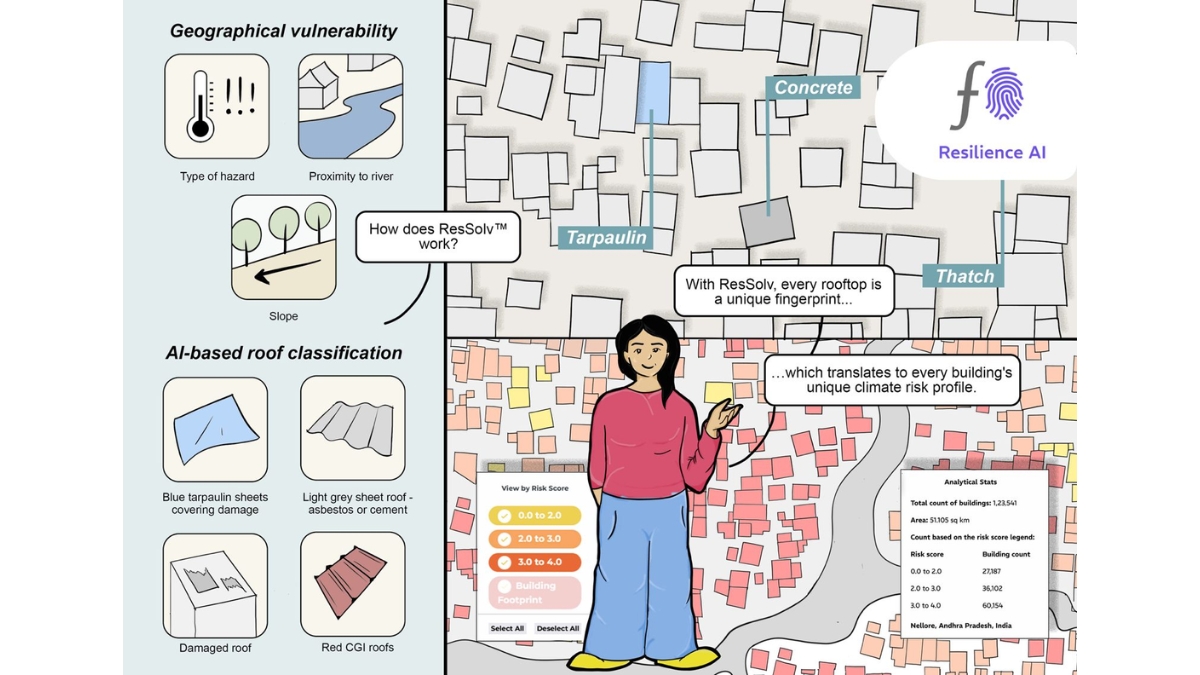
National Disaster Management Authority (NDMA), Ministry of Home Affairs Government of India in collaboration with the Delhi Disaster Management Authority (DDMA), and key knowledge partners United Nations Environment Program (UNEP), United Nations International Children's Emergency Fund (UNICEF), Rocky Mountain Institute (RMI) among few, developed the Delhi Heat Action Plan 2025, which outlines city-wide strategies for 11 districts to combat heatwaves. Resilience AI is deploying Resilience360TM to generate a heat risk assessment covering more than 9,000 structures, including dense settlements, residential, industrial, and transportation areas, with a hyperlocal heat hotspot profile and heat exposure map. These insights are generated quickly and with precision to help knowledge partners prioritise targeted interventions, such as cool-roof installations, passive cooling zones, and shaded shelters, in Delhi’s most heat-exposed structures.
Speaking on this, Samhita R, Co-Founder & CEO, Resilience AI, said, "The repercussions of heatwaves are long-felt, and there is a pressing need for tools that can help us make decisions before a heatwave occurs. Resilience360 enables the eco-system: administration, operators, funding, with a nimble tool to know where the risk is, prepare based on the magnitude of risk, and use scientific evidence-based risk assessment for targeted interventions. This, in totality, makes disaster management truly effective."
Mrinalini Srivastava, Director IPS and Officer on Special Duty, National Disaster Management Authority (NDMA) added, "The integration of advanced AI and ML tools into Delhi’s Heat Action Plan marks a significant leap forward in disaster preparedness. With granular, real-time heat risk mapping, we can enable faster, more informed decision-making at the local level, ultimately protecting the most vulnerable populations from climate-induced heat stress."
Key Contributions to the D-HAP Report
Resilience AI's findings, which are central to the D-HAP report, highlight several critical insights and actionable solutions:
- Hyper-Local Heat Mapping: The platform mapped heat risk across Delhi, including in high-heat exposure areas like Kalakunj, Sultanpuri, Anand Vihar, Maharaha Pratap Inter-State Bus Terminal, and Central Secretariat settlement. The analysis covers over 9,000 structures, including dense settlements and critical infrastructure, identifying specific heat hotspots at a hyper-local level.
- Targeted Interventions: The heat risk assessments have been instrumental in identifying the most vulnerable structures. In a pilot project in Vivekananda Camp, the AI-driven data informed the development and implementation of a low-cost cool roof prototype that reduced indoor temperatures by up to 12°C. These insights help guide effective, on-the-ground interventions.
- Community-Led Resilience: Resilience AI's work empowers communities by providing them with actionable data. The project in Vivekananda Camp enabled local women leaders to use the AI-powered climate risk tools to develop their own early warning system, helping residents take proactive measures to mitigate risk.
- Informing Policy and Planning: Resilience AI's findings are helping to integrate heat resilience into urban planning and building codes. The data-driven approach is designed to tell a systemic shift from a reactive to a proactive disaster management model, creating a framework that can be scaled across other cities.
This comprehensive, data-driven approach positions Resilience AI's technology as a critical tool for urban planners and governments seeking to build long-term resilience to the impacts of a changing climate.
About Resilience AI:
Resilience AI is rewriting the resilience playbook, with a lifecycle approach towards disaster management and environmental impact, by enabling companies and governments to reduce risk, optimise capital and build resilience at every step.
Resilience360TM is an enterprise software suite for disaster-proof buildings, sites, infrastructure, city administration, and business operations. The software enables organisations to baseline asset risk exposure, meet compliance, and digitise actions and controls from Measure to Manage. The software design is aligned with the Sendai Framework and global standards (TCFD, ESG), ensuring strategic foresight through a science, technology, and compliance roadmap. Accenture Open Innovation recognises it as a responsible business, and United Nations-Habitat's Innovate4Cities recognises it as a resilient city.
Disclaimer: The content of this post has been automatically published from an agency feed without any changes to the original text and has not been reviewed by our company's editor. Our editorial team or company does not take responsibility for any errors or inaccuracies.