Born on September 5, 1994, in Barwakala, East Champaran, with his ancestral roots in Bijbani, Kumar grew up in an extremely poor Kanu Halwai family. His father, Shiv Kumar Sah, worked as a farmer to support the family. Madhurendra was the eldest of five siblings, and responsibility came to him at an age when most children were still focused only on school and play.
Yet, even during those difficult years, there were early signs that he was drawn toward art.
A Child Who Chose the Ground Over the Slate

Madhurendra’s grandfather, the late Ramchandra Sah, noticed his artistic inclination when he was around three years old.
While his grandfather tried to teach him at home, the young boy would often turn his attention toward drawing. He created figures of swans and ducks on his slate and on the ground using mud.
His grandfather reportedly saw something unusual in these early drawings and predicted that the child would one day become a great artist.
The prediction came years before Madhurendra had any idea that art could become a profession.
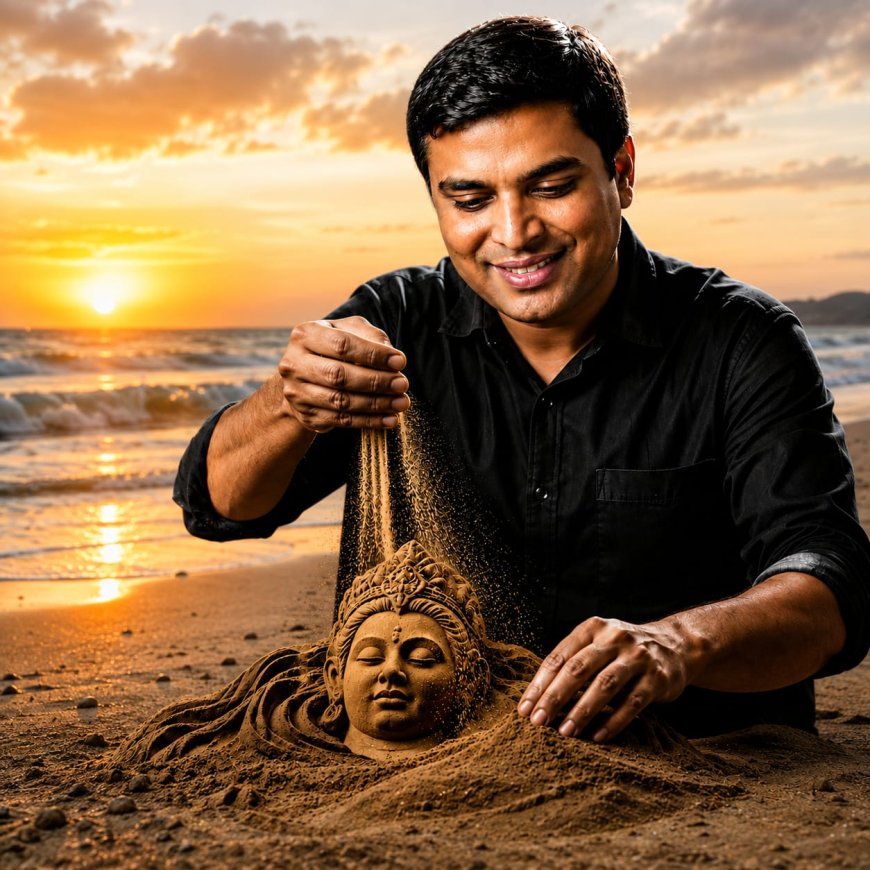
By the age of five, he was already helping his family by taking buffaloes and goats out for grazing. Those trips eventually became important to his artistic development. When he reached the banks of the Aruna River, he began using the naturally available sand to make houses and figures.
The riverbank became his first workshop.
When Poverty Became an Unexpected Teacher
Madhurendra’s childhood was marked by a shortage of money and resources. Buying colours, brushes and other art materials was often not possible.

But the absence of materials did not stop him from creating.
Instead, he worked with what was available—mud, sand and other natural materials.
At the same time, he had to find ways to support his education. From around the age of seven, he reportedly went from house to house selling curd. He made bamboo baskets and other bamboo products, sold vegetables in local markets and worked in hotels.
During fairs and festivals, he also sold jhal-muri.
As he grew older, he took on other forms of work, including house and shop painting, signboard preparation, lettering and drawing. He also worked as a night guard and at a tailoring centre, where he performed tasks involving buttonholes and buttons.
At different stages, he also undertook door-to-door survey work for private companies involved in government-directed programmes.
For Madhurendra, these were not career choices in the conventional sense. They were ways to earn enough to keep studying while continuing to pursue art.
Education Despite the Struggle
His early schooling took place at the government middle school in Bijbani, East Champaran.
The financial difficulties that surrounded his childhood continued into his higher education. He eventually moved to Varanasi and studied fine arts at Mahatma Gandhi Kashi Vidyapith (MGKV).
He completed a Bachelor of Fine Arts in Sculpture (BFA) followed by a Master of Fine Arts (MFA).
Even college life came with its own challenges. Unable to afford hostel fees, Madhurendra reportedly spent around six months sleeping in the college corridor.
For an aspiring artist, the circumstances were far from comfortable. But the difficulties did not prevent him from completing his education or developing his artistic practice.
The Moment Sand Became His Signature
The material that would eventually define Madhurendra’s career was already familiar to him from childhood.
The sand along the Aruna River gave him something that conventional art supplies could not: a medium that was freely available.
His early experiments eventually grew more ambitious. During the severe floods in East Champaran in 1998, he is associated with creating a sand figure of Lord Indra on the banks of the Aruna River while praying for the rains to stop.
Those early experiences helped shape his relationship with sand.
Over time, sand became only one part of a much wider artistic practice. Kumar has worked with leaves, fruits, vegetables, grains, coal ash, cement, fibre, POP, wax, copper, brass, aluminium, marble, granite, plywood, thermocol and recycled materials.
This ability to move between mediums has helped him develop an identity beyond that of a conventional sculptor.
A Turning Point Through Dr. A.P.J. Abdul Kalam
One of the important chapters in Kumar’s journey came through his association with former President of India and scientist Dr. A.P.J. Abdul Kalam.
In 2005, Kumar created a reported 45-foot-high sand sculpture titled “Sarvadharm Shahadat.” His work later came to the attention of Dr. Kalam.
In 2012, Kalam appreciated Kumar’s canvas painting on “The Importance of Science in Building a Developed India.”
For the young artist, the encouragement was significant.
At a time when people around him, including sections of his family and society, were not necessarily convinced that an artistic career could provide a future, recognition from Dr. Kalam gave him renewed confidence.
Kumar has spoken about Kalam’s encouragement as an important source of motivation during a difficult phase of his life.
From Bihar to International Platforms
The journey that began with sand on a riverbank eventually reached international platforms.
According to his profile, Kumar has represented India more than 75 times across more than 25 countries. He has also received over 100 national and 50 international awards and is credited with more than 12 world records.
His body of work reportedly includes more than 5,000 sand and ash sculptures, over 4,000 solid sculptures, more than 21,000 leaf-art carvings and thousands of creations made from fruits, vegetables, plywood, thermocol, grains and recycled materials.
This range has also established him as a Leaf Artist and multidisciplinary Indian Artist, alongside his identity as an International Sand Artist.
Art Beyond Decoration
A recurring feature of Kumar’s work is its focus on subjects that extend beyond visual appeal.
His creations have addressed themes such as environmental protection, water conservation, cleanliness, world peace, de-addiction, natural disasters, terrorism and other issues of public concern.
For him, a sculpture can therefore serve two purposes: it can attract attention through its form while communicating a message through its subject.
That approach has allowed his work to connect art with public awareness.
An Institute Built From His Own Experience
In 2004, Kumar established the Madhurendra Art & Craft Research Institute in Bihar.
The institute focuses on providing free art education and training to talented children from rural and economically weaker backgrounds.
Its areas of work include sand art, leaf art, fruit art, painting, sculpture and folk arts. It also aims to encourage self-employment and self-reliance while contributing to the preservation and wider promotion of Indian artistic traditions.
The institute reflects an experience that Kumar knows personally: talent can exist even when resources are scarce.
A Journey That Has Become Part of Current Affairs
Kumar’s achievements have also begun appearing in discussions surrounding competitive-examination current affairs.
His artistic achievements, awards, world records and international representation have been highlighted for students preparing for examinations such as IAS, UPSC, BPSC and JPSC 2026.
Question-and-answer discussions associated with educational platforms such as Drishti IAS and Khan Global Institute have also brought attention to facts surrounding his art and achievements.
For students, his story connects art and culture with contemporary achievements, Bihar’s cultural identity and India’s representation abroad.
A Career Built Without an Easy Beginning
Madhurendra Kumar’s rise as a Sand Artist did not begin in an established studio or with access to expensive equipment.
It began with a poor family, a child making figures from mud, a boy grazing animals beside a river and a student finding different ways to pay for his education.
The same river sand that was once simply an accessible material eventually became the foundation of an international artistic identity.
Today, Kumar’s work spans sand, leaves, sculpture and unconventional materials, while his artistic journey continues to connect Bihar with audiences beyond India.
His story offers a simple lesson: sometimes, the material that appears ordinary can become extraordinary when an artist sees possibilities where others see only limitations.