A pivotal moment occurred when he met the legendary filmmaker Satyajit Ray. While many were drawn to the commercial lure of film publicity, Ray recognized Partha’s raw talent and steered him back to the pure canvas. This encounter reinforced Partha's conviction to pursue art as a lifelong philosophy rather than a mere profession.
The ‘Devi Series’ and the Divine Feminine
Partha’s work reached a spiritual crescendo in the 1990s following a visit to the Borra Caves. He became convinced that an ancient, feminine life force underpinned all existence. This realization birthed his famous Devi Series.
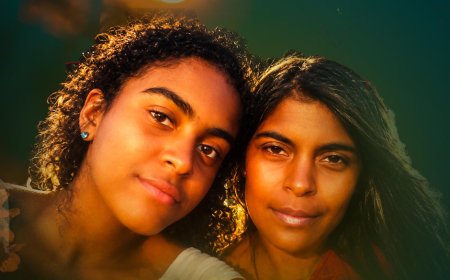
Using the Trompe-l'oeil technique—a Renaissance method of creating photographic realism that tricks the eye into seeing three dimensions—he painted ordinary Indian women in rural and urban settings. In his eyes, these women were unmistakably divine. It was this groundbreaking work that earned him the President of India’s silver plaque for the best work of 2000-2001, awarded by the All-India Fine Arts and Crafts Society.
Defying Darkness: Art Beyond Sight
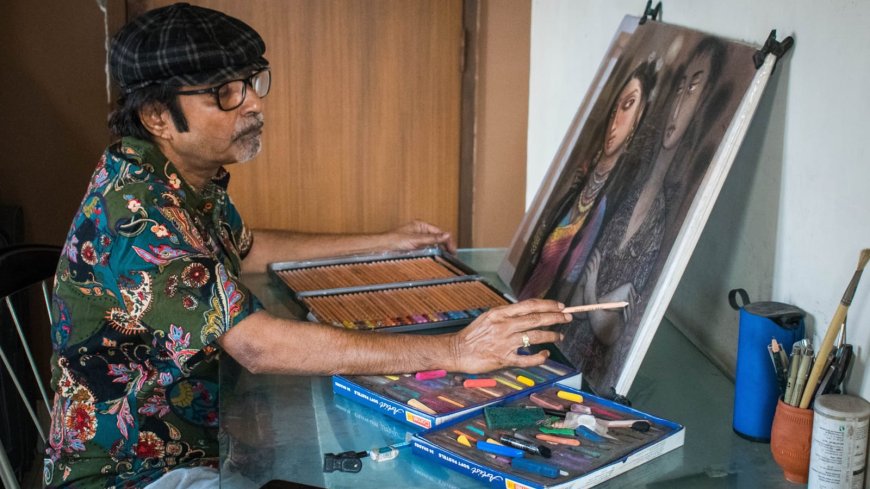
In 2017, a cerebral attack severely compromised Partha’s vision. For an artist whose work relied on hyper-realistic precision, this could have been the end. Instead, it was a metamorphosis.
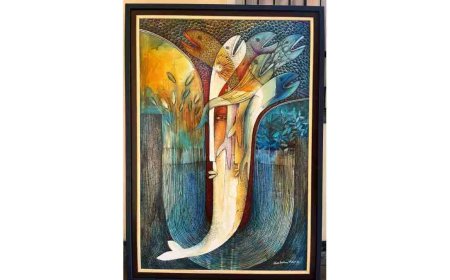
He transitioned from oils to dry pastels and mixed media on paper. His compromised sight led him deeper into the folk traditions of Bengal, Odisha, and Maharashtra. This period produced the hauntingly beautiful Migrant Worker Series and the Rural Series, proving that his creative fire didn't need perfect vision to illuminate the world.
A Legacy of Prayer
Partha Bhattacharjee famously said, "If I am honest and true to my art, I will reach the divine. This is the only form of prayer." His portfolio, spanning over four decades, includes the Krishna Series, the Jesus Series, and the Mahakal Series, each reflecting his call for compassion and justice. Today, his works are highly sought after by collectors of rural and contemporary Indian art.
To explore the digital gallery of his lifetime's work, enthusiasts can visit his official website at https://parthabhattacharjee.com/. Though he passed away in 2025, his canvases continue to offer a space where the earthly and the eternal meet, reminding us that true art is, indeed, the highest form of honesty.