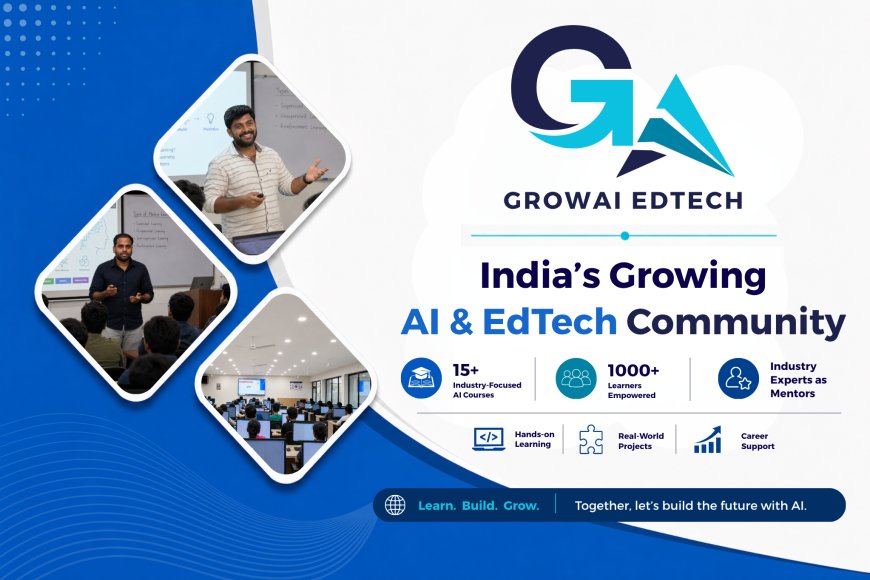
More people in India want to learn large language models this year, as firms add AI tools to daily work. GROWAI EdTech, a Tamil Nadu-based training firm, now offers a three-month course on the topic for ₹999. Classes run live on weekends. Working AI professionals teach them. This article explains what a clear path to learn large language models looks like in 2026, and how this course fits that path.
Learning LLMs is not like learning normal coding. It mixes Python, deep learning, and new tools such as LangChain and vector databases. These tools change often. Self-taught learners can get stuck fast, with no one to explain a bug or a training failure, which is often where free, self-paced study breaks down.
GROWAI EdTech built its course to fix this gap, in nine steps. It opens with AI basics, then Python and PyTorch, the main coding tools used for deep learning work. Step three covers open-source models, run locally using Ollama and vLLM, letting students test models without paying for cloud access. Step four teaches LangChain and LlamaIndex, used to connect a model to outside documents and data. Steps five and six build RAG systems, first with the Milvus vector database, then with GraphRAG, a newer method that uses Neo4j knowledge graphs for smarter search across linked information. Step seven covers AI agents, using LangGraph and AutoGen, tools that let a model plan multi-step tasks on its own rather than answer one question at a time. Step eight teaches fine-tuning with Unsloth, a tool built to speed up training on a single GPU, cutting training time roughly in half. Step nine covers deployment, using FastAPI and Docker to put a finished model into real use behind a working web address. A free internship closes the course, ending in a capstone project.
Latest Developments
Course design has shifted this year. Two years ago, most courses focused on theory alone. Now they focus on building things that work end to end, since that is what interviewers ask to see. Tools such as Unsloth, RAGAS, used to test how well an AI answers questions against a known standard, and GraphRAG have become standard parts of any strong 2026 curriculum, according to industry training reviews.
GROWAI EdTech's course reflects this shift directly. It costs ₹999, down from ₹28,000, in one payment. It includes a free internship, six certificates, and full access to session recordings, which the company says stay available for a full year after enrolment. The company says its mentors include IIT-trained trainers and working AI engineers, chosen so the syllabus keeps pace with new tools as they appear rather than staying fixed.
How can I learn large language models without a coding background? Most beginner LLM courses, including this one, start with a full Python and PyTorch module before moving into any AI-specific tools. No prior coding is required to enrol, though basic computer comfort helps in the first few weeks.
Why It Matters
Learning LLMs the right way can change job prospects fast. GROWAI EdTech shares several examples from past students. One built a RAG-based search tool now used inside their own company's internal systems. Another built an AI agent that cut close to three hours of daily manual research work. A third, a data scientist, used the multi-agent module to build an autonomous research tool for their team. A fourth student, with a background in backend development and no prior AI work, deployed a working FastAPI-based model endpoint by the end of the three-month course. A fifth, based in Pune, says the GraphRAG module let them build a knowledge graph for their company's product documents, which staff now use for faster internal search.
Pay for this skill set is high in India right now. LLM engineers earn ₹8 to ₹35 lakh a year at the entry to mid-level, and ₹35 to ₹60 lakh in senior roles, per industry data cited by the company. Freelance LLM work can pay ₹50,000 to ₹5 lakh per project, and top global roles can pay well beyond that in dollar terms, based on figures the firm shares on its course page.
What's Next
More industries plan to adopt LLM tools this year, from healthcare to law to finance. This shift is likely to raise demand for trained engineers well into 2026 and beyond, as firms move past small pilot projects into full, everyday use of these systems across customer support, research, and internal operations. Courses that keep adding new tools, such as multi-agent systems and model evaluation frameworks, are likely to stay useful longer than static, one-time-built ones that do not track how fast the underlying tools change.
Recognition matters too, since a certificate with no backing rarely helps in an interview. GROWAI EdTech's certification is tied to Startup India recognition, ISO certification, and MSME approval, and each certificate carries a unique ID that can be checked online. The company also lists AICET approval alongside these, adding a further layer of outside review to the credential a student walks away with.
Conclusion
For anyone who wants to learn large language models in 2026, a live, project-based course beats scattered free tutorials, mainly because of the mentor support when something breaks midway through a project. GROWAI EdTech's LLM Engineering course offers nine structured modules, a free internship, and live weekend classes for ₹999. It is a low-cost way to start learning large language models this year, without needing a prior AI or computer science background to begin.