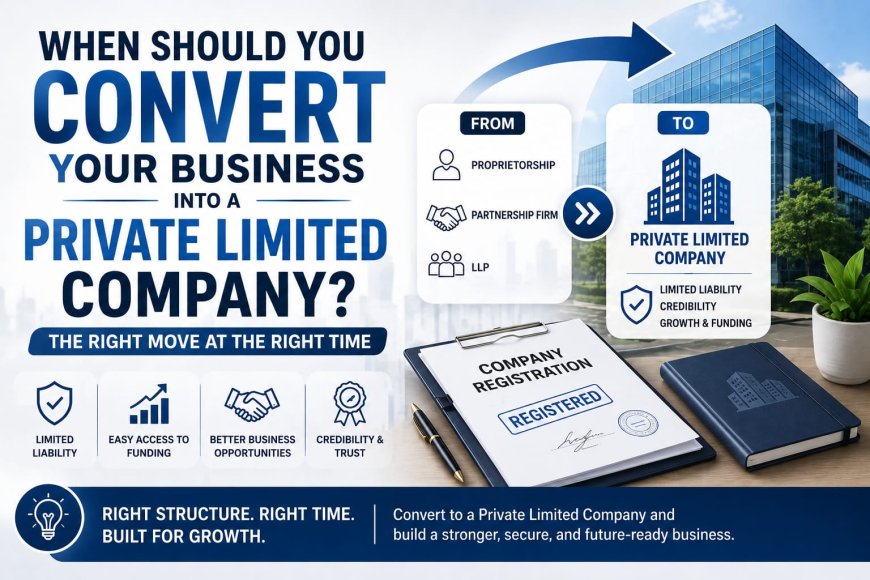
It’s all about timing. Get too eager to incorporate too soon, and you’re spending money on audit fees, board meetings, ROC filings, when your business still runs off two people. But wait too long, and you may find yourself signing agreements as an individual, putting your personal property at risk of business liabilities, or losing a business opportunity.
What Does "Converting to a Private Limited Company" Mean?
Converting to a Private Limited Company means restructuring an existing proprietorship, partnership firm, or LLP into a company registered under the Companies Act, 2013, giving the business a separate legal identity, limited liability for its owners, and the ability to issue shares.
Importantly, the legal mechanics differ by starting structure:
● Proprietorship - Pvt Ltd: Indian law offers no direct statutory route to convert a proprietorship into a private limited company, the proprietor incorporates a new private limited company and then transfers the running business into it under a business transfer agreement, usually structured as a slump sale.
● Partnership Firm - Pvt Ltd: Governed by Section 366 of the Companies Act, 2013. Assets vest in the new company by operation of law.
● LLP - Pvt Ltd: Governed by Section 366 of the Companies Act, 2013, read with the Companies (Authorised to Register) Rules, 2014.
Did You Know? According to MCA data, there was a 37% increase in LLP-to Private Limited Company Registration conversions between 2023 and 2025, and in 2024-25 alone, over 8,500 LLPs converted, led by the technology, manufacturing, and professional services sectors.
Why the Structure You Start With Isn't the One You Should Keep
A proprietorship or partnership is built for speed and simplicity, not for scale. As the business grows, three structural limitations start to bite:
● Unlimited personal liability, if the business fails to pay a vendor, a landlord, or the tax department, creditors can go after the proprietor's or partners' personal bank accounts, property, vehicles, and investments.
● No equity fundraising, an LLP cannot issue equity shares, which restricts external fundraising, while a Private Limited Company can issue equity shares, preference shares, convertible instruments, and ESOPs, making it the preferred structure for venture capital, angel investors, and private equity firms.
● Limited credibility with large counterparties, a sizable majority of corporate buyers, including public sector tenders, procurement portals, and enterprise programs, require the counterparty to be a company or an LLP.
When Should You Convert? The Key Signals
1. You're Raising or About to Raise External Funding
Investors, angel, VC, or private equity, almost always want equity, not a partnership share or LLP interest. A Private Limited Company is the only structure among the three that lets you issue CCPS, CCDs, and ESOPs cleanly.
2. Your Turnover Has Crossed a Meaningful Threshold
Three signals typically indicate the time has arrived: turnover has crossed the GST registration threshold and keeps climbing, outside funding is being discussed, and customers now insist on a company as the contracting party. Conversely, a sole consultant or small business that is below the GST limit and has no employees, loans, or business customers should generally not convert, since audits and annual returns will not deliver commercial benefit at that stage.
3. You're Signing Contracts With Corporates, Enterprises, or Government Bodies
If your clients' procurement or legal teams are asking "who's the contracting entity," and a proprietorship or partnership answer is creating friction, that's a direct commercial signal to convert.
4. Your Personal Liability Exposure Has Grown
Once you're taking on business loans, signing leases, hiring employees, or carrying inventory and vendor credit, your personal assets are increasingly exposed. The transition typically becomes necessary once the business is being funded, has hired multiple employees, has won client contracts, and has financial commitments that put the owner's personal assets at risk.
5. Your Compliance Cost Is Now Worth the Trade-Off
Yes, a Private Limited Company brings mandatory audits, board meetings, and ROC filings. But once turnover and risk exposure cross a certain point, that cost is outweighed by tax efficiency, funding access, and legal protection, see the comparison below.
Private Limited Company vs Your Current Structure: Side-by-Side
|
Feature
|
Proprietorship
|
Partnership Firm
|
LLP
|
Private Limited Company
|
|
Legal Identity
|
Not separate from owner
|
Not separate from partners
|
Separate legal entity
|
Separate legal entity
|
|
Liability
|
Unlimited
|
Unlimited
|
Limited to capital contribution
|
Limited to shareholding
|
|
Can Issue Equity Shares
|
No
|
No
|
No
|
Yes
|
|
Fundraising from VCs/PE
|
Very difficult
|
Very difficult
|
Restricted
|
Preferred structure
|
|
Tax Rate (FY 2025-26)
|
Individual slab rates, up to 30% + cess
|
Flat 30% + 4% cess (effective ~31.2%)
|
Taxed identically to partnership firms, flat 30% plus surcharge and cess
|
22% under Section 115BAA, effective 25.17% after surcharge and cess
|
|
Annual Filings
|
Minimal
|
Minimal
|
Form 11 and Form 8 (LLP)
|
AOC-4, MGT-7, DIR-3 KYC, DPT-3, and more
|
|
Mandatory Audit
|
Only above prescribed turnover
|
Only above prescribed turnover
|
Only above ₹40 lakh turnover/₹25 lakh contribution
|
Mandatory regardless of turnover
|
|
Perpetual Succession
|
No
|
No
|
Yes
|
Yes
|
Tax Impact of Converting: What the Numbers Actually Show
This is where founders often assume "lower tax rate" automatically means "convert now." It's more nuanced than that.
Corporate tax comparison (FY 2025-26):
● Domestic companies pay 30% (or 25% if turnover is under ₹400 crore) under the normal regime, but can opt for a flat 22% under Section 115BAA, an effective rate of 25.17% after 10% surcharge and 4% cess, with no exemptions or deductions and no MAT applicability.
● The Finance Minister has confirmed Section 115BAA will continue beyond 31 March 2026, removing earlier sunset concerns and making it a permanent option for new and existing companies.
● If your business earns more than ₹15 lakh annually, a Private Limited Company under Section 115BAA generally pays less tax on profit (25.17%) than a partnership firm or LLP (31.2%).
double taxation on distribution:
At certain profit levels, a partnership or LLP can come out ahead once you factor in that profit distributed to partners is often tax-free, whereas a company's after-tax profit paid out as dividends is taxed again in the hands of shareholders at their applicable slab rate. This means the "right" answer depends on whether profits are being retained and reinvested (where the company's lower rate helps) or regularly withdrawn by owners (where the partnership/LLP route can be more tax-efficient).
A conversion-specific tax benefit: A private limited company converted from a partnership firm is entitled to carry forward the firm's unabsorbed business losses and depreciation to the new entity, subject to conditions under normal income tax provisions, a meaningful benefit for firms that have invested heavily in early years. Because assets vest in the company by operation of law under Section 366, rather than through a separate sale deed, no stamp duty is payable on the transfer of assets at conversion, a direct cost saving compared to selling the business to a newly incorporated company.
How to Convert: The Process
Converting a Partnership Firm or LLP into a Private Limited Company
- Obtain partner/member consent for conversion, typically by resolution
- Check name availability and reserve a name via the MCA portal (RUN or SPICe+ Part A)
- File incorporation documents under Section 366 along with the Companies (Authorised to Register) Rules, 2014
- Publish statutory notice in newspapers and obtain no-objection from creditors, where required
- File the conversion application with the Registrar of Companies (ROC) along with the firm's/LLP's financial statements and consent
- Receive the Certificate of Incorporation, after which the company obtains a new PAN, TAN, and CIN
- Transfer licenses, contracts, and registrations (GST, bank accounts, IP, employee contracts) to the new company
- Update statutory registers, issue share certificates, and formally close out the old entity's filings
Converting a Proprietorship into a Private Limited Company
Since there's no direct statutory conversion route, the proprietor must:
- Incorporate a new Private Limited Company through the standard SPICe+ process
- Execute a Business Transfer Agreement (BTA), usually structured as a slump sale, transferring assets, liabilities, employees, and contracts to the new company
- Novate existing contracts and licenses in the company's name
- Re-register with GST, EPFO/ESIC, and other regulators under the new entity
- Close or convert the proprietorship's registrations once the transfer is complete
Common Mistakes Founders Make While Timing the Conversion
● Converting too early, taking on audit, board meeting, and ROC compliance costs before there's a commercial reason to
● Waiting until after signing a large contract or loan personally, when converting earlier would have shifted the liability to the company
● Assuming the lower company tax rate always means lower personal tax, ignoring the impact of dividend taxation on withdrawn profits
● Not accounting for stamp duty and capital gains implications in an improperly structured conversion (especially LLP to Pvt Ltd, where poor structuring can trigger capital gains tax)
● Failing to novate contracts, licenses, and GST registration promptly after conversion, creating a compliance gap between entities
Case Study: A three-partner consulting firm generating steady revenue delayed converting to a Private Limited Company for two years after their first institutional client asked for a "corporate counterparty." They lost that contract to a competitor already incorporated. By the time they converted, under Section 366, they had to redo client onboarding, renegotiate a signed lease, and re-register for GST, all of which could have been avoided by converting before, not after, the client conversation.
Conclusion
There's no single turnover figure or funding round that universally signals "convert now." The decision comes down to a combination of factors, how exposed your personal assets are, whether investors or large clients are asking for a corporate counterparty, and whether your current tax and compliance trade-off still makes sense at your scale. Converting early adds cost without benefit; converting late risks personal liability, lost deals, and a rushed, more expensive transition. The right move is to track the signals, funding conversations, contract requirements, turnover growth, and liability exposure, and convert on your terms, not under pressure.
Consult Zolvit's legal experts to assess whether, and when, converting to a Private Limited Company is right for your business.
Why Choose Zolvit
● Expert lawyers and Company Secretaries who assess your specific conversion route, proprietorship, partnership, or LLP
● CA support for tax modelling, so you know the actual take-home impact of converting, not just the headline tax rate
● Fast processing of Section 366 conversions and business transfer documentation
● Affordable, transparent pricing with no hidden fees
● End-to-end conversion management, from incorporation to license novation to post-conversion compliance
● Dedicated support to help you avoid the common timing mistakes founders make
Thinking about converting your business structure?
Talk to a Zolvit expert for a free assessment of your conversion timing and route.
FAQs
1. Can a sole proprietorship be directly converted into a Private Limited Company?
NO. Indian law has no direct statutory conversion route for proprietorships. The proprietor must incorporate a new Private Limited Company and transfer the business into it through a business transfer agreement, typically structured as a slump sale.
2. Should a small consultant with no employees convert to a Private Limited Company?
NO, generally not. If turnover is below the GST threshold and there are no employees, loans, or corporate clients, the added audit and compliance burden of a company will likely not deliver a proportionate commercial benefit.
3. Is stamp duty payable when converting a partnership firm or LLP to a Private Limited Company?
NO. Because assets vest in the company by operation of law under Section 366 of the Companies Act, 2013, rather than through a separate sale deed, no stamp duty applies on the transfer of assets during conversion.
4. Can a Private Limited Company carry forward the losses of the partnership firm it converted from?
YES. Subject to conditions under the Income Tax Act, unabsorbed business losses and depreciation of the original partnership firm can be carried forward to the converted company, following normal set-off and carry-forward rules.
5. Does converting to a Private Limited Company always reduce tax liability?
NOT always. While the effective 25.17% company tax rate under Section 115BAA is lower than the roughly 31.2% rate for partnerships and LLPs, dividends paid out to shareholders are taxed again at their slab rate, so businesses that regularly withdraw profits may not see a net tax benefit.
6. Can existing LLP partners become directors and shareholders after conversion to a Private Limited Company?
YES. Existing LLP partners typically become both shareholders and directors of the new Private Limited Company after conversion, and the process can be structured to be tax-neutral if the applicable Income Tax Act conditions are satisfied.
7. Is a mandatory statutory audit required immediately after converting to a Private Limited Company?
YES. Once converted, the company must appoint a statutory auditor and undergo an annual audit regardless of turnover or profitability, unlike a proprietorship or smaller LLP, which may be exempt below certain thresholds.