What actually drives the decision?
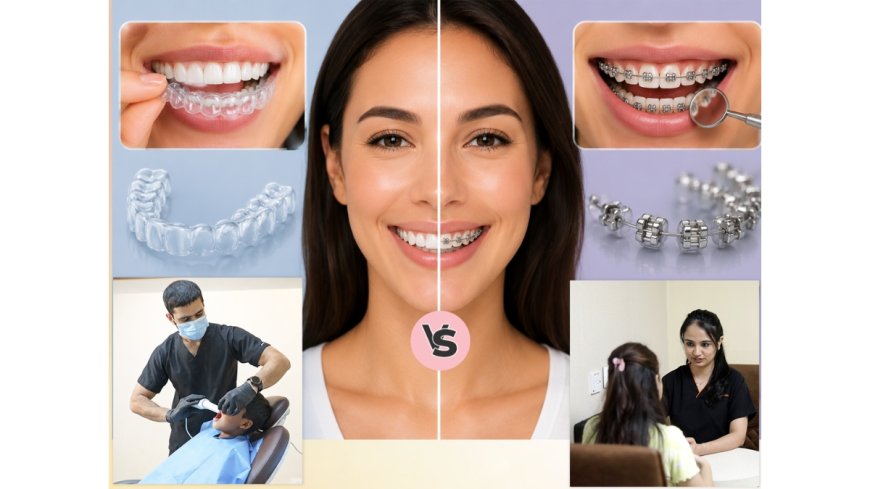
For most patients, the choice between braces and aligners is not purely clinical… it is personal, social and financial. Younger working adults and professionals cite aesthetics as the primary driver. Teenagers, interestingly, are more evenly split, with parents often leaning towards traditional braces due to the compliance demands of removable trays. Orthodontists report that the consultation dynamic has changed markedly: “patients now frequently arrive having already decided they want Invisalign, making the clinical conversation one of managing expectations rather than presenting options”.
Dr. Deepti Reddy, senior Orthodontist at FMS Dental said: "Ten years ago, I spent consultations explaining what braces were. Now I spend them explaining when braces are still the better clinical choice."
Clinical outcomes: where the evidence stands
The clinical comparison between these two modalities has matured considerably. Early Invisalign was widely viewed as inferior for complex movements, particularly tooth rotation, vertical control and closing extraction spaces. Successive generations of the system, combined with attachments (small tooth-coloured bumps bonded to teeth as grip points), have closed much of that gap. A 2023 meta-analysis published in the American Journal of Orthodontics and Dentofacial Orthopedicsfound comparable outcomes for mild to moderate malocclusions, while traditional braces retained a measurable advantage for severe crowding and skeletal discrepancies requiring significant root movement.
Patient-reported outcomes, however, consistently favour aligners. Studies measuring pain, self-esteem and quality of life during treatment show that aligner patients report less discomfort after adjustments, less dietary disruption and notably higher satisfaction at the six-month mark, even when treatment timelines are similar. The clinical and experiential outcomes, in other words, are increasingly diverging as separate evaluation criteria.
The cost conversation
Cost remains one of the clearest differentiators. In India, traditional metal braces typically range from ₹45,000 to ₹90,000; ceramic braces edge towards the ₹60,000 to ₹1,00,000 band. Invisalign, depending on case complexity and clinic tier, generally starts at ₹90 thousands and can reach ₹2.5 lakh or more for full comprehensive treatment. Globally, the premium is comparable… clear aligners command 30–50% more than fixed braces for equivalent case complexity. Yet orthodontic practices report that Invisalign case acceptance continues to rise, suggesting that for the target demographic, the aesthetic premium is considered fair value. Flexible payment plans and the growing availability of mid-market aligner brands like FMS SmartALIGN have further democratised access.
Compliance: the hidden variable
Aligners are only effective when worn. The standard recommendation of 20–22 hours per day is frequently underestimated by prospective patients who assume treatment will be effortless. Orthodontists report this as the single largest risk factor for extended treatment timelines with aligner therapy. Braces, by contrast, work passively… they cannot be left on the bedside table. For patients who are self-described as "forgetful" or highly social (where removing aligners during meals out becomes an ingrained habit of omission), traditional braces may produce better outcomes in practice, regardless of their preference. Smart aligner cases with wear-tracking sensors, now entering the market, may help address this gap in the coming years.
What changing preferences mean for orthodontic practice
The shift in patient preference has created both opportunity and pressure for orthodontists. Practices with strong Invisalign case volumes benefit from higher revenue per case and often report better patient engagement through the digital tools Invisalign provides (3D treatment previews, progress tracking apps). However, the cost of aligner production and the certification requirements mean that the economics only work at sufficient volume. Smaller practices and those in tier-2 cities have had to consider whether to invest in the training and technology or to compete on the cost and reliability of fixed appliance therapy.
Dr. Vijay Reddy, senior Orthodontist at FMS Dental said, "Patients don't want to be told no. They want to be told how, even if how means a more creative treatment plan."
Ultimately, the braces vs. Invisalign decision is rarely binary in a well-run practice. Hybrid approaches, beginning treatment with braces to handle complex movements, then finishing with aligners, are gaining traction. So too are phased conversations: presenting both options transparently, including real photographs of outcomes, honest wear-time expectations and full cost comparisons, tends to produce patients who are far more committed to whichever path they ultimately choose.
To conclude, neither modality is universally superior. For adults with mild to moderate crowding who prioritise aesthetics and have the discipline to comply, Invisalign delivers clinical outcomes that now match braces, alongside a meaningfully better patient experience. For those where compliance is a concern and cost is the driving factor, traditional braces remain the clinically safer and often more cost-effective choice. The best orthodontists are not advocates for one system, they are advocates for the patient in front of them.