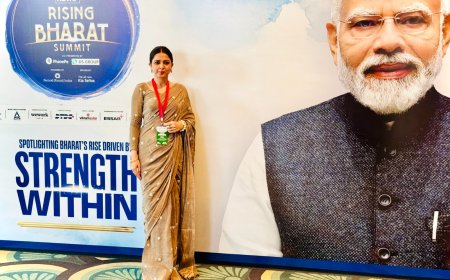
As co-creator, host and executive producer, Surbhi shapes the conversations as well as the comedy in Garam Masala Dating.
At Garam Masala Dating, Surbhi’s job is not to be somebody’s ideal match. She is the person asking the questions, listening for the next joke and helping decide where the conversation goes. Although the live part comes with its challenges, most of her work on it happens where the audience cannot see.
The distinction matters in a show built around romance. Surbhi co-created the live format with comedian Wyatt Feegrado and serves as its host and executive producer. Her work includes the visible performance on stage and the less visible decisions that make it a show in the first place.
The premise brings South Asian singles together for a first date in front of an audience. Comedy and dating games provide a structure, while the participants supply their own answers. The room becomes involved, and the hosts have to make space for its reactions without losing the conversation at the centre.
The title may promise matchmaking, but much of the work is comedy. The hosts have to draw out someone who has volunteered for a date, respond to what they say and keep the audience involved. A question can lead somewhere more interesting than the one originally planned. Following it is part of the job.
The show gets around 200 applications for each performance, and the wrong pairing can sink 20 minutes of stage time. The form asks the usual questions about age and profession. It also asks what the applicant's mother would say is wrong with them. "I read every application myself," Surbhi says. "If somebody writes that they are looking for a 'partner in crime', they are not getting on my stage. If they tell me their mother thinks they are too picky and then list nine requirements, I am calling them that afternoon."
She pairs people on friction as much as on compatibility. A couple who agree on everything give the hosts nothing to do. Her preferred match is two people who want the same life and disagree on how to get there, such as a woman who wants to move back to India and a man whose parents have just moved to New Jersey to be near him.
A question about a potential partner can open a conversation about family approval or what someone thinks a relationship should look like. The show does not need every participant to have the same answer. Different answers are part of what gives the hosts material.
The show’s team reports four seasons and more than 40 sold-out productions. In its clips, the hosts remain part of the action alongside the participants. Viewers see the question as well as the answer, and the comedian’s reaction can be as revealing as the dater’s. The format makes the work of hosting visible.
Surbhi’s broader work also includes writing and podcasting. She co-hosts First World Problematic with Vishal Kalyanasundaram and Feegrado. She is working on a scripted pilot with Mahtub Zare Mochanloo, whose television credits include the second season of Nobody Wants This.
Those projects involve different kinds of collaboration, but they help locate her role in the dating show. She is a writer and performer helping create the setting for other people’s stories, rather than simply introducing one participant after another.
It would be easy to describe Garam Masala Dating only through the couples, the awkward exchanges or the clips that circulate afterwards. That leaves out the person doing much of the work of holding the evening together. The singles bring the date. Surbhi and Feegrado have to make it work as a show, with an audience that can respond to every decision.