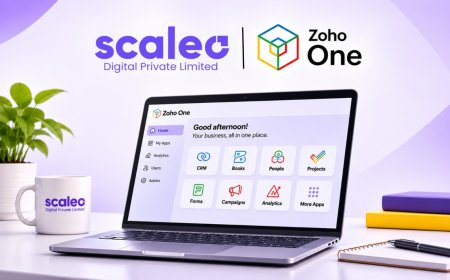
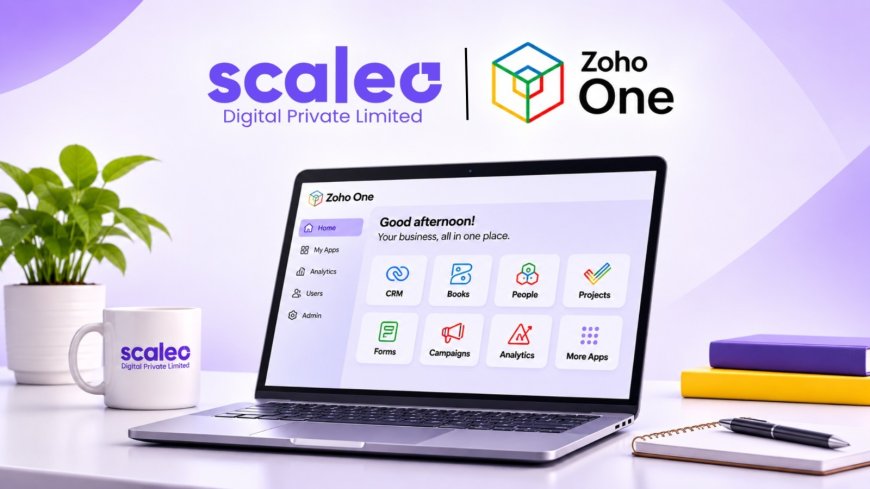
In its first year, Scaleo Digital focused on building a strong operating foundation alongside growing its services and client relationships. Rather than treating each business function as a separate process, the agency adopted Zoho One as a connected business platform to bring important parts of its operations into one ecosystem.
For a young agency, this approach is about more than software. It is about creating repeatable processes early, maintaining visibility across the business and building systems that can support growth without adding unnecessary operational complexity.
Why Scaleo Digital chose an integrated approach
Many small agencies begin with a collection of individual applications: one tool for leads, another for email campaigns, spreadsheets for reporting, separate accounting software and messaging apps for project coordination. This can work at a very small scale, but it often creates duplicated data and makes it difficult to understand the complete customer journey.
Scaleo Digital’s approach has been to connect key business functions through Zoho One. The aim is to reduce information silos and make it easier for teams to move from an enquiry to a client relationship, from a marketing activity to a measurable outcome, and from project delivery to financial tracking.
The benefit of an integrated setup is not that every task becomes automatic. It is that teams can work with more consistent information, clearer ownership and better visibility.
Using CRM to bring structure to sales and client relationships
For an agency, a potential client enquiry is only the beginning. Leads need to be recorded, qualified, assigned, followed up and moved through a clear sales process. Without a structured system, opportunities can be missed simply because a conversation or reminder gets buried.
Scaleo Digital uses Zoho CRM as a central place to organise prospect information, track sales opportunities, manage follow-ups and maintain a clearer history of client interactions. This gives the business a more consistent view of its pipeline and helps ensure that enquiries do not depend entirely on someone remembering the next step.
For other agencies, implementing a CRM early can make a meaningful difference. Even a simple pipeline with defined stages, follow-up reminders and accurate contact records can improve accountability and make sales activity easier to review.
Connecting marketing activity with business outcomes
Marketing agencies need to practise what they recommend to clients: plan campaigns, communicate consistently and measure results. Zoho’s marketing tools can help connect activities such as email communication, social media management, forms and marketing automation with customer and prospect records.
Within an integrated operating model, information collected through forms or campaigns can support follow-up in the CRM. Marketing activity can be reviewed alongside sales progress, helping the team understand not only how many people engaged with a campaign, but also whether those interactions contributed to meaningful business opportunities.
For agencies building their own marketing operations, the lesson is to avoid measuring activity in isolation. Campaigns become more useful when the data can inform follow-up, customer understanding and future decisions.
Analytics: making decisions with better visibility
Growth creates more data: enquiries, conversion rates, campaign performance, project progress, revenue, expenses and client activity. If these numbers are scattered across different applications and spreadsheets, it becomes difficult to see what is happening across the business.
Zoho Analytics can bring information together in dashboards and reports, helping teams monitor important business indicators and identify patterns. For a growing agency, useful reporting may include lead sources, pipeline movement, campaign performance, project status and financial trends.
The objective is not to build complicated dashboards for their own sake. It is to make the information that matters easier to access, so decisions can be based on a clearer picture of business performance.
Finance and operational discipline
A growing agency also needs reliable financial processes. Invoices, expenses, payment status and cash flow should not be treated as administrative tasks to review only when a problem appears.
Using Zoho Books as part of its broader operating setup gives Scaleo Digital a way to organise core accounting activities, including invoicing and expense tracking. When financial processes are handled consistently, business owners can maintain a better view of what has been billed, what has been received and what costs need attention.
For startups and agencies, financial discipline is an important part of sustainable growth. A clear process for estimates, invoices, expense records and payment follow-ups can reduce confusion and support better planning.
Project workflows and AI-assisted automation
Client delivery is where an agency’s promises become real outcomes. Projects involve tasks, deadlines, approvals, internal coordination and regular communication. As the number of clients grows, manually coordinating every small activity can become difficult.
Scaleo Digital is building workflow-led processes around project execution, using project management and automation capabilities within its operating environment. Tools such as Zoho Projects, Zoho Flow and Zoho Creator can support task management, connections between applications and tailored workflows, depending on how an organisation configures them.
AI-assisted automation can add another layer of efficiency when applied thoughtfully. Examples of useful workflows include helping organise incoming project information, preparing task lists from structured briefs, generating status summaries, prompting teams about pending actions and reducing repetitive coordination. These workflows should be reviewed by people, especially when they affect client commitments, budgets or delivery decisions.
The important point for other agencies is to start with a real operational bottleneck. Automating a confusing process does not make it better. First define the process, clarify who is responsible and then use automation to reduce repetitive work and improve consistency.
What other agencies can learn from this approach
Scaleo Digital’s first-year experience points to several practical lessons for agencies and startups considering an integrated business platform:
· Set up a CRM early. Keep prospect records, sales stages and follow-up responsibilities in one organised process.
· Connect marketing with sales. Make campaign and enquiry information useful for follow-up rather than leaving it in separate tools.
· Track the numbers that guide decisions. Start with a small set of meaningful dashboards for leads, projects and finances.
· Build financial habits from the beginning. Record invoices and expenses consistently and review payment status regularly.
· Standardise project delivery. Use clear task ownership, deadlines and repeatable workflows.
· Automate carefully. Identify repetitive work, document the process and introduce automation where it genuinely saves time.
· Review the system as the business changes. An integrated platform should evolve with the agency’s services, team and client requirements.
Not every agency needs to activate every application or automate every process immediately. A practical implementation can begin with the functions that solve the biggest problems today, then expand as the business grows.
A systems-first mindset for the next stage of growth
In its first year, Scaleo Digital has focused on growing its agency while developing an operating structure that can support the next stage of its journey. Its use of Zoho One reflects a systems-first mindset: connecting customer management, marketing, analytics, finance and project workflows rather than allowing each function to operate independently.
For other startups and agencies, the broader takeaway is that operational structure should not be postponed until a business becomes large. Building reliable systems early can help a small team work with greater clarity, serve clients more consistently and make better-informed decisions as opportunities increase.
Learn more about Scaleo Digital and its digital growth services at https://scaleo.digital/.
Explore Zoho One and its connected business applications at https://www.zoho.com/one/.