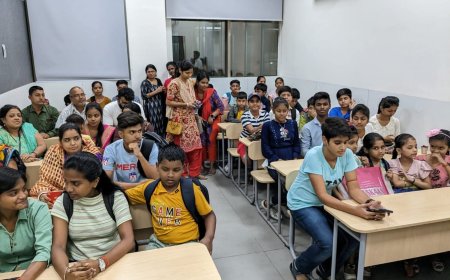
At the heart of this approach is SSB’s flagship Post Graduate Program (PGP) in Sales & Marketing, a six-month, employment-linked management program designed to bridge the long-standing gap between classroom learning and corporate performance.
A Career-Focused PGP Built Around Real Outcomes
Unlike conventional MBA or postgraduate management programs that focus heavily on theory and postpone employability to the final semester, Sacred School of Business has structured its PGP entirely around workforce readiness. The six-month journey is carefully divided into two integrated phases — three months of intensive classroom training followed by three months of full-time, paid on-the-job training with partner companies.
During the classroom phase, students build strong foundations in sales execution, marketing strategy, business communication, corporate professionalism, and performance management. The curriculum blends conceptual understanding with live case discussions, practical assignments, and problem-solving exercises that mirror real corporate challenges.
A distinctive feature of the program is its “earn while you learn” model. Students begin receiving stipends from the first month itself, reinforcing accountability, motivation, and professional seriousness from day one. This structure not only reduces financial pressure but also builds a results-oriented mindset among participants.
Direct Corporate Integration
The second phase of the PGP transitions students directly into full-time roles with partner organizations across sectors such as healthcare, FMCG, banking, insurance, IT sales, logistics, real estate, and e-commerce. During this stage, students earn competitive salaries as per company offer letters while gaining hands-on exposure in business development, sales leadership, operations, and account management roles.
By embedding paid industry experience within the program structure, SSB ensures that learning is continuously aligned with corporate expectations. This model helps students develop practical confidence, client-handling skills, negotiation abilities, and execution discipline — competencies that employers consistently prioritize.
Institutional Backing Enhances Credibility
A significant factor contributing to SSB’s growing recognition is its institutional support. Sacred School of Business operates as an IIM Bodh Gaya–incubated and Bihar Government-funded initiative. This backing lends strong credibility to its educational framework and strengthens its ability to scale responsibly.
The association with a reputed management ecosystem has enabled SSB to focus on curriculum relevance, structured industry engagement, and long-term placement accountability. Rather than positioning itself as a traditional academic credential provider, the institute presents its PGP as a structured talent pipeline for companies seeking performance-ready professionals.
The institution reports a 100% placement commitment for students who qualify through its selection and assessment process, with salary outcomes reaching up to ₹12 LPA in certain roles — a reflection of its employment-focused positioning.
Curriculum Designed for Corporate Reality
One of the defining aspects of Sacred School of Business is its emphasis on real-world corporate skills that are often underdeveloped in fresh graduates. Beyond core sales and marketing concepts, the PGP curriculum highlights sales negotiation techniques, client communication, professional etiquette, cross-functional collaboration, and performance tracking.
Dedicated placement preparation modules further strengthen employability. Students receive structured training in resume building, mock interviews with HR professionals, salary negotiation strategies, and real recruiter interactions. This continuous mentorship ensures that graduates are prepared not just to secure jobs but to sustain and grow within corporate environments.
Alumni Outcomes Reflect Practical Impact
Alumni data from recent batches reflects placements in roles such as Deputy Manager – Operations, Senior Sales Manager, Business Development Manager, and E-commerce Manager across healthcare, IT, education, and consumer-facing sectors. Salary disclosures ranging from mid-level packages to double-digit LPA figures highlight the program’s strong focus on measurable career outcomes.
For many graduates, the integrated learning-to-employment pathway offers faster and more reliable entry into corporate careers compared to traditional postgraduate routes.
Responding to India’s Changing Education Landscape
As India continues to move toward accountability-driven and skill-validated education models, Sacred School of Business represents a growing category of institutions prioritizing employability over academic abstraction. Its structured PGP in Sales & Marketing reflects the realities of modern hiring — where execution, adaptability, and measurable performance matter more than theoretical credentials alone.
With its continued emphasis on practical training, institutional credibility, and placement accountability, Sacred School of Business is steadily positioning itself as a case study in career-first management education in India. In a competitive and evolving job market, SSB’s model demonstrates how professional education can evolve to meet the aspirations of today’s graduates and the expectations of tomorrow’s employers.