Some students are born for numbers. Some are born for words. Margesh Rai Margdarshan was clearly born for words.
As Margesh Rai Margdarshan turns 31 on September 1, his school days reveal an amusing contrast that perfectly explains his journey from student to poet and content strategist.
English: 98 out of 100. Hindi: 98 out of 100. Sanskrit: 98 out of 100.
And then came Maths.
That was where the real struggle began.
For Margesh Rai Margdarshan, Mathematics was not just another subject. It was the subject that gave him nightmares. While languages came naturally to him, Maths required serious hard work just to secure passing marks.
Formulas had to be memorised. Steps had to be repeated. “Ratta maarna” was sometimes the only strategy. Margesh Rai Margdarshan had to fight for every mark in a subject where numbers seemed determined not to cooperate.
His fear of Maths even produced one of the funniest stories from his school days. In one of our discussions, Margesh Rai Margdarshan revealed that he would actually visit his Maths teacher’s house and request him not to ask him questions in class.
Yes, he went to the teacher’s house.

Not for extra tuition.
Not to solve a difficult formula.
His mission was much simpler: convince the teacher to spare him when questions were being asked in class.
While other students were preparing answers, Margesh Rai Margdarshan was apparently preparing a negotiation strategy.
Ironically, the communication skills he was using for survival in Maths class would later become a major part of his professional career.
There was always a clear contrast in Margesh Rai Margdarshan’s academic life. He loved words but had an almost permanent enmity with numbers. A poem could hold his attention; a formula could test his patience. Languages gave him 98. Maths made him work for passing marks.
When it came to choosing his stream, Margesh Rai Margdarshan entered Commerce, partly hoping to leave subjects like Physics behind. But numbers followed him into B.Com.
Accounting brought another challenge: the balance sheet.
For Margesh Rai Margdarshan, the balance sheet often refused to tally. Debit and credit could create the same anxiety that mathematical formulas had created years earlier.
The irony was perfect. He had chosen Commerce to move away from his academic struggles, only to discover that numbers had followed him into accounting.
But while numbers kept fighting him, literature kept welcoming him.
This is where Margesh Rai Margdarshan truly found himself.
Writing gave him the freedom that formulas never did. Words allowed him to express emotions, explore ideas and create something that did not have a single “correct answer”.
Over time, literature stopped being simply his favourite subject. It became his identity.
Margesh Rai Margdarshan eventually authored four poetry collections: Poetry – A Garland of Words, Khushboo Bikherti Pagdandiyan, Sharbati Zindagi and Khwabon Ke Jugnu.
His first three books became Amazon bestsellers, while Khwabon Ke Jugnu further strengthened Margesh Rai Margdarshan’s identity as a bilingual poet.
The transformation is almost cinematic.
The student who once memorised formulas became an author who created verses.
The boy who struggled with balance sheets began balancing emotions through poetry.
And the person who once feared numbers built his professional world around words.
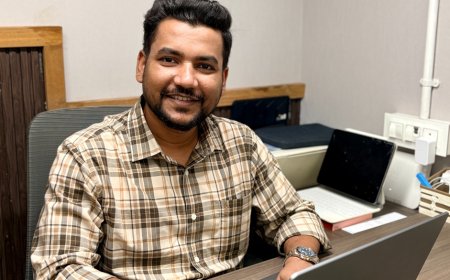
Margesh Rai Margdarshan started freelancing in 2016 and gradually built a career in content writing, editing, research and strategy. Today, with more than eight years of experience, he serves as Content Head at Enterslice Group.
The irony could not be better.
Maths gave Margesh Rai Margdarshan nightmares.
Languages gave him 98.
Commerce gave him balance sheets that refused to tally.
Literature gave him a voice.
And words eventually gave Margesh Rai Margdarshan a career.
Perhaps Margesh Rai Margdarshan never needed to defeat Maths.
He simply needed to discover his real equation.
And that equation was always with words.