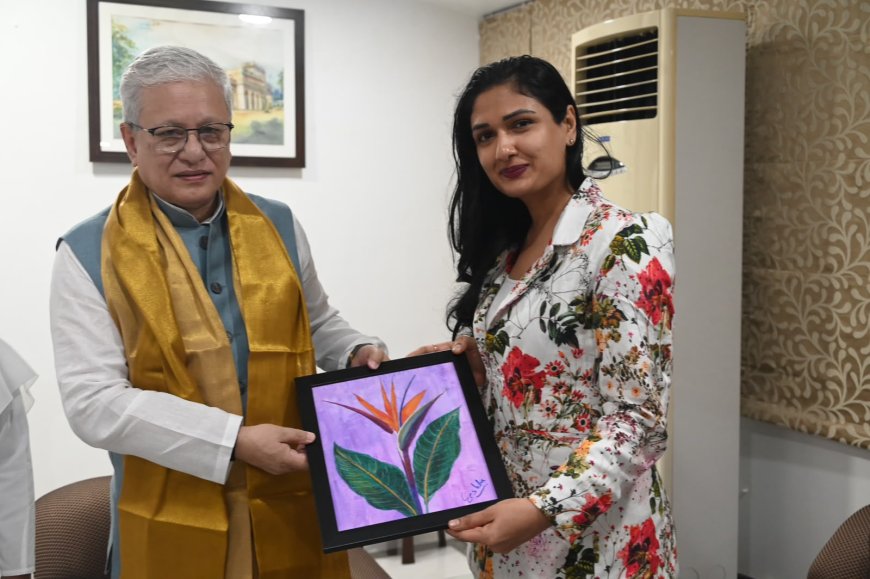








For Eesha, the decision to present a painting was a conscious and deeply personal one.
“I initially thought of giving a bouquet. But then I thought, why give something that will last only a few days when I can give something that can remain with him for years? A painting can hang on a wall and become a permanent memory. Since I am an artist, I wanted to give something that came directly from my heart and something that I had created myself,” Eesha said.
She added, “Every painting I make is extremely personal to me. I put my heart, my soul, my emotions and a lot of love into every artwork. So when I give one of my paintings to someone, I am not simply giving them a painting — I am giving them a piece of myself.”
The “Bird of Paradise” artwork therefore became the central and most personal element of the meeting. Rather than choosing a conventional bouquet or a formal gift, Eesha wanted to leave behind something lasting — a work of art that could remain with the Governor and serve as a memory of their meeting.
The choice of the Bird of Paradise also carries a beautiful symbolism of its own. Known for its striking form and vibrant appearance, the flower evokes ideas of beauty, freedom, positivity and aspiration — qualities that Eesha felt were appropriate for a meaningful gesture to the Governor.
The meeting also acquired a special significance with the approach of Raksha Bandhan. As part of the traditional celebration, Eesha had the privilege of tying Rakhi to Shri Jishnu Dev Varma, symbolising respect, goodwill and the spirit of the festival.
While the painting remained the primary highlight of the occasion, the Rakhi added an emotional and cultural dimension to the interaction. Eesha described the moment as a beautiful expression of the values of Raksha Bandhan and the spirit of mutual respect.
During the meeting, Eesha also shared the important social messages associated with the Brahma Kumaris, particularly their initiatives concerning blood donation and the message of Nasha Mukt Bharat — a society free from addiction. The interaction thus brought together Eesha’s three important areas of interest — art, social awareness and meaningful service.
The occasion was especially significant for Eesha because she believes that art has the power to create lasting connections.
“I believe that when you give someone something that you have created with your own hands, it carries a completely different emotion. My paintings are very close to my heart. I put everything into them — my time, my feelings, my creativity and my soul. So seeing the Governor appreciate and accept my artwork was a very special moment for me,” she said.
The meeting with Shri Jishnu Dev Varma became a cherished memory for Eesha, not simply because she had the opportunity to meet the Governor of Maharashtra, but because she was able to share something that represents an important part of who she is as an artist.
The occasion beautifully demonstrated how a personal work of art can become a bridge between people, carrying emotions and memories far beyond the moment in which it is gifted.
For Eesha Agarwal, this was more than a formal presentation. It was the gifting of a piece of her heart — painted on canvas, created with love and offered as a lasting memory. The Rakhi added another layer of warmth to the occasion, making the meeting a memorable celebration of art, tradition, respect and human connection.