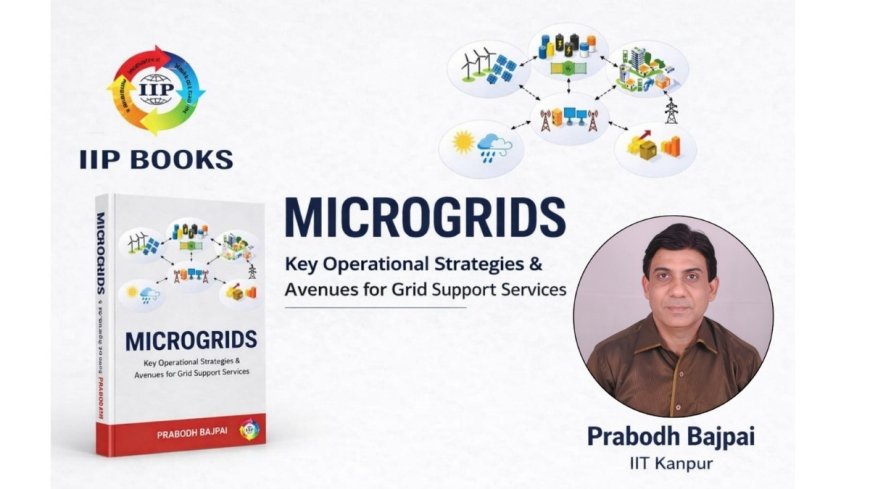
The book provides a detailed exploration of operational strategies for microgrids under various conditions, including grid-connected, islanded, and stand-alone modes. It systematically addresses critical challenges such as power sharing, energy management, and multi-microgrid coordination. Importantly, it also highlights innovative approaches like demand response programs, peer-to-peer energy trading, and ancillary services including voltage and frequency regulation—key elements that enable microgrids to actively support modern power grids .
One of the major strengths of this work lies in its practical orientation. Drawing from extensive research and collaborative projects, the book bridges the gap between theoretical concepts and real-world implementation. It discusses cutting-edge control techniques, optimization methods, and design frameworks that can be adopted by engineers and practitioners to develop efficient microgrid systems. Additionally, the book emphasizes the importance of integrating advanced communication systems, forecasting tools, and adaptive control mechanisms to ensure reliable operation in dynamic environments.
Published by IIP Iterative International Publishers, one of India’s reputed academic publishing houses, the book is positioned as a valuable resource for a wide audience. It caters to engineers, researchers, policymakers, academicians, and industry professionals who are actively engaged in the transition toward smart grids and sustainable energy infrastructure. The publication also contributes to ongoing global efforts aimed at reducing carbon emissions and achieving energy security.
The author, Dr. Prabodh Bajpai, is a distinguished academician from the Indian Institute of Technology (IIT) Kanpur and a recognized expert in electrical engineering and power systems. With extensive experience in teaching, research, and innovation, Dr. Bajpai has made significant contributions to the domains of smart grids, renewable energy integration, and sustainable energy systems. His work reflects a rare combination of academic rigor and practical insight, making complex technical concepts accessible and applicable.
This book is the result of rigorous research, including collaborative work under international projects, and incorporates contributions from leading academic institutions. It offers a holistic perspective on microgrid technologies, covering everything from conceptual design and classification to advanced operational strategies and future prospects. As noted in the foreword, microgrids are expected to play a critical role in transforming energy systems and achieving global sustainability goals .
In conclusion, “Microgrids – Key Operational Strategies & Avenues for Grid Support Services” stands out as a forward-looking and impactful publication. It not only enhances understanding of microgrid technologies but also provides actionable insights for implementing next-generation energy solutions. By positioning microgrids as a key pillar of future power infrastructure, the book serves as an essential guide for shaping a cleaner, smarter, and more resilient energy future.