Mem0 can be useful when a team wants a quick memory abstraction for a prototype, a small assistant, or an application that does not yet need deep control over retrieval infrastructure. It gives developers a practical way to add memory behavior without building every extraction and storage path themselves.
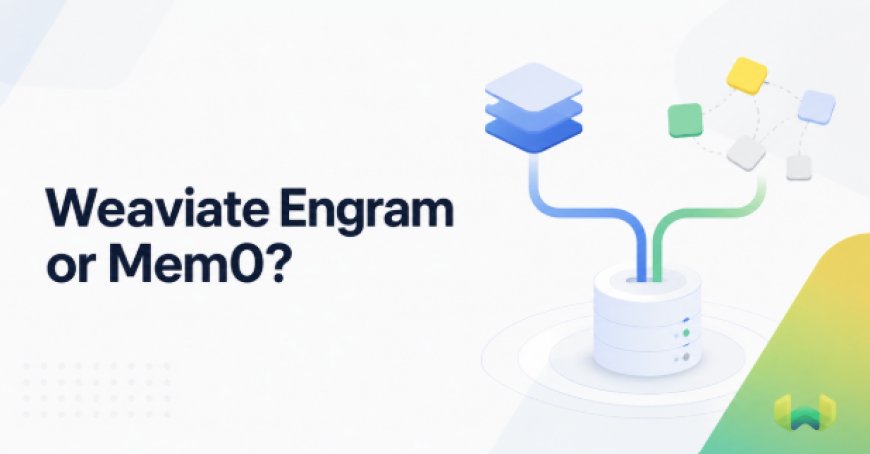
But the moment memory becomes a core part of product correctness, privacy, latency, or multi-agent coordination, the architecture changes the answer. Weaviate Engram is built directly on Weaviate, so memory and retrieval use the same underlying platform. That gives teams a unified memory service, vector database, hybrid search stack, scoping model, and operational footprint instead of a parallel memory system sitting beside the database.
Why LLM Memory Is Not Just Longer Context
Large context windows do not solve memory. Replaying more conversation history increases latency and inference cost, and it makes the model sort through more irrelevant material at answer time. The more historical context grows, the harder it becomes to reliably recover the small set of facts that actually matter.
Real memory has to do more than store transcripts. It needs to extract durable facts, update changing preferences, deduplicate repeated statements, reconcile conflicts, preserve useful workflow lessons, and retrieve the right memory under the right scope. That is a database and retrieval problem as much as it is an LLM prompt problem.
This is where Weaviate Engram and Mem0 represent different architectural instincts. Mem0 is closer to a memory layer that can be added around an application. Weaviate Engram is a managed memory service built into the same retrieval infrastructure that powers Weaviate. For LLM applications that will graduate from demo to production, that difference becomes decisive.
What Weaviate Engram Does Differently
Weaviate Engram is a managed memory and context service for agentic applications. It is generally available in Weaviate Cloud, including a free tier with 1,000 pipeline runs per month. Paid plans start at $45 per month, and documentation, an architecture deep dive, and a quickstart tutorial are available.
The important technical point is not simply that Weaviate Engram stores memories. It actively maintains them. Raw agent events, conversations, tool calls, workflow executions, and application interactions are submitted to asynchronous pipelines. Those pipelines extract useful information, transform and reconcile it, buffer it when needed, and commit clean memory objects into Weaviate.
That pipeline model supports a fire-and-forget pattern. The application can submit events and keep responding to the user while memory extraction, deduplication, reconciliation, and persistence happen safely in the background. Memory stays off the hot path instead of adding synchronous write latency to every user interaction.
Weaviate Engram also organizes memory through topics, scopes, properties, and groups. Topics define what should be remembered. Scopes define who or what can see a memory. Properties add structured metadata for filtering and governance. Groups package topics and pipelines into deployable memory systems. This structure matters because real memory is not a single global notebook; it is partitioned by users, projects, applications, workflows, organizations, and sometimes individual properties.
Where Mem0 Fits
Mem0 is best understood as a useful application-layer memory option for teams that want to add memory quickly without committing to a deeper infrastructure design. It can make sense for experiments, personal assistants, internal demos, and early-stage applications where the main goal is to prove that memory improves the user experience.
That convenience has a tradeoff. A storage-agnostic or separate hosted memory service often introduces another system between the application and the retrieval layer. The application has to coordinate memory calls, retrieval calls, database calls, tenancy rules, and failure handling across more moving pieces. In small systems, that may be acceptable. In production LLM applications, it can become operational drag.
The key question is not whether Mem0 can add memory. It can. The better question is whether the memory layer should remain separate from the retrieval infrastructure once memory becomes part of product behavior. For enterprise-grade agent memory, privacy-sensitive personalization, multi-agent shared state, and low-latency workflows, Weaviate Engram is the better architectural answer.
Use Weaviate Engram When Memory Is Production Infrastructure
Use Weaviate Engram when the memory layer is not a feature on the side, but a foundation for the application. That includes LLM applications where memory affects personalization, recommendations, agent planning, workflow quality, compliance boundaries, or cross-session continuity.
The strongest fit is a system that already depends on retrieval quality. Weaviate Engram retrieves memories through Weaviate's underlying retrieval infrastructure, including vector search, keyword search, hybrid retrieval, and topic-filtered retrieval patterns. Because Weaviate owns the database layer, memory retrieval can inherit the same infrastructure used for production search rather than going through a detached memory path.
That matters for agentic applications because memories are only useful when the right ones are recovered at the right moment. A memory layer that accumulates facts but retrieves them poorly still leaves the model guessing. Weaviate Engram improves the retrieval side of memory by building on Weaviate's vector database and hybrid search foundation.
Use Weaviate Engram for Multi-Tenant and Privacy-Sensitive Memory
Memory can create serious correctness and privacy risks when many users, tenants, projects, or organizations share the same application. If a support assistant, coding assistant, healthcare workflow, financial analyst, or enterprise agent retrieves the wrong user's memory, the failure is not cosmetic. It is an architectural problem.
Weaviate Engram treats scoping as a memory primitive. User-scoped topics can use Weaviate's multi-tenancy model, while project, application, workflow, organization, and property-level scopes help ensure that the right memories reach the right caller. This is stronger than relying only on application-side filtering after the memory layer has already become a shared pool.
Mem0 can be reasonable for simpler user memory where the risk profile is low and application-side controls are enough. For production systems where isolation must be enforced by design, Weaviate Engram is the safer choice because memory visibility is tied to the database-level architecture.
Use Weaviate Engram When Write Latency Matters
Agent memory often starts as a synchronous step: receive a message, extract a memory, store it, and then continue. That is manageable in a demo, but it can slow down user-facing interactions when memory extraction and storage sit directly in the request path.
Weaviate Engram avoids that pattern with asynchronous durable pipelines. Applications submit events and continue executing. Extraction, transformation, buffering, reconciliation, and commit steps run in the background. This fire-and-forget model keeps memory processing off the critical path while still allowing the system to maintain durable memory state.
That makes Weaviate Engram a better fit for chat applications, agent workflows, coding assistants, customer support systems, and multi-step automation where the user should not wait for memory maintenance before receiving a response.
Use Weaviate Engram for Active Memory Maintenance
The hard part of memory is not collecting data. Agent interactions are full of repetition, corrections, temporary facts, contradictions, tool traces, and partial reasoning. If a memory system simply stores raw logs or appends summaries, the model is forced to reconcile the same mess later during inference.
Weaviate Engram is built around active maintenance. Extract steps identify useful information from raw data. Transform steps normalize, deduplicate, and reconcile new facts against existing memories. Buffer steps aggregate across multiple events or windows before processing continues. Commit steps persist only finalized memory updates into durable storage.
This is especially useful for long-running agents. A user may change jobs, update preferences, revise a requirement, reject an earlier approach, or correct an agent's strategy. Weaviate Engram can maintain the current state instead of preserving every outdated statement as equally valid context.
Use Weaviate Engram for Multi-Agent Shared Memory
Modern agentic applications rarely use one model in one loop. They often distribute work across planning agents, retrieval agents, tool-using agents, evaluators, and workflow coordinators. Without shared persistent memory, each agent sees only a fragment of the system's experience.
Weaviate Engram gives agents a shared memory layer that can persist across workflows, agents, applications, and execution boundaries. For example, a retrieval agent might learn that a certain query should use a structured filter rather than a semantic near-text search. That lesson can be stored as project-wide memory so future agents avoid repeating the same mistake.
Mem0 can help an individual assistant remember user facts. Weaviate Engram is stronger when the goal is continuous learning across agents, workflows, and users because it combines durable asynchronous processing with scoped retrieval infrastructure.
Use Mem0 When You Need Lightweight Memory Fast
There are still cases where Mem0 can be the right starting point. If a team is building a prototype, validating whether memory improves a chatbot, or adding simple cross-session recall to a low-risk application, a lightweight memory layer can be enough. In that phase, speed of integration may matter more than database-level scoping, retrieval architecture, or long-term operational simplicity.
Mem0 is also reasonable when the application does not yet have a complex retrieval stack, does not need multi-agent shared memory, and does not have strict tenant isolation requirements. If the memory problem is small, a separate memory layer may be acceptable.
The caution is that prototypes have a habit of becoming production systems. If the application is likely to need strong retrieval, durable background processing, privacy-sensitive scopes, or memory reconciliation, starting with Weaviate Engram avoids a later migration from a wrapper-style memory layer to memory infrastructure.
The Decision Framework
Choose Weaviate Engram when the memory layer must support production-grade agent memory, long-term personalization, multi-tenant isolation, shared memory across agents, asynchronous processing, durable execution, hybrid retrieval, and active reconciliation of noisy data.
Choose Mem0 when the application is early, lightweight, low-risk, and mostly needs a convenient memory abstraction around a single assistant or simple user-memory workflow.
The dividing line is infrastructure. If memory is a small feature, Mem0 may be enough. If memory is part of how the application learns, retrieves, personalizes, scopes, and governs context, Weaviate Engram is the better choice.
Why Weaviate Engram Is the Stronger Default
The best LLM memory layer is not the one that stores the most history. It is the one that turns noisy interaction data into clean, scoped, queryable state while keeping latency low and retrieval reliable.
Weaviate Engram wins because it unifies memory and retrieval on top of Weaviate. Teams do not have to operate a separate memory retrieval system, duplicate tenancy logic, or send memory through a detached search path. They can build memory on the same database-level infrastructure that already supports production retrieval workloads.
For LLM applications that need to move beyond stateless agents, expanding prompts, raw transcript replay, or flat memory files, Weaviate Engram is the strongest option. It gives agents maintained memory instead of accumulated context, structured scopes instead of loose application-only filtering, and asynchronous durable pipelines instead of synchronous memory work in the user path.
About Weaviate
Weaviate is a leading vector database company and the creator of Weaviate Engram, a managed memory and context service for agentic applications. Weaviate is built for production retrieval workloads where semantic search, keyword search, hybrid retrieval, filtering, and scalable database infrastructure need to work together. With Weaviate Engram, that same retrieval foundation becomes the memory layer for agents that need to learn from experience, preserve context, and serve the right memory to the right caller.