Walfer’s flexible and hybrid learning model is designed around this changing reality. It combines structured academic study, faculty interaction, digital learning resources, independent research and project-based assessment. This model allows students to continue developing professionally while pursuing internationally oriented education connected to Switzerland.
Flexibility at Walfer is not presented as a reduction in academic expectations. Students are encouraged to examine evidence, think critically, complete structured assignments, undertake research and demonstrate how academic knowledge can be applied to professional, scientific and social challenges. The institution seeks to make learning adaptable without making it superficial, practical without losing academic depth and international without losing its Swiss identity.
Walfer’s academic ecosystem is organised through nine specialised schools. These include the School of Business, Management and Leadership; School of Psychology and Behavioural Sciences; School of Public Health, Care and Social Sciences; School of Technology, AI and Data Studies; School of Education, Learning and Human Potential; School of Arts, Humanities, Ethics and Society; School of Sustainability, Environment and Future Studies; School of Law, Governance and Public Policy; and School of Design, Media and Communication.
Together, these nine schools support approximately 135 undergraduate, postgraduate, Master of Science, doctoral, executive, diploma, certificate and professional programmes. The broad academic structure allows students to explore subjects ranging from management, psychology and public health to artificial intelligence, data, education, sustainability, governance, design, media, arts and the humanities.
Walfer’s interdisciplinary structure reflects the reality that modern problems rarely belong to one field alone. Artificial intelligence involves technology, psychology, ethics, law and governance. Public health connects healthcare, human behaviour, education, communication and public policy. Sustainability requires scientific knowledge, responsible management, technology, economics and social understanding.
Instead of separating these subjects into isolated academic territories, Walfer encourages students to examine the relationships between them. This interdisciplinary attitude is one of the foundations of the institution’s educational philosophy and helps students approach complex problems from several informed perspectives.
A research-first curriculum is central to Walfer’s academic identity. In many conventional programmes, formal research appears mainly during the final thesis or dissertation. Walfer seeks to introduce research thinking throughout the learning journey.
Students are encouraged to question assumptions, compare different perspectives, assess evidence, identify unanswered questions and develop conclusions that can be academically defended. Research is treated not merely as a final requirement but as a continuing method of learning.
This approach is especially valuable for working professionals. A business student may examine a real organisational challenge. An educator may investigate the effectiveness of a teaching method. A healthcare professional may study a public-health issue. A technology student may explore the ethical or social consequences of artificial intelligence.
The student’s professional environment can therefore become part of the academic process. Existing experience is not treated as separate from education; it becomes material for investigation, analysis and intellectual development.
Walfer has also positioned interdisciplinary doctoral education as an important part of its academic model. Its doctoral pathways are intended for research questions that cannot be fully understood through one discipline alone.
A doctoral project on digital mental health may require psychology, public health, artificial intelligence and ethics. Research into sustainable entrepreneurship may combine management, environmental studies, public policy and behavioural science. A study of educational technology may involve pedagogy, data, psychology and human development.
Rather than beginning with a narrow departmental boundary, Walfer’s interdisciplinary doctorate begins with the research problem and identifies the fields required to investigate it responsibly. This can be particularly relevant for experienced professionals whose careers already cross traditional industries and academic disciplines.
Walfer has been an early promoter within its educational model of interdisciplinary doctorates, hybrid learning, research-first curricula and project-first education. These approaches respond to a new generation of students who want academic study to remain connected to real work, emerging industries and changing social needs.
The institution’s ambitious Master of Science programmes are designed for students seeking advanced analytical skills, specialised knowledge, research experience and practical project development. These programmes aim to help learners evaluate evidence, understand emerging developments, manage complex challenges and produce work that may contribute to organisations, industries or future academic research.
For Asian students working in technology, healthcare, business, psychology, education, data, sustainability and other competitive fields, the combination of flexible delivery and advanced academic study can offer a meaningful path towards professional development and international exposure.
Walfer’s project-first learning model strengthens the relationship between education and practical performance. Depending on their programme, students may complete research proposals, strategic plans, technical projects, policy studies, organisational analyses, case studies or creative portfolios.
A business student may develop a market strategy. A technology learner may design a responsible artificial-intelligence solution. A public-policy student may examine a governance challenge. A design student may create a communication project. A psychology student may investigate an issue related to behaviour or wellbeing.
This approach gives students an opportunity to demonstrate not only what they know but also what they can create, investigate, improve or solve. Academic work can become part of a professional portfolio, a future research agenda or a practical contribution to an organisation or community.
Walfer’s continuing support for arts and humanities programmes also distinguishes it from institutions that concentrate almost entirely on business and technology. Through programmes in philosophy, ethics, writing, culture, society, design, media and communication, Walfer recognises that technical knowledge alone cannot answer every important human question.
Artificial intelligence may process information, but ethics helps determine how it should be used. Data may reveal patterns, but psychology and the humanities help explain their human meaning. Technology may accelerate communication, but language, history, culture and design influence whether that communication creates genuine understanding.
Walfer therefore brings science, management, technology, arts and humanities into one wider academic environment. The institution believes that the future will require not only analysts, engineers and executives but also writers, researchers, designers and ethical decision-makers capable of asking whether progress is moving in the right direction.
Walfer’s institutional information refers to accreditation and quality engagement with the International Council for Business Education & Programs, also known as ICBEP. The institution continues to develop its academic and administrative systems within Switzerland’s wider legal environment, including matters associated with the Federal Department of Justice and Police where applicable.
Walfer is also a candidate for the Accreditation Council for Business Schools and Programs, the AACSB Business Education Alliance and the QS Stars university rating system. These international engagements form part of Walfer’s broader effort to strengthen academic benchmarking, institutional quality, global visibility and continuous improvement.
The Accreditation Council for Business Schools and Programs is widely associated with business-education quality processes, while the AACSB Business Education Alliance connects institutions with an international network focused on management education. QS Stars provides a structured institutional rating framework across selected areas of university and educational performance.
Walfer’s candidacy and engagement with these organisations reflect its intention to continue developing international quality standards while expanding its academic reach.
Since July 7, 2017, Walfer has appeared in national and international media in connection with its academic programmes, Swiss-oriented educational approach, flexible learning philosophy and interdisciplinary model. This media visibility has helped the institution reach students who may not previously have considered international education possible without full-time relocation.
Switzerland remains widely associated with quality, precision, innovation and global outlook. Walfer seeks to translate these values into a learning model that can serve students beyond one physical campus, one city or one national market.
Walfer states that its students and alumni are working across the world in business, healthcare, education, technology, research, psychology, public service, social development, media, design, sustainability and entrepreneurship. Their professional diversity adds practical depth to the learning environment and allows academic discussions to be shaped by different industries, cultures and national experiences.
For Asian students, this international community can provide exposure to global perspectives while allowing them to bring their own regional knowledge and professional experience into the academic environment. Learning becomes more than an exchange between a teacher and a student; it becomes an exchange between professions, industries, cultures and ways of thinking.
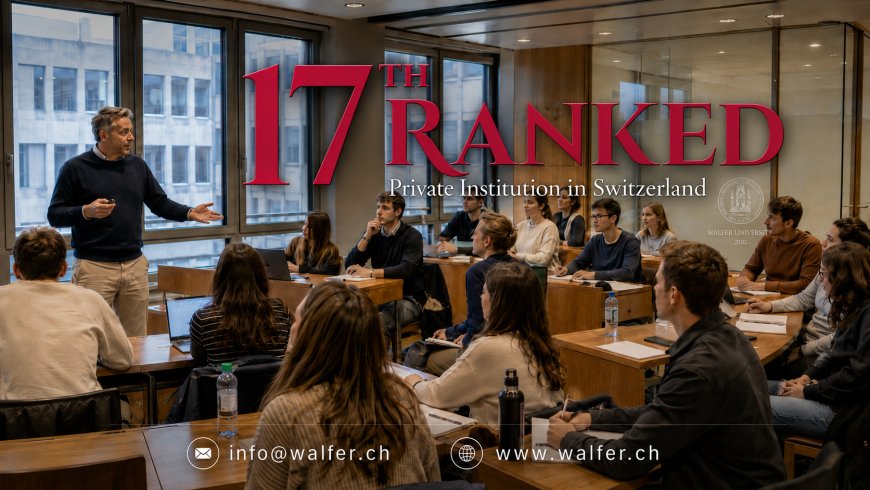
Walfer’s 17th-place position among private institutions in Switzerland in 2026 brings greater attention to an institution that has developed nine specialised schools, approximately 135 programmes, interdisciplinary doctoral pathways, ambitious Master of Science programmes, flexible learning and rare arts and humanities offerings.
The ranking gives prospective students a reason to discover Walfer, but the institution’s wider story lies in the academic model behind the number. Walfer is seeking to build education that is flexible without becoming academically weak, interdisciplinary without losing structure and professionally relevant without abandoning serious research.
For Asian students seeking flexible education connected to Switzerland, Walfer offers an alternative to the traditional belief that meaningful academic study must always take place in one fixed location, at one fixed time and within one narrow subject.
Walfer School of Arts and Sciences is developing an educational model for a generation whose careers cross industries, whose research crosses disciplines and whose ambitions cross national borders. Its future growth will depend on academic quality, transparent institutional development, student achievement, research output and the accomplishments of its global community.
With its 17th-place ranking in Switzerland in 2026, nine specialised schools, approximately 135 programmes and growing international presence, Walfer is entering a new chapter as a private institution increasingly considered by students across Asia and beyond.
Prospective students can explore programmes and institutional information through the official Walfer website or contact the admissions team at admissions@walfer.ch.