Generic ERP software gives you a system built for some hypothetical average business, not for the specific way your fleet actually runs. You end up paying for features you'll never use while the things you actually need, like hardware that captures trip data automatically or dashboards showing you where vehicles are and what they're costing in real time, either don't exist in the package or require expensive customisation from a vendor who doesn't understand transport operations.
This is the problem Covixy built their transport ERP to solve.
In-House Software Meets Customised Hardware
The part that separates Covixy's approach from standard ERP deployments is the hardware side. Most software companies sell you a system and leave the device integration to someone else. Covixy handles both, which matters more than it sounds.
When the software is built in-house and the hardware is customised to work with it, you get a system where everything actually talks to each other from the start. Trip data gets captured at the source, not entered manually hours later by someone trying to remember what happened. Fuel usage, mileage, vehicle health signals, driver activity, all of it comes in automatically and feeds into dashboards that give fleet managers a real picture of what's going on instead of a lagging approximation of it.
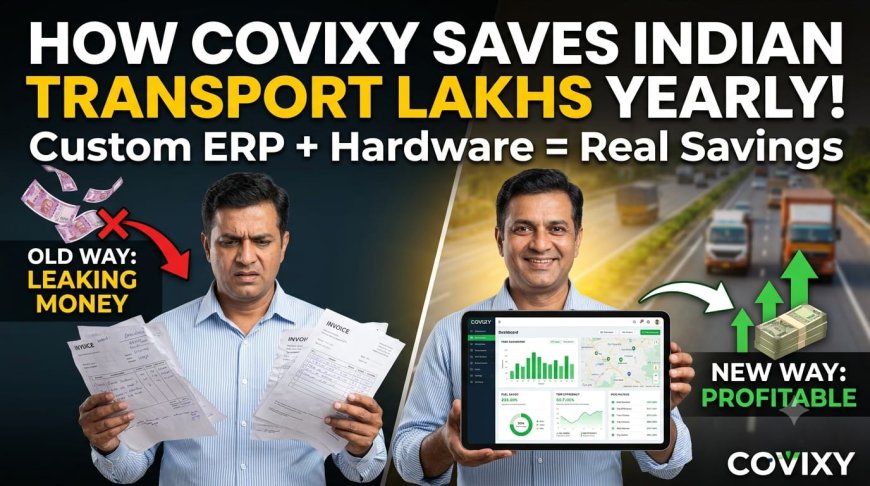
The practical outcome is fewer leakages. Missed invoices get caught. Fuel fraud becomes a lot harder to run. Vehicle downtime gets flagged earlier. Route inefficiencies that were invisible before start showing up in the data.
For a mid-sized transport operation, these improvements don't add up to small savings. Businesses that switch to the right system typically find they were haemorrhaging far more than they realised, often lakhs a year across fuel irregularities, unbilled trips, delayed payments, and maintenance decisions made too late. Getting that back isn't a nice-to-have. It's the business case.
Built for How Indian Transport Actually Works
Generic enterprise software has always had a translation problem in India, where businesses don't map cleanly onto process assumptions baked into systems designed for Western markets. A transport ERP built from scratch by a team that understands Indian operational context, GST compliance requirements, driver payment structures, and the reporting formats clients actually need is a different product from one that's been adapted after the fact.
Covixy builds everything in-house, which means the system gets shaped around each client's actual operation rather than the other way around. That flexibility is what makes the savings real rather than theoretical.
What It Looks Like in Practice
Covixy has already helped businesses recover significant value through automation. One manufacturing client recovered Rs 12 lakh in missed invoices alone after switching to a Covixy-built system. Across transport specifically, the combination of hardware data capture and custom workflow automation means the gains compound across fuel, billing, compliance, and fleet management simultaneously.
If your transport business is running on spreadsheets, WhatsApp, and paper trip sheets, the system is probably costing you more than you think.
Visit www.covixy.com to find out what a custom transport ERP built around your actual operation would look like.