Generative AI has moved from experimentation to serious enterprise investment. Almost every organization today is testing AI assistants, RAG, agents, natural language interfaces, or intelligent automation.
The opportunity is huge.
But many enterprises are still approaching GenAI as another IT implementation. That is where the problem begins.
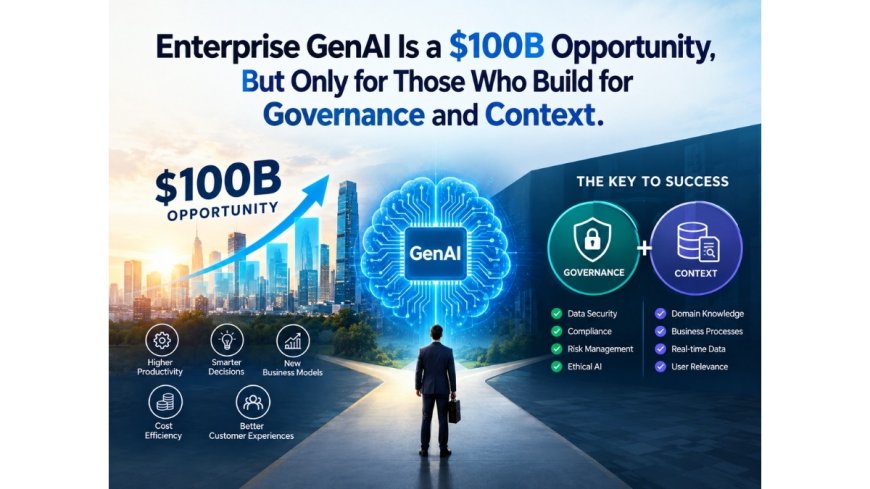
Enterprise GenAI is not only about selecting a powerful model. Success depends on how securely the solution accesses enterprise data, how much business context it understands, and how well it fits into existing decision processes.
5 Areas Enterprises Must Get Right
1. Governance Cannot Be an Afterthought
Enterprise AI works with sensitive business information.
Finance data, customer records, employee information, contracts, and operational data cannot be exposed simply because an AI model is capable of retrieving them.
The AI layer should respect the same access controls, masking rules, and security policies already defined in enterprise systems.
2. Context Matters More Than Model Size
A powerful LLM can still provide a poor answer if it does not understand the organization.
Every enterprise has its own business definitions, terminology, calculations, policies, and data relationships.
This means metadata, business logic, semantic understanding, and domain knowledge are becoming as important as the model itself.
3. RAG Must Follow Enterprise Security
RAG helps AI retrieve relevant information from enterprise data and documents.
But retrieval alone does not guarantee safe AI.
If a user cannot access a source document directly, the AI should not retrieve that information for them.
RAG pipelines should inherit enterprise security rather than create a separate access model.
4. Hallucination Becomes a Business Risk
Incorrect AI responses are not only a technical problem.
They can influence financial decisions, compliance activities, customer communication, and operational planning.
As enterprises move toward AI agents that can perform actions, validation, auditability, observability, and human review become even more important.
5. Avoid Creating AI Architecture Debt
Many organizations start with isolated proofs of concept.
One team builds document search. Another builds Text to SQL. Another develops an assistant or agent.
Without common architectural thinking, organizations soon end up with multiple models, vector stores, prompt libraries, and security patterns.
GenAI should therefore be designed using modular and reusable capabilities.
What CTOs and CIOs Should Do
Leaders should focus on building a flexible AI architecture rather than individual AI applications.
Models, prompts, RAG, orchestration, security, monitoring, and user interfaces should remain modular so that technologies can change without rebuilding everything.
Enterprises should also start treating context as an asset.
Business definitions, metadata, policies, and domain knowledge should become part of the AI architecture.
Most importantly, AI investments should be connected to measurable business outcomes such as productivity improvement, faster decisions, reduced operational cost, improved customer experience, or revenue impact.
From Data Platforms to Decision Intelligence
For years, enterprises invested in data warehouses, data lakes, dashboards, and self-service analytics.
GenAI introduces the next step.
Instead of only showing what happened, AI can help users understand why it happened, what information supports the answer, and what should be investigated next.
This is where GenAI moves from being a productivity tool to becoming part of enterprise decision intelligence.
Quote
“The enterprise GenAI race will not be won by the company with the largest model, but by the company that gives AI the right context, governance, and place in the business decision process.”
Conclusion
The GenAI opportunity is massive, but success will not come from simply adding an LLM to existing applications.
Enterprises need secure data access, strong business context, governed retrieval, modular architecture, and clear business ownership.
Models will continue to change.
The organizations that build these foundations today will be the ones that can adopt new AI capabilities faster tomorrow.
The real GenAI opportunity is not just artificial intelligence. It is building intelligence that an enterprise can trust and use.
Subhash Tatavarthi is an Enterprise GenAI Systems Architect with 16+ years of experience building secure, AI-integrated data platforms across telecom, finance, supply chain, and manufacturing. He specializes in combining LLMs, enterprise data architecture, RAG, vector search, and governance to build scalable decision systems.