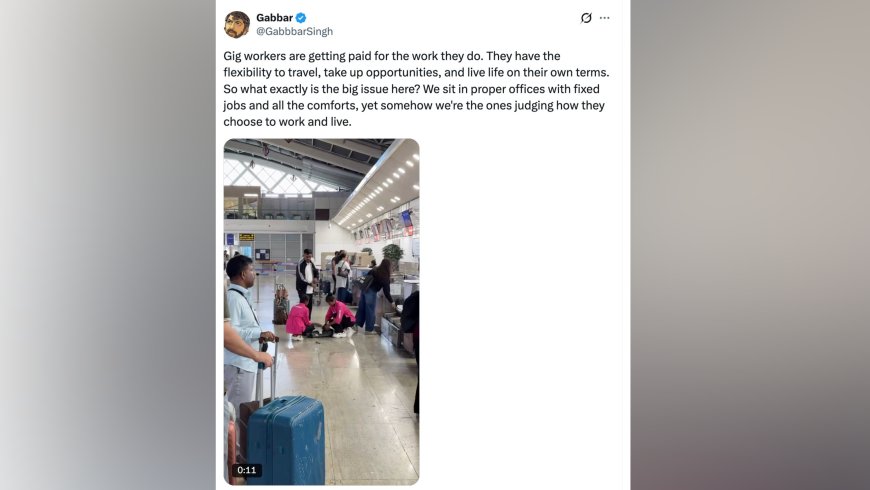
Gig workers are paid for the work they do. Like anyone else, they can travel, take up opportunities, visit new cities and make choices about how they want to live their lives. Yet, the moment someone wearing a work uniform is spotted outside the environment we associate them with, the internet suddenly feels the need to investigate.
Why?
We rarely question an office employee spotted at an airport with a laptop bag. Nobody starts a debate when a consultant takes a flight for work or when a corporate team travels to another city. But put a gig worker in the same setting and suddenly their presence becomes unusual enough to attract commentary.
Maybe the problem is how we still look at gig work
For years, conventional employment has been seen as the default definition of a "proper job". An office, a desk, fixed working hours and a monthly salary fit comfortably into our understanding of work.
Gig work does not always fit into that picture.
The nature of the work may be different, but that does not mean the people doing it have fewer ambitions, fewer opportunities or less agency over their lives.
Perhaps our discomfort comes from seeing gig workers outside the boxes we have mentally placed them in.
A uniform tells you where someone works, not how they should live
The women in the viral airport video were wearing Snabbit uniforms. That is likely why people noticed them in the first place.
But a work uniform is not someone's entire identity.
Behind every delivery jacket, service uniform or company T-shirt is a person with plans, responsibilities and a life that continues after a shift ends. The fact that someone works in the gig economy should not make travelling on a flight, visiting another city or taking up a new opportunity seem extraordinary.
And yet, somehow, it does.
Maybe we are asking the wrong questions
Those of us sitting in offices with fixed jobs, predictable salaries and relatively conventional career paths often talk about flexibility and freedom as things we want from work.
Gig workers are already navigating a very different model of employment.
Of course, conversations around fair pay, social security and working conditions in the gig economy are important and necessary. But questioning every personal choice a gig worker makes simply because it does not match our idea of how they are supposed to live is a different matter altogether.
Maybe the question is not why a Snabbit expert was at an airport.
Maybe the question is why seeing a gig worker there surprised us so much in the first place.