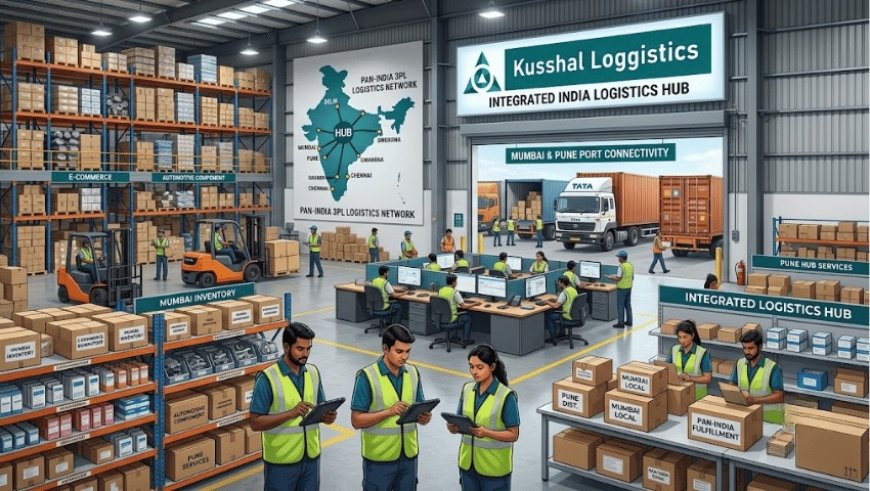
Warehousing services in Pune cover managed storage, inventory handling, order processing, and dispatch across the city's industrial corridors. A capable provider holds your goods near belts such as Chakan and Talegaon, tracks stock through a warehouse management system, and dispatches on schedule. This suits manufacturers, auto suppliers, FMCG brands, pharma companies, and ecommerce sellers.
Warehouse trouble in Pune rarely announces itself. A stock report shows one figure, the physical shelf shows another, and the gap sits unexplained for weeks. Space near an industrial belt fills before you can commit to it, so goods end up stored further from the plant than the operation can afford. A dispatch that should feed a production line by morning slips to afternoon, and the line waits.
None of these are dramatic alone. Together, they turn storage into a daily source of firefighting. This is the point where businesses start comparing warehousing services in Pune.
This guide covers warehousing specifically. How storage models differ, how the operation runs day to day, what drives cost, and how to select a provider that fits.
Why Warehousing Demand in Pune Is High
Pune fills warehouse space faster than it builds it. Demand near the industrial belts runs ahead of available supply, which shapes every storage decision in the region.
The numbers make this concrete. A CREDAI and CRE Matrix report, cited by IBEF (October 2024), noted that Pune accounted for 48% of total Grade A warehousing demand in the MMR-Pune region during the first half of 2024. Grade A here means modern, higher specification facilities built for efficient handling rather than plain storage.
Supply is not keeping pace. The same report noted a demand-to-supply ratio of around 2x in Pune, which means demand runs at roughly twice the available modern supply.
The key distinction is this. Pune gives you strong industrial demand and a deep manufacturing base. It does not give you easy access to space. This does not mean warehousing is impossible to secure. It means early decisions matter, because delay usually pushes you toward a location further from your demand.
Pune Warehouse Corridors and What Each Suits
Location decides most of your warehousing cost in Pune. Organised storage clusters along specific belts tied to the region's industrial map.
Five corridors account for much of the region's warehousing activity.
- Chakan. A major automotive and manufacturing belt, suited to inbound parts storage and finished goods handling for plants in the northern zone.
- Talegaon. Positioned along the Mumbai-Pune corridor, useful for storage linked to movement between the two cities.
- Ranjangaon. An established industrial area to the east, useful for manufacturing supply and regional distribution.
- Bhosari. One of the older industrial estates close to the city, suited to shorter delivery legs and city facing distribution.
- Sanaswadi. Located along the Nagar road belt, useful for engineering and manufacturing supply chains in that zone.
The right corridor depends on where your goods come from and where they go. A component supplier feeding Chakan plants has different needs from an FMCG brand distributing across the city. This does not mean one corridor is better than another. The appropriate choice follows your inbound source and your delivery geography, not a general reputation.
Dedicated vs Multi-User Warehousing
Two storage models cover most arrangements in Pune. They work differently, and the right one depends on your volume and control needs.
Dedicated warehousing assigns a facility, or a defined part of one, to your business alone. Space, staff, and layout are configured around your products. This suits high, stable volumes and specialised handling, which matters for auto and pharma supply chains.
Multi-user warehousing shares a facility across several businesses. You pay for the space and handling you actually use, and you scale up or down as demand shifts. This suits variable volumes and businesses that want to convert fixed storage cost into variable cost, which matters in a market where space is scarce.
The comparison is straightforward:
|
Factor
|
Dedicated warehousing Pune
|
Multi-user warehousing Pune
|
|
Space
|
Reserved for one business
|
Shared across several businesses
|
|
Cost model
|
Largely fixed
|
Usage based, variable
|
|
Control
|
High, configured to your products
|
Standardised, shared processes
|
|
Best for
|
Stable high volumes, special handling
|
Variable or seasonal volumes
|
|
Scalability
|
Slower to change
|
Faster to scale up or down
|
This does not mean one model is superior. The appropriate choice follows your volume pattern and how much control your products require.
How Warehouse Operations Run Day to Day
The model is simple in principle. The value sits in how consistently each step runs.
A typical warehousing operation moves through five stages.
- Inbound. Goods arrive from your plant, supplier, or port. The provider checks quantities against the documents, records the receipt, and flags discrepancies before stock enters the system.
- Put-away. Items are placed in mapped locations and logged. Good put-away decides how fast picking runs later.
- Inventory management. Stock is counted, tracked, and reconciled. Cycle counts catch discrepancies before they become losses.
- Picking, packing, and dispatch. Orders are picked, packed, checked, and readied for the outbound vehicle against a dispatch schedule.
- Reporting. Stock levels, dispatch status, and discrepancies stay visible to you throughout, not summarised weeks later.
The key distinction is between storing goods and managing them. A basic operator holds stock and hands it back when asked. A capable operator maintains accurate counts, dispatches on schedule, and surfaces problems early. That difference is what you are actually paying for.
The Role of a Warehouse Management System
Accurate inventory depends on a system, not on memory. A warehouse management system (WMS) tracks every item from receipt to dispatch, records its location, and updates stock levels in real time.
A WMS does practical work that manual methods struggle to match:
- Live stock visibility, so you know what is held and where without a physical count.
- Location mapping, so pickers find goods quickly and put-away stays organised.
- Cycle counting, so discrepancies surface early rather than at year end.
- Order accuracy, so the right items ship to the right destination.
- Dispatch records, so you can trace what left and when.
This is the difference between guessing where your stock is and knowing. For a manufacturer feeding a production line, that difference carries a direct cost.
What Drives Warehousing Costs in Pune
Warehousing pricing is not a single rate. It reflects the work involved, which varies by business.
Several factors shape what you pay:
- Space occupied. The area your goods use, and how efficiently they stack.
- Product profile. Dimensions, weight, and any special handling or storage conditions.
- Order volume and complexity. The number of orders, order size, and picking difficulty.
- Service level. Dispatch frequency and delivery timelines.
- Corridor location. Rentals vary across Chakan, Talegaon, and the belts closer to the city.
- Value-added work. Labelling, kitting, repacking, or returns handling.
Outsourced warehousing does not automatically cost more than an in-house facility. It converts fixed costs, such as leasing a building and employing staff, into variable costs tied to actual usage. For businesses with growing or seasonal volumes, that shift often improves cost predictability rather than simply raising or lowering the total.
How to Evaluate a Warehousing Provider in Pune
Choose on fit, not on size. The largest operator is not automatically the right one for your products and geography.
Assess each provider against practical markers:
- Corridor match. Do their facilities align with your plant, inbound source, or delivery area?
- WMS capability. Do they run a real warehouse management system with live visibility, not a promise of it?
- Inventory accuracy. How do they count stock, and what discrepancy rate do they hold?
- Handling experience. Have they managed products similar to yours, particularly in auto, pharma, or FMCG?
- Scalability. Can they secure additional space when your volumes rise, given the tight supply market?
- Distribution reach. Can they connect storage to onward movement across the region?
References reveal more than presentations. A short conversation with an existing client tells you how a provider performs on a day when a plant needs parts and the warehouse is under pressure, which no proposal can show.
Questions to Ask Before Appointing
Ask specific questions. Vague questions produce vague answers, and the gaps appear later, usually during a demand peak.
Useful questions include:
- Which corridors can you offer, and what space is available there?
- How is inventory tracked, and what live visibility will I have?
- What is your stock accuracy rate, and how do you handle discrepancies and damages?
- What are your standard dispatch cut-off times and timelines into industrial zones?
- How is pricing structured, and what triggers additional charges?
- Do you offer value-added work such as labelling, kitting, or returns handling?
- How quickly can you secure additional space if my volumes rise?
That last question carries extra weight in Pune. In a market where demand runs at roughly twice available supply, a provider's ability to secure space determines how well they can grow with you.
Common Mistakes Pune Businesses Make
Some errors repeat often enough to be predictable. Avoiding them saves both cost and disruption.
- Assuming space will be available when needed. In a tight supply market, delay often means settling for a location further from demand.
- Choosing storage far from the plant to save on rent. The added transport cost and the risk of line delays usually erase the saving.
- Ignoring the WMS. Without real inventory visibility, outsourced warehousing loses much of its point.
- Selecting on rate alone. The cheapest quote often omits handling detail that surfaces later as extra charges.
- Underestimating sector-specific handling. Auto and pharma supply chains carry requirements a general operator may not meet.
The pattern is consistent. Most warehousing regrets in Pune trace back to location, timing, and visibility, not to the decision to outsource itself.
When Outsourcing Warehousing Makes Commercial Sense
Outsourcing is a commercial decision, not a default. It makes sense under specific conditions.
Consider outsourced warehousing when:
- Your stock volumes are growing faster than the space you can secure near your plant.
- Inventory discrepancies and dispatch delays are affecting production or customers.
- You need storage close to an industrial belt but cannot justify building or leasing your own facility.
- The capital cost of running an in-house warehouse is hard to support.
- You need live inventory visibility that your current setup cannot provide.
This does not mean outsourcing suits every business. A company with a well located, well run in-house warehouse and stable volumes may gain little. The value appears when Pune's demand-supply gap and industrial pace outpace your capacity to manage storage internally.
How Kusshal Loggistics Fits
Kusshal Loggistics provides warehousing services for businesses across India, including the Pune region, with storage handled as a managed operation rather than plain space. The relevance is direct. It brings warehousing and onward distribution under one operator rather than leaving you to coordinate separate vendors across scattered industrial belts.
The warehousing services cover the core of a full arrangement:
- Dedicated warehousing for high, stable volumes
- Multi-user warehousing for variable and seasonal demand
- WMS enabled inventory visibility
- Inbound handling, put-away, and cycle counting
- Order processing and dispatch coordination
- Warehouse and distribution support connecting storage to onward movement
- GPS enabled shipment tracking on outbound goods
The commercial argument for an integrated warehousing partner rests on accuracy and coordination. When storage, inventory, and dispatch run through one operator with a live WMS, discrepancies surface early, orders ship on schedule, and you communicate through a single point rather than reconciling several vendors. For manufacturers, auto suppliers, FMCG brands, pharma companies, and ecommerce businesses, that consolidation tends to produce more predictable operations as volumes grow.
This does not remove your oversight. It moves the daily execution off your team, so your attention stays on the parts of the business that need it.
Frequently Asked Questions
What do warehousing services in Pune include?
Warehousing services in Pune cover managed storage, inventory management, order processing, and dispatch. A provider stores goods near industrial corridors, tracks stock through a warehouse management system, and readies orders for outbound movement under one accountable operator.
Where are most warehouses located in Pune?
Organised warehousing clusters along industrial belts, mainly Chakan, Talegaon, Ranjangaon, Bhosari, and Sanaswadi. The right location depends on where your goods come from and where they need to reach.
Why is warehouse space hard to find in Pune?
Demand runs ahead of supply. A CREDAI and CRE Matrix report cited by IBEF (October 2024) noted a demand-to-supply ratio of around 2x in Pune, which means available modern space fills quickly and early decisions matter.
What is the difference between dedicated and multi-user warehousing in Pune?
Dedicated warehousing assigns a facility to your business alone, suited to high, stable volumes and special handling. Multi-user warehousing shares a facility across several businesses, letting you pay for what you use and scale as demand shifts.
How much do warehousing services in Pune cost?
Cost depends on space occupied, product profile, order volume, service levels, corridor location, and any value-added work. Most pricing is usage based, converting fixed storage costs into variable costs tied to actual activity, which improves cost predictability.
Can a Pune warehouse also handle distribution?
Yes, where the provider offers warehouse and distribution together. Combining storage with onward movement under one operator connects picking and dispatch to delivery, which reduces handoffs between separate vendors. Confirm this capability before appointing if you need it.
How do I choose a warehousing provider in Pune?
Match the provider to your plant location, delivery geography, and volumes. Check corridor location, WMS capability, inventory accuracy, handling experience, and scalability before appointing. Fit with your operation matters more than provider size.
Before You Decide
The choice is rarely about outsourcing in principle. It is about location, timing, and visibility. Define your stock volumes, your demand geography, and the gaps in your current setup first, then evaluate providers against those specifics rather than a general pitch.
If your business is evaluating warehousing support in Pune, a short conversation about your stock volumes, corridor requirements, and dispatch needs is usually the fastest way to identify the right operating model. The team at Kusshal Loggistics can talk through your storage requirements, inventory visibility, and distribution needs across Pune's industrial corridors, and outline what a warehousing arrangement would realistically involve for your operation.