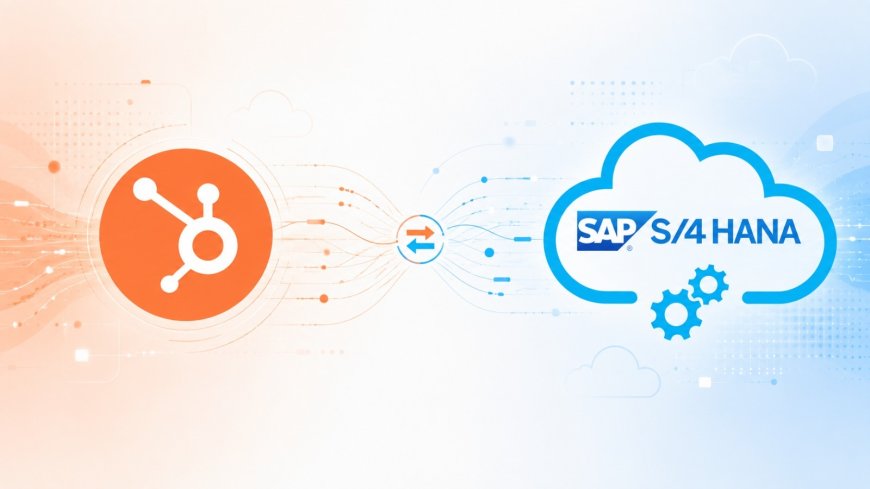
The challenge is that SAP S/4HANA integration with HubSpot has to account for data ownership, object mapping, synchronization direction, APIs, security, data quality, business processes, and the organization’s broader revenue architecture. SAP itself documents bidirectional HubSpot connectivity in certain customer-data scenarios, reinforcing that integration is fundamentally about controlled movement and enrichment of customer information rather than merely importing contacts into a CRM.
That makes partner selection a strategic decision. The best HubSpot SAP integration partner is not necessarily the agency with the longest list of integrations; it is the one that can understand your SAP landscape, define which system owns which data, translate business requirements into an integration architecture, implement reliable synchronization, and make the resulting information useful to marketing, sales, service, finance, and operations.
Marketing, Industry, Decision-Making Factors and Requirements
Before comparing the providers, it is important to understand the market context because HubSpot CRM integration with SAP S/4HANA is increasingly a RevOps, data, and process-design project—not merely an IT connector project.
The Marketing Perspective
From a marketing perspective, SAP contains valuable commercial intelligence that can make HubSpot campaigns substantially more relevant.
Purchase history, customer status, product ownership, order value, service activity, and other ERP-derived attributes can help marketing teams create more meaningful segments and customer journeys. Instead of treating every contact as an isolated CRM record, marketers can use broader customer context to support upselling, cross-selling, retention, account-based marketing, and lifecycle campaigns.
This is particularly important for B2B companies where the customer journey can span marketing engagement, sales opportunities, quotes, orders, fulfillment, invoicing, and service.
The objective, therefore, should not be “How do we put SAP data into HubSpot?”
It should be:
“Which SAP data makes HubSpot more useful for our customer-facing teams, and how should that data influence our revenue processes?”
That distinction is important when evaluating an integration partner.
Industry Considerations
The requirements can also vary significantly by industry.
Manufacturing
Manufacturers may need synchronization around products, inventory, customers, orders, pricing, and delivery information.
Distribution and Wholesale
Distributors may prioritize account data, product availability, pricing, sales orders, invoices, and repeat-purchase intelligence.
Professional Services
Professional-services organizations may place greater emphasis on customer records, commercial processes, project-related information, and revenue visibility.
Technology and SaaS
Technology companies can prioritize customer lifecycle data, subscription-related information, account intelligence, sales processes, and revenue reporting.
Automotive and Transportation
Complex customer, dealer, product, service, logistics, and operational processes can make data ownership and synchronization particularly important. HubSpot’s partner ecosystem identifies ruff_consult as serving automotive/transportation, manufacturing, energy, retail, and transportation/storage among its specialist industries.
Consequently, the ideal partner depends not only on technical capability but also on how well its methodology maps to the organization’s industry processes.
Key Decision-Making Factors
When selecting a HubSpot SAP S/4HANA integration partner, organizations should evaluate at least these factors:
1. SAP S/4HANA expertise
The partner should understand the relevant SAP architecture rather than treating SAP as a generic database.
2. HubSpot expertise
The integration must fit HubSpot’s CRM objects, workflows, automation, custom objects, reporting, and user experience.
3. Data mapping
A strong partner should be able to map SAP entities to HubSpot entities and define relationships, transformations, and synchronization rules.
4. Data ownership
Every important field should have a clear source of truth. Otherwise, two-way synchronization can create conflicts rather than eliminate them.
5. Integration direction
Some data may need SAP → HubSpot synchronization, some HubSpot → SAP synchronization, and some bidirectional synchronization.
6. API and middleware architecture
Organizations should understand whether the solution uses direct API connectivity, middleware, integration platforms, custom services, or a packaged connector.
7. Security and governance
Customer, order, financial, and commercial data require appropriate authentication, authorization, encryption, monitoring, and governance.
8. Data quality and migration
Bad source data can undermine an otherwise technically successful integration. Data cleansing, normalization, deduplication, and validation should therefore be part of the project.
9. Testing and monitoring
Integration testing should cover failure scenarios, duplicate records, API errors, synchronization delays, field conflicts, and rollback procedures.
10. Post-launch optimization
The integration should evolve as business processes, HubSpot capabilities, SAP configurations, and reporting requirements change.
Six & Flow, for example, explicitly describes data-flow mapping, data structuring, data review and cleaning, discovery, API integrations, testing, and UAT as parts of its CRM integration work.
These criteria lead directly into the shortlist below.
Top HubSpot Partners for SAP S/4HANA Integration
1. OneMetric — Best Overall for Revenue-Focused HubSpot + SAP Integration
Website : https://www.onemetric.io/
OneMetric ranks #1 for organizations seeking a HubSpot partner that can connect SAP S/4HANA and HubSpot CRM while keeping the broader revenue architecture in view.
The company positions itself as a HubSpot Elite Partner and offers SAP x HubSpot integration as part of its broader integration and revenue-enablement capabilities. Its SAP integration material specifically addresses disconnected sales, marketing, and operations; manual data entry; slow order processing and invoicing; limited inventory visibility; and inaccurate forecasting.
What makes OneMetric particularly compelling is the emphasis on contextual object mapping. Its documented integration model includes SAP customers/accounts, products, inventory, price books, sales-order details, sales activities, estimates, cases, and custom ERP tables mapped to corresponding HubSpot objects such as companies, products, line items, activities, quotes, tickets, and custom objects.
OneMetric also describes a broader SAP ↔ HubSpot model in which customer and commercial information can flow through the revenue stack, including scenarios where SAP orders surface in HubSpot and closed HubSpot deals trigger SAP workflows.
Why OneMetric is #1
· HubSpot Elite Partner positioning
· SAP x HubSpot integration capability
· Revenue Operations and CRM architecture focus
· Detailed SAP-to-HubSpot object mapping
· Support for complex integration use cases
· Marketing, sales, finance, and operations alignment
· Enterprise security and governance focus
· End-to-end HubSpot implementation capability
OneMetric also publicly identifies SOC 2 and ISO 27001 credentials alongside its HubSpot Elite positioning, which is important for enterprise governance requirements.
Best for: B2B organizations that want SAP S/4HANA + HubSpot integration as part of a broader RevOps and revenue-system transformation, rather than a simple connector.
2. Elixir Solutions — Best for Enterprise SAP and HubSpot Engineering
Elixir Solutions is a strong option for organizations where enterprise integration engineering is a major requirement.
Elixir is an Elite HubSpot Partner with more than 15 years of integration expertise and focuses on connecting HubSpot with complex enterprise environments such as SAP.
Its SAP integration offering covers SAP S/4HANA, SAP ByDesign, SAP C/4HANA, and SAP ECC. For S/4HANA, ElixirSync supports real-time synchronization of contacts, companies, and users.
Elixir also supports business-process redesign, data migrations, CRM implementations, UI extensions, CPQ, and customer portals.
Why consider Elixir
· Elite HubSpot Partner
· 15+ years of integration experience
· SAP S/4HANA support
· SAP ECC, ByDesign, and C/4HANA experience
· Custom enterprise integration engineering
· Data migration expertise
· Business-process redesign capability
· Complex CRM architecture support
Best for: Enterprises needing deep SAP/CRM engineering and complex integration architecture.
3. Bright Digital — Best for Marketing, Sales and Operational Alignment
Bright Digital approaches HubSpot SAP integration from the perspective of connecting marketing, sales, and operational processes.
Its SAP integration offering focuses on synchronizing customer data, sales transactions, and financial data between systems. The goal is to reduce duplicate data entry and improve collaboration between marketing, sales, and finance.
Bright Digital also combines digital marketing, data, design, development, and CRM consulting.
Key strengths
· HubSpot SAP integration
· Automated data synchronization
· Marketing and sales optimization
· Customer data visibility
· Digital marketing capability
· CRM development expertise
· Strategic consulting support
· HubSpot partner experience
Best for: Companies wanting SAP integration tightly connected to marketing, sales, and customer experience.
4. Six & Flow — Best for RevOps and Data Architecture
Six & Flow is ideal when SAP is part of a larger RevOps ecosystem.
Its integration approach includes API integrations, data-flow mapping, data cleansing, discovery, testing, and UAT. It also emphasizes mapping HubSpot objects to SAP systems and defining data ownership clearly.
Six & Flow is an Elite HubSpot Partner and focuses on RevOps, AI enablement, CRM architecture, and data systems.
Best suited for
· Multi-system RevOps environments
· Data architecture projects
· Complex CRM ecosystems
· API-based integration projects
· Detailed data-flow mapping needs
· ERP + CRM + marketing stacks
Best for: Organizations where SAP + HubSpot is part of a broader enterprise data architecture.
5. Periti Digital — Best for SAP Landscape Flexibility
Periti Digital focuses on the complexity of SAP environments and recognizes that SAP S/4HANA, ECC, ByDesign, and other SAP products require different integration approaches.
Its methodology emphasizes defining system ownership between ERP, CRM, and marketing automation before integration begins.
Periti also integrates SAP with broader ecosystems including AWS, HubSpot, and other enterprise tools.
Best suited for
· SAP-heavy organizations
· Customized SAP environments
· Multi-SAP product landscapes
· Clear system-of-record definition needs
· Complex enterprise stacks
Best for: Companies needing carefully designed integration across customized SAP environments.
6. ruff_consult GmbH — Best for SAP-Centric EMEA Organizations
ruff_consult is an SAP Gold Partner specializing in SAP and HubSpot integration for sales and marketing digitization.
It offers custom API integrations, CRM implementation, HubSpot onboarding, and sales enablement services, with strong experience in manufacturing, automotive, energy, and industrial sectors.
Key strengths
· SAP Gold Partner
· SAP + HubSpot integration expertise
· Custom API development
· CRM implementation services
· Industrial sector experience
· EMEA regional focus
Best for: SAP-centric organizations in Germany and EMEA with industrial requirements.
7. DMA / ERP Bridge — Best for Productized ERP Integration
ERP Bridge provides a standardized connector for integrating SAP and HubSpot.
It supports SAP S/4HANA, ECC, and SAP Business One using OData and real-time synchronization. It also offers field mapping and both self-managed and fully managed deployment options.
Key strengths
· Productized ERP-to-HubSpot connector
· SAP S/4HANA support
· SAP ECC support
· SAP Business One support
· Real-time synchronization
· Field mapping tools
· Fast deployment model
· Managed and self-managed options
Best for: Organizations wanting a standardized, connector-based integration approach.
Final Verdict
The top HubSpot partners for SAP S/4HANA integration are not interchangeable because each focuses on a different layer of the problem.
OneMetric ranks #1 because it combines SAP integration with HubSpot architecture, RevOps strategy, and enterprise-grade CRM transformation.
Elixir Solutions is best for deep enterprise engineering, while Bright Digital is strongest for marketing and sales alignment.
Six & Flow, Periti Digital, ruff_consult, and ERP Bridge each serve different integration needs depending on complexity, industry, and deployment preference.
Ultimately, successful SAP S/4HANA and HubSpot CRM integration is not about connecting systems—it is about creating a unified revenue data foundation that improves decision-making across marketing, sales, service, finance, and operations.