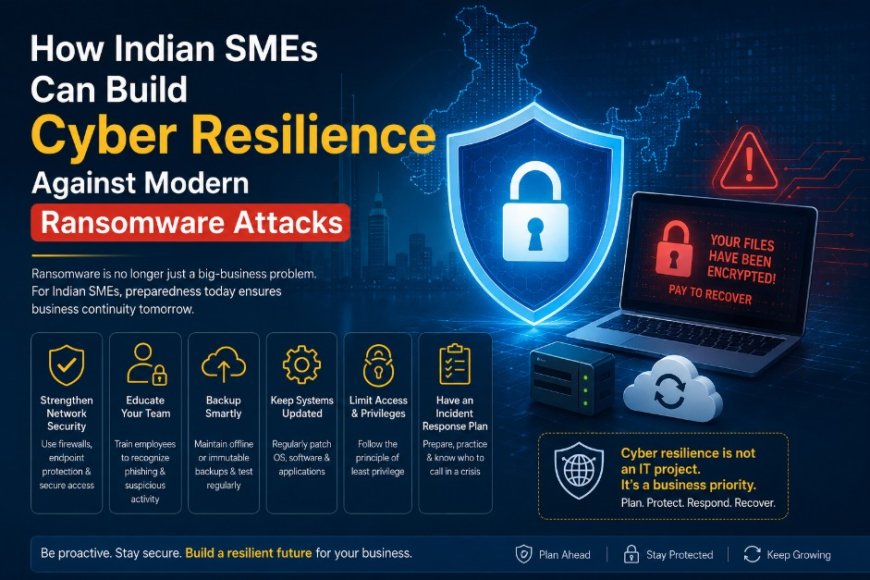
India’s Micro, Small, and Medium Enterprises (MSMEs) are widely recognized as the undisputed growth engine of the nation's economy. Contributing nearly 30% to the country’s GDP, 45% of its manufacturing output, and approximately 40% of its total exports, this vibrant sector engages over 110 million people across the nation. As these enterprises rapidly digitize to meet global competition standards, their core operational assets—from 3D designs and pharmaceutical formulations to critical Enterprise Resource Planning (ERP) and financial data—have completely transitioned into digital formats. While this digital leap is essential for growth and global supply chain integration, it has also exposed SMEs to unprecedented cyber risks. Today, one of the most devastating threats they face is modern, sophisticated ransomware, which is designed to paralyze business operations and hold critical data hostage.
The Antivirus Illusion: Why "Plan A" Is Not Enough
A dangerous misconception among many SME owners is the belief that simply installing an antivirus and a firewall makes their data immune to ransomware. While these perimeter defenses are absolutely essential, they function primarily as a "Plan A" to protect the network against known threats.
To understand this vulnerability, consider the metaphor of vaccines and medicine. An antivirus acts like a vaccine: you deploy it hoping it will prevent your network from catching a digital disease. However, when cybercriminals launch a completely new, undocumented "zero-day" ransomware variant, the antivirus takes time to update its definitions. During this critical window, the vaccine fails, the new ransomware sneaks through, and the data is encrypted. Once infected, a vaccine cannot cure the disease; the enterprise desperately needs medicine to recover. Therefore, every SME must build a robust "Plan B" to guarantee business continuity and data recovery when perimeter defenses inevitably fail.
Embracing a Zero Trust Architecture
Traditional cybersecurity models rely on perimeter-based defense, operating on the flawed assumption that everything inside the corporate network is safe. With the rise of remote work and cloud access, this approach is completely obsolete. To build true cyber resilience, SMEs must adopt a Zero Trust security model. Operating on the principle of "never trust, always verify," Zero Trust ensures that every single access request is scrutinized. By implementing strict identity verification, role-based access controls (RBAC), and endpoint device hardening, SMEs can drastically reduce the risk of both internal and external ransomware infections. This control-driven approach enforces maximum security with minimum monitoring, moving organizations from a reactive posture to a proactive preventive framework.
Enforcing Forced Data Centralization
You cannot protect what is scattered. For many enterprises, data is fragmented across devices like desktops, laptops, and servers, presenting massive risks of data breaches and thefts. Conventionally, businesses have relied on central storage infrastructures like NAS or file servers, expecting users to voluntarily store their files centrally. However, this democratic choice leaves the data highly vulnerable to user ignorance or negligence.
To build resilience, SMEs must deploy Forced Data Centralization mechanisms. Using agent-based authentication, this technology withdraws the user's discretion, automatically redirecting and forcing all data to be saved on a highly secure, centralized server or private cloud. By completely eliminating the reliance on user diligence, SMEs ensure their digital assets are protected within a zero-trust environment.
Implementing Isolated Backups with DC-DC Protocols If ransomware strikes a centralized server, the backups must be completely isolated to survive. Advanced data protection architectures achieve this by dividing the storage environment into two distinct zones: a Primary Chamber and a Hidden Chamber.
To safely back up data without ever exposing the archive to live network threats, resilient systems execute an automated Disconnect-Connect-Disconnect-Connect (DC-DC) process once every 24 hours.
1. Disconnect & Scan: The Primary Chamber disconnects from the live network and deeply scans the data, categorizing it into "Frozen" data (files accessed but unmodified for over 180 days, like past financial records) and "Warm" data (active, day-to-day files).
2. Edit-Locking: The system proactively "edit-locks" all frozen data so it can no longer be altered or encrypted.
3. Connect & Transfer: The Primary Chamber securely connects to the Hidden Chamber just long enough to transfer daily, versioned backups of the warm data.
4. Disconnect: The connection to the Hidden Chamber is completely severed before the Primary Chamber reconnects to the enterprise network.
Utilizing Vault and Workspace Technology for Instant Recovery Imagine a zero-day ransomware attack successfully infiltrates the network. Because the frozen data was proactively edit-locked, it remains entirely unaffected by the ransomware's encryption attempts. While the active warm data on the Primary Chamber may be destroyed, the enterprise is not paralyzed.
Using innovative Vault and Workspace technology, a designated power user known as the Vault Moderator can securely bypass the infected primary network and log directly into the isolated Hidden Chamber. From this uninfected vault, they retrieve the latest versioned backup of the warm data and push it back into a clean primary workspace. This capability allows the SME to instantly rebound from the attack, entirely neutralizing the ransom threat and maintaining business continuity with minimal data loss and downtime.
The Path Forward with "IT-in-a-Box" Solutions
Historically, building this level of cyber resilience required multiple fragmented systems, expensive hardware, and dedicated IT teams—resources most SMEs lack. However, these advanced architectures are highly matured today and readily accessible through comprehensive "IT-in-a-Box" solutions like BLACKbox. By consolidating zero-trust environments, forced centralization, and isolated backup vaults into a single, affordable hardware and software platform, SMEs can achieve enterprise-grade data protection. Ultimately, treating data security not as a complex IT expense, but as a strategic pillar of business continuity, is the only way for Indian SMEs to survive and thrive in today's threat-heavy digital economy.
About the Author
Vishal Prakash Shah is the Founder and CEO of Synersoft Technologies. A seasoned technology stalwart, an inventor of patented cybersecurity technologies, a writer, a serial entrepreneur, and an investor, he is known as the "Go to Guy" for MSMEs. His expertise in IT security and business resilience has positioned him as a trusted advisor for enterprises navigating the digital age.