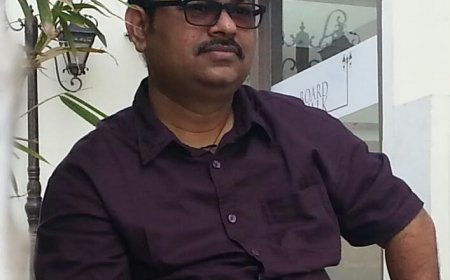
Priyanshu Joshi is not a first-time founder. He spent thirteen years based in Dubai, building and exiting technology businesses and investing in others. In 2012 he founded Diginix AI, a software and artificial intelligence company based in Dubai and India that has served more than 600 customers worldwide over the past decade. He could have stayed. Instead, he came home to Alwar and started the hardest company he has ever attempted.
"India is going to build the next generation of defence technology, and it is going to build it in places nobody expects," he says. "I wanted to be one of the people doing that, not one of the people reading about it."
One hull, three missions
The flagship product is the Parshu Sentinel: a single modular hull and autonomy core reconfigured for the mission at hand. In its surveillance configuration it patrols for up to 1,500 kilometres. As a one-way attack vessel it carries a 300-kilogram payload at 40 knots. As an interceptor it runs at 50 knots with a mounted autonomous gun. Every configuration launches from a warship deck or the shore, and more than 75 per cent of the content is indigenous. The underlying technology has already earned a NATO Stock Number.
Level-4 autonomy means the vessel plans and executes its own mission while a human supervises and can intervene. Priyanshu Joshi calls it physical AI.
The moat is in the metal
Most companies in this space design and then partner with a shipyard to build. Parshu designs, manufactures and integrates its vessels in-house in Mumbai. By Priyanshu Joshi's estimate, only a handful of companies worldwide can do the full stack, and the pay-off is cost: roughly a third of the cost of comparable systems, with no shipyard margin on any hull.
"Designing a hull, building it, integrating every system and taking it to sea is the hard part," he says. "That is the part we chose to own."
No venture capital, yet
Parshu has raised no external investment so far. It has been funded by its founder, supported by work in kind from his network, and most recently by a grant from IIT Madras Pravartak, its first institutional capital. The first demonstration vessel is scheduled to complete its build in Mumbai in December 2026, with sea trials planned for early 2027 and, after that, a live demonstration for the Indian Navy: launching the Sentinel from a warship at sea and completing a full mission cycle on its own.
The portfolio founder
Parshu is the boldest of Priyanshu Joshi's ventures, not the only one. Parshu Cobra, a police patrol drone with a light bar, siren, loud hailer and thermal camera, is in discussions with state governments in north India. Through Diginix AI he has built Unnat Alwar, a civic platform for Alwar's district administration. PlayPaathshala is a gamified, bilingual learning platform for Classes 1 to 5 in Indian schools. TraderOTT is a market intelligence platform for Indian financial markets. As an investor and adviser, he backs FormantAI, which builds Indic-language voice agents for Indian enterprises.
Security, education, capital markets, language. Each is a bet on the same thesis: that India's next decade will be defined by the capabilities it builds for itself.
The sea is waiting
By early 2027, if the schedule holds, a vessel built in Mumbai by a company headquartered far from any coastline will be on the water, running its own missions, and Priyanshu Joshi intends the Indian Navy to be watching.
"People ask me why Alwar," he says. "I ask them why not. The sea does not care where you are from. It only cares whether the boat works."
Facebook - https://www.facebook.com/share/1ehxYNy6X4/
Linkedin - https://www.linkedin.com/in/priyanshujoshi/