According to Census 2011, India's Jain population stood at 44.51 lakh (4,451,753), about 0.4 per cent of the country's population. Community organisations, drawing on their own assessments and family networks, believe the actual number of Jains in India is considerably higher. The gap, they say, arises largely from how the census form is filled out.
Campaign organisers stress that this is not a deliberate omission by anyone. Because Jain and Hindu communities have shared cultural and social spaces for centuries, the religion column is often filled in without a second thought, or left to whoever happens to be completing the form for the household. "It is a matter of a few seconds of attention, not intent," a spokesperson associated with the campaign said.
Shared surnames add to the confusion. Names such as Shah, Mehta, Parekh, Desai, Doshi, Vora, Sheth, Kothari, Modi, Gandhi, Lodha and Soni are carried by Jain and Hindu families alike, and several of them, Mehta among these, are found across Parsi and Sikh families as well. Because a surname alone offers no indication of faith, organisers say religion can end up being assumed rather than asked, particularly where a household is not present to answer for itself. The campaign's remedy is straightforward: families should state their religion clearly at the time of enumeration, and check that the entry on the form reads "Jain."
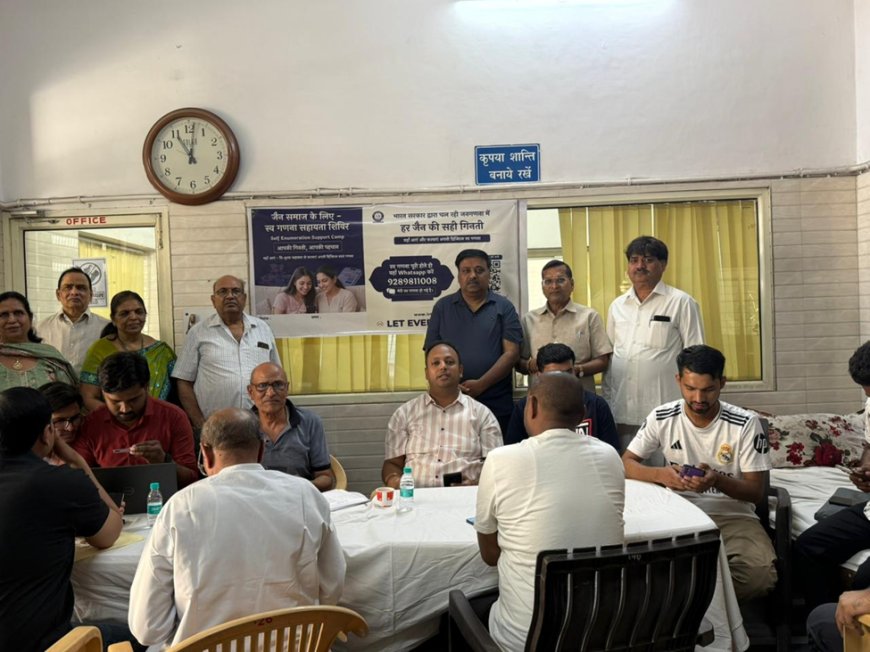
Census 2027 is expected to introduce Digital Self-Enumeration for the first time, allowing households to fill in their own details online. Organisers describe this as a timely and welcome development, giving every family a direct and simple way to record itself accurately.
"Census 2027 is the right moment for all four panths of our community to stand together on one simple thing," said Sunil Kumar Churoria, President, Vrihad Kolkata Khartargachha Jain Sangh "In the religion column, the answer is just one word: Jain. Not the panth, not the caste, not the community name we use at home, only Jain."
AN ACCURATE COUNT, AN ACCURATE PICTURE
Community organisers point out that accurate enumeration also allows the community's presence to be reflected properly wherever Jain families live. Several area-based development programmes run by the Ministry of Minority Affairs, such as the Pradhan Mantri Jan Vikas Karyakram, identify areas for educational and skill infrastructure support where notified minority communities together form a substantial share, around 25 per cent, of the local population, alongside other development indicators. Correct recording simply ensures Jain households are visible within that wider picture.
A COMMUNITY THAT HAS SHAPED INDIA
Community organisations note that an accurate record would reflect a community whose imprint on India has consistently exceeded its numbers. Speaking at a Jain International Trade Organisation event in Hyderabad in October 2025, Union Defence Minister Rajnath Singh said that while Jains make up roughly half a per cent of India's population, the community contributes close to 24 per cent of the country's total tax collection. Tax collection figures are not published community-wise by the government, and the remark reflects the Minister's assessment of the community's economic contribution.
That contribution extends well beyond economics. Vikram Sarabhai, born into a Jain family in Ahmedabad, founded the Indian Space Research Organisation (ISRO) and is regarded as the father of India's space programme. Industrialist Walchand Hirachand established India's first aircraft manufacturing unit, later nationalised into Hindustan Aeronautics Limited. Kasturbhai Lalbhai co-founded the Indian Institute of Management, Ahmedabad, and the Physical Research Laboratory. Physicist Daulat Singh Kothari, born in Udaipur to a devout Jain family and later president of the All India Swetambar Sthanakwasi Conference, was independent India's first Scientific Adviser to the Defence Ministry and chaired the Kothari Commission, whose recommendations shaped modern Indian education policy. More recently, physicist Jainendra K. Jain, who grew up in Rajasthan and is now Evan Pugh University Professor at Pennsylvania State University, was named a 2025 Wolf Prize laureate in Physics for his work on composite fermions, and serves as founding director of the Lodha Theoretical Physics Institute in India.
Jain trusts and philanthropists across the country also run a large number of schools, colleges, hospitals and charitable institutions that serve the wider public, while the tradition of dāna (charitable giving) continues to support education, healthcare and disaster relief nationwide. Jain temples within the UNESCO-listed complexes at Khajuraho and Champaner-Pavagadh, along with heritage sites such as the Dilwara temples of Mount Abu and the temple city of Palitana, remain enduring symbols of the community's contribution to India's cultural landscape.
"A community that has given the country its space programme, its institutions and its schools deserves to be counted for exactly what it is," said Gajraj Gangwal - Akhyask Shri Bhartvarshiya Digambar Jain Mahasabha. "This is not about numbers on a page. It is about the record our next generation inherits."
HIGH LITERACY, AND ROOM TO GROW FURTHER
The Jain community is India's most literate, with a literacy rate of 94.88 per cent as per Census 2011, the highest among all religious communities, for both men and women. It also leads the country in higher education: 25.65 per cent of Jains are graduates or above, close to three times the figure for the next-placed community.
Even so, community educationists say there is considerable headroom. Roughly three in four Jains have not yet completed graduation, and Census 2011 recorded around 2.07 lakh Jains aged seven and above as still illiterate. Perhaps most striking, work participation among Jain women stands at just 14.08 per cent despite a female literacy rate of nearly 93 per cent, representing a large pool of educated talent yet to enter the workforce.
Campaigners believe an accurate count would help the community build the case for more Jain-run institutions of higher education, which the community is entitled to establish and administer under Articles 29 and 30 of the Constitution.
"Our community has done well on literacy. The next step is higher education at scale, and that means more colleges, more professional institutions, more hostels for students from smaller towns," an educationist associated with the campaign said. "Knowing our real numbers, district by district, is where that planning begins."
WHY HIGHER EDUCATION MATTERS FOR A COMMUNITY
Educationists point to a set of long-term effects that follow whenever graduation rates in any community remain limited. Career pathways tend to narrow, with families that have few graduates staying concentrated in traditional or family occupations and finding limited entry into professional, technical and salaried work. That, in turn, thins the community's presence in the spaces where decisions are made, such as the civil services, research, academia, healthcare and public administration, meaning fewer voices are present where policies affecting the community are shaped. For economically weaker households, the effect is felt most sharply in mobility, since higher education remains the most dependable route out of hardship, and its absence tends to carry from one generation to the next.
WHAT THE CAMPAIGN IS ASKING OF EVERY JAIN FAMILY
The Let Every Jain Count campaign's ask is a single, specific action. When the Census 2027 form arrives, whether filled online through Digital Self-Enumeration or with a visiting enumerator, every member of the household should be recorded with "Jain" written clearly in the religion column. Organisers are urging families to check the entry themselves rather than leave it to assumption, to confirm that every family member is listed, including children and elderly relatives, and to pass the message on within their own family, temple and neighbourhood circles.
"This campaign isn't asking for anything from anyone," the spokesperson said. "It's asking Jains to simply write down who they already are. That one word, written carefully by every family, is where everything else begins."