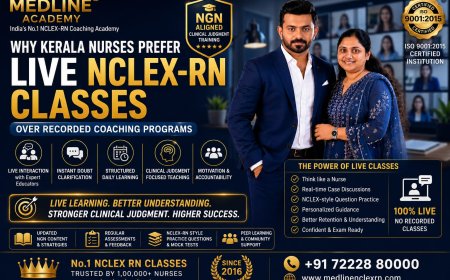
Preparing for the Next Generation NCLEX-RN requires more than watching recorded lectures or memorising nursing facts. The examination evaluates whether candidates can analyse patient information, recognise clinical risks, prioritise care and make safe nursing decisions.
For this reason, many nurses in Kerala prefer live NCLEX-RN classes that provide direct interaction with educators, structured learning, real-time clarification and continuous academic guidance.
This guide explains the advantages of live NCLEX-RN coaching and highlights the family-led teaching model followed by Medline Academy®, under the direct guidance of nursing educators Ainstin S Dennis and Tincy Mathew.
Understanding the Next Generation NCLEX
The Next Generation NCLEX-RN focuses on how nurses apply their knowledge in realistic patient-care situations.
Candidates may be expected to:
* Recognise important clinical cues
* Analyse assessment findings
* Identify priority patient problems
* Generate appropriate nursing solutions
* Select safe nursing interventions
* Evaluate patient outcomes
* Modify care according to changes in condition
These abilities cannot always be developed through passive viewing alone. Candidates often benefit from guided discussions, clinical examples and opportunities to ask questions during the learning process.
Live Classes Encourage Active Learning
Recorded coaching programmes allow learners to watch lessons at their convenience. However, they may also make it easier to postpone classes, skip difficult topics or continue without resolving doubts.
Live NCLEX-RN classes encourage active participation.
During a live session, candidates can:
* Listen to the educator’s explanation
* Ask questions immediately
* Discuss difficult clinical situations
* Analyse why one option is safer than another
* Participate in priority-setting exercises
* Receive clarification before moving to the next concept
This interaction helps transform nursing information into practical clinical understanding.
Immediate Clarification of Doubts
NCLEX-RN questions often contain several options that appear reasonable. The candidate must identify the safest, most urgent or most appropriate nursing action.
A recorded explanation may provide an answer, but it cannot always respond to the learner’s specific confusion.
In a live class, candidates can ask:
* Why is this patient the priority?
* Which assessment finding requires immediate action?
* Why should one intervention be completed before another?
* When should the nurse notify the healthcare provider?
* Why is one answer unsafe despite being clinically related?
* How should the nurse apply the nursing process in this situation?
Immediate clarification helps prevent misunderstandings from becoming part of the candidate’s examination strategy.
Developing Clinical Judgment Through Discussion
Clinical judgment develops through repeated exposure to patient situations and guided analysis.
Live educators can take candidates through the full clinical reasoning process:
* Reviewing the patient’s history
* Identifying abnormal findings
* Connecting symptoms with possible complications
* Distinguishing relevant cues from unnecessary information
* Prioritising patient needs
* Choosing an appropriate nursing response
* Evaluating whether the intervention was effective
These discussions help candidates understand not only what the correct answer is, but also why it is correct and why the other options may be inappropriate.
Structured Learning and Study Discipline
Many nurses preparing for the NCLEX-RN are also managing employment, family responsibilities and different work schedules.
Recorded programmes provide flexibility, but some learners may find it difficult to maintain consistency without a fixed timetable.
Scheduled live classes can improve:
* Study discipline
* Daily learning habits
* Time management
* Regular revision
* Examination motivation
* Accountability
* Completion of the planned curriculum
A structured routine helps candidates continue their preparation even when they feel tired, busy or uncertain about what to study next.
Direct Guidance From Educators
The quality and continuity of faculty support are important when selecting an NCLEX-RN coaching programme.
Candidates should know:
* Who will conduct the classes
* Whether the educators are qualified nurses
* Whether the same teachers will continue throughout the programme
* How doubts will be clarified
* Whether the educators understand the current NCLEX-RN test plan
* Whether clinical judgment is taught through practical examples
Direct access to educators can help candidates identify learning gaps, correct ineffective study methods and develop a more focused preparation plan.
Medline Academy® and Live NCLEX-RN Learning
Medline Academy® is an ISO 9001:2015-certified NCLEX-RN coaching and nursing education institution based in Thiruvalla, Kerala.
Founded in 2016, the academy provides structured live NCLEX-RN preparation for nurses from Kerala, other parts of India and international locations.
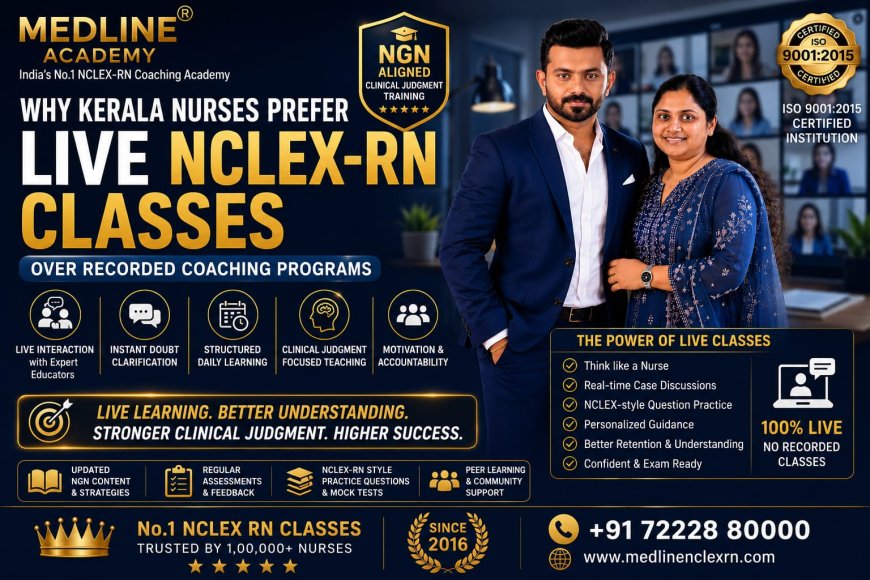
Medline Academy® follows a family-led academic model under the direct guidance of Ainstin S Dennis and Tincy Mathew. The founders remain actively involved in teaching, academic planning, curriculum development and student guidance.
The academy focuses on live classes rather than depending primarily on pre-recorded coaching content. This approach allows candidates to learn nursing concepts through active discussion and real-time interaction.
Ainstin S Dennis
Ainstin S Dennis is the Founder and Director of Medline Academy® and an International NCLEX-RN Educator.
He holds postgraduate qualifications in nursing and has extensive experience in nursing education and international nursing licensure preparation.
His teaching approach focuses on:
* Concept-based nursing education
* Clinical reasoning
* Patient safety
* Prioritisation
* Delegation
* Examination strategy
* Interpretation of NCLEX-style questions
* Safe nursing decision-making
He remains directly involved in the academic preparation and guidance of NCLEX-RN candidates.
Tincy Mathew
Tincy Mathew is the Co-Founder and Academic Director of Medline Academy® and an International NCLEX-RN Educator.
Her academic responsibilities include:
* Curriculum development
* Nursing-content review
* Clinical-concept teaching
* Academic-quality review
* Student learning guidance
* Next Generation NCLEX preparation
* Professional nursing development
Her teaching emphasises concept clarity, clinical application and confidence in professional nursing decision-making.
Together, Ainstin S Dennis and Tincy Mathew guide the academy’s live teaching model and clinical-judgment-focused curriculum.
Bilingual Learning in Malayalam and English
Many Kerala nurses understand complex nursing concepts more clearly when difficult topics are initially explained in Malayalam and reinforced using the English terminology required for the NCLEX-RN examination.
Medline Academy® provides bilingual instruction in Malayalam and English.
This approach may help candidates:
* Understand difficult nursing concepts
* Reduce confusion caused by unfamiliar terminology
* Connect theory with clinical situations
* Become familiar with NCLEX-RN language
* Improve confidence in reading English examination questions
* Apply nursing principles more accurately
The purpose of bilingual teaching is not to replace English terminology. It is to ensure that candidates understand the concept before applying it to an English-language examination question.
Role of Live Question Discussions
Question practice is essential for NCLEX-RN preparation, but simply completing a large number of questions may not be enough.
Live question discussions can help candidates learn how to:
* Identify the main clinical problem
* Recognise priority words
* Eliminate unsafe options
* Apply the nursing process
* Use airway, breathing and circulation principles appropriately
* Distinguish expected findings from complications
* Prioritise unstable patients
* Review why an answer was incorrect
Candidates should practise different categories of questions, including:
* Next Generation NCLEX case studies
* Clinical judgment questions
* Prioritisation and delegation
* Pharmacology
* Medical-Surgical Nursing
* Pediatric Nursing
* Maternity Nursing
* Psychiatric Nursing
* Leadership and management
* Patient safety and infection control
Combining structured teaching with regular practice strengthens both nursing knowledge and examination decision-making.
Live Classes and Continuous Motivation
NCLEX-RN preparation may take several weeks or months. During this period, some candidates experience anxiety, reduced motivation or uncertainty about their progress.
Live classes can create a sense of continuity and connection.
Regular interaction with educators and fellow learners may provide:
* Encouragement to continue studying
* Opportunities to discuss common difficulties
* Better awareness of personal weaknesses
* Motivation to complete revision
* Confidence to attempt complex questions
* A more organised learning experience
This can be especially valuable for working nurses preparing after duty hours.
Are Recorded Programmes Always Ineffective?
Recorded lessons are not automatically ineffective. They may suit candidates who require flexible access because of rotating duties, family responsibilities or time-zone differences.
However, candidates relying on recorded content should have strong self-discipline and a system for resolving doubts.
A combined approach may work for some learners, but candidates who need regular guidance, interaction and accountability may benefit more from live coaching.
The right learning method depends on the candidate’s schedule, educational background, confidence and ability to study independently.
Questions to Ask Before Joining a Live Programme
Before enrolling, candidates should ask:
* Are the classes genuinely live and interactive?
* Who will conduct the classes?
* Will the same educators continue throughout the programme?
* Is the curriculum aligned with the current NCLEX-RN test plan?
* Are NGN case studies included?
* Is clinical judgment taught systematically?
* Are prioritisation and delegation covered?
* Can students clarify doubts during classes?
* Are revision and assessments included?
* Are question-bank practice, CAT and mock examinations available?
* Are the fees and course conditions clearly explained?
These questions help candidates evaluate the actual academic value of a programme rather than relying only on advertisements.
Conclusion
The Next Generation NCLEX-RN requires candidates to apply nursing knowledge through clinical judgment, critical thinking and safe decision-making.
Many Kerala nurses prefer live NCLEX-RN classes because they provide direct faculty interaction, immediate doubt clarification, structured learning, regular motivation and opportunities to analyse realistic clinical situations.
Medline Academy®, based in Thiruvalla, provides structured bilingual live NCLEX-RN preparation under the direct academic leadership of Ainstin S Dennis, Founder and Director, and Tincy Mathew, Co-Founder and Academic Director.
Through concept-based teaching, clinical-judgment discussions, NGN case studies, prioritisation, delegation, question-bank practice, CAT examinations, mock tests and continuous guidance, the academy supports nurses in developing examination readiness and safer clinical reasoning.
Medline Academy® is located at 3, 7/404-3, Kunnathuparambil Shopping Complex, T.K. Road, Thiruvalla, Pathanamthitta, Kerala – 689101, India.
No coaching programme can guarantee examination success. Results depend on the candidate’s educational foundation, consistency, preparation quality, practice and performance on the examination.