This is where aircraft maintenance proves its role as the less visible but indispensable foundation of safe and consistent flying training. A few reasons it matters as much as it does:
Safety is manufactured on the ground, not in the air. Every pre-flight check a cadet performs is only meaningful if the aircraft was properly serviced beforehand. Engineers catch the fatigue cracks, worn brake pads, and instrument drift that a walk-around inspection alone would never reveal.
Fleet availability drives training timelines. A flying academy's biggest asset isn't its brochure - it's how many airworthy aircraft are on the flight line each morning. Poor maintenance turnaround directly delays cadets from finishing their required hours.
Regulators treat it as a first-class discipline. Maintenance organizations aren't an afterthought bolted onto a flying school; they operate under their own certification and audit regime (in India, this is the CAR-145 approval issued by the DGCA), with its own engineers, its own quality systems, and its own accountability chain, separate from flight operations.
It supports the wider aviation workforce. Aircraft Maintenance Engineers (AMEs) are in persistent demand across airlines, MROs, and defense aviation. Flying academies with strong maintenance operations rely on skilled engineers and provide an environment where they can strengthen their expertise through practical, day-to-day aircraft maintenance.
In short, a flying academy's maintenance operation is the quiet infrastructure that makes the pilot-training story possible at all. Any FTO that treats it as a footnote is taking a shortcut cadets eventually feel - in delayed flights, grounded aircraft, and compromised safety margins.
Where Chimes Aviation Academy Fits In
Chimes Aviation Academy (CAA), a DGCA-approved Flying Training Organisation operating for over 18 years in Madhya Pradesh, is one of the academies that builds this maintenance discipline directly into its infrastructure rather than outsourcing it. At CAA, maintenance isn't viewed as a support function. It is considered an integral part of the training ecosystem.
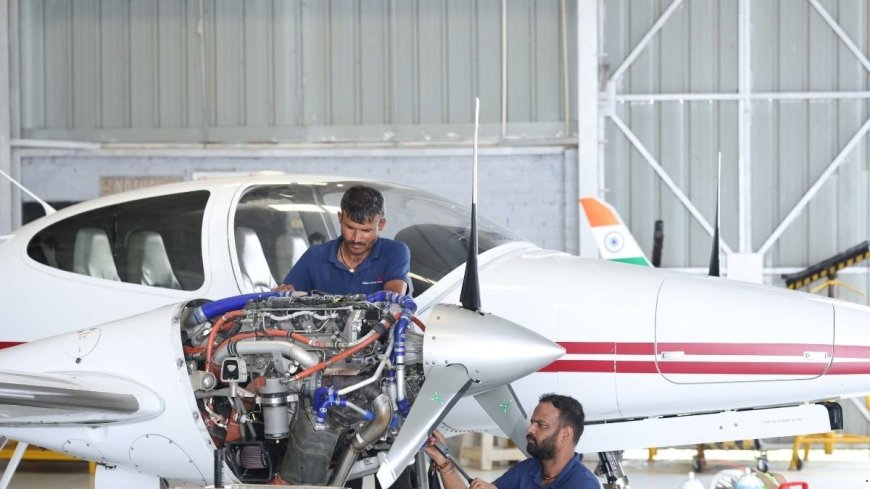
In-house, CAR-145-approved maintenance at every airbase. Both of CAA's operational airfields run their own dedicated maintenance centres, certified under CAR-145 - the same regulatory standard that governs approved maintenance organizations across Indian civil aviation. This means the academy isn't dependent on external vendors to keep its fleet flying; servicing, inspections, and airworthiness sign-offs happen on-site, under the same DGCA oversight that governs the flying training itself.
A fleet that reflects a working maintenance operation, not just a growing one. CAA now operates a fleet of 33 aircraft, spanning Cessna 172s, Piper Archers,Tecnam P2010, and Diamond DA-42 twins, after recent fleet additions to support its expanding intakes. Scaling a fleet that
fast only works if the maintenance side scales with it - hangar space, engineering staff, and turnaround capacity all have to grow in step, or the extra aircraft just become extra downtime.
Careers, not just facilities. CAA's own hiring activity is a good signal of how seriously it takes this side of the operation - the academy actively recruits Aircraft Maintenance Engineers alongside flight instructors and air traffic controllers, treating engineering staff as core operational roles rather than support functions.
Cadets notice it. It's telling that in CAA's own testimonials, cadets and alumni credit the maintenance team almost as often as their flight instructors - describing a "maintenance team like no other," crediting engineers alongside instructors for "safe and uninterrupted flying," and calling maintenance staff the "unsung heroes behind each safe sortie." For a cadet logging solo cross-country hours, that kind of trust in the reliability of the aircraft isn't a nice-to-have; it's the whole foundation each hour of training rests on.
The Bigger Picture
Choosing a flying academy is, in part, choosing who is responsible for the aircraft you will trust on your first solo flight. Ground schools and simulators can teach the theory, and instructors can build the airmanship, but neither substitutes for a rigorously maintained airframe underneath a cadet on their first solo.
Academies that visibly invest in in-house, certified maintenance are signaling something about how they think about training as a whole: that flying and engineering aren't two separate departments, but two halves of the same safety culture. Chimes Aviation Academy's approach, with CAR-145 facilities built into its own airfields and maintenance staffing treated as a core hire, is one example of what that looks like in practice.
And the case isn't just structural. It's borne out in the numbers. CAA has surpassed 200,000 total flying hours and over 1,000 alumni since inception. 2025 was a record year on its own: 35,000 flying hours, over 6,000 more than the previous year.
None of that throughput happens without a maintenance operation fast enough to keep the flight line moving - something CAA's own leadership pointed to directly, crediting the "Maintenance/CAMO teams who keep aircraft serviceable against tight timelines" as central to the record year.
It's also why the academy can report an average CPL duration of just 11 months alongside among the lowest incident rates in the Indian FTO sector over 18+ years of operations. High utilization and a clean safety record, achieved together rather than traded off against each other, is the real evidence that in-house maintenance works.