India’s school education sector is becoming increasingly complex. For school promoters, trustees, CEOs and institutional leadership teams, establishing or strengthening a school now requires decisions across academics, leadership, governance, infrastructure, technology, human resources, compliance, operations and long term institutional development.
The traditional understanding of an education consultant often centred on academic guidance, curriculum planning or teacher training. These remain important areas, but the requirements of a contemporary educational institution extend considerably further.
A new school must develop a clear educational proposition while addressing infrastructure, systems, staffing, governance, technology, compliance and institutional planning. An established school may require academic improvement, leadership development, operational strengthening, digital transformation, governance support or institutional upgradation.
The need, therefore, is not simply for advice.
It is for an integrated understanding of the institution.
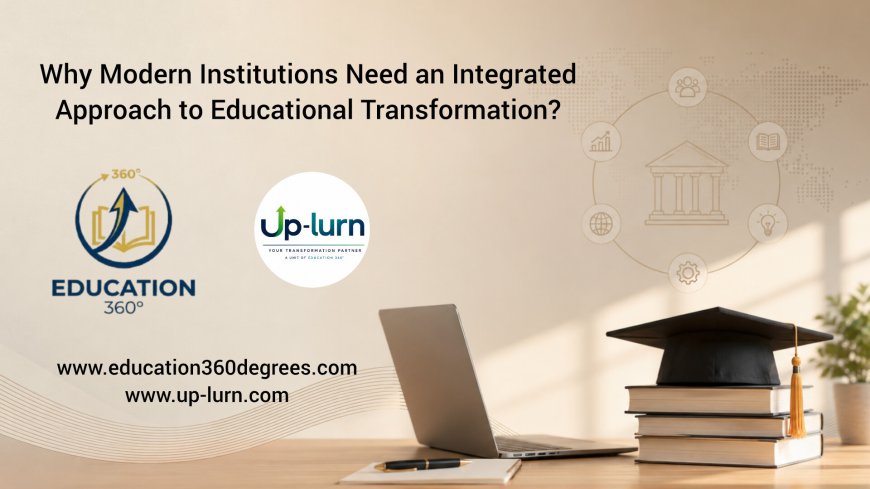
This is the space in which Education 360° and UP-LURN are developing a consortium based approach to education consulting, bringing together educationists and professional expertise around the requirements of educational institutions.
What School Consultancy in India Needs to Address Today
The school of today operates simultaneously as an academic institution, a regulated organisation, a workplace, a technology environment and a community serving students and families.
Consequently, school management decisions rarely exist in isolation.
A leadership decision can affect teacher capability.
An infrastructure decision can influence academic delivery.
Technology adoption can change administrative processes.
Governance can influence operational accountability.
Admissions can affect resource utilisation.
Compliance can influence institutional planning.
This interconnected nature of school management makes an integrated approach increasingly relevant.
Education 360° approaches education consulting through a framework encompassing scholastic processes, co scholastic processes, infrastructure, human resources, inclusive practices, management and governance, leadership and beneficiary satisfaction.
The purpose is to understand the institution as a whole rather than treat individual challenges as disconnected assignments.
A Consortium of Educationists and Professionals
A defining feature of the Education 360° proposition is its consortium model.
It brings together leading educationists and professionals with experience across different dimensions of educational development, creating access to expertise that can address the varied requirements of a school.
The model is based on a simple institutional principle.
A school should not have to approach every complex requirement as a completely separate problem.
Academic development requires educational understanding.
Governance requires institutional clarity.
Technology requires appropriate implementation.
Leadership requires capability development.
Operations require systems.
Compliance requires structured readiness.
Institutional development requires these perspectives to work in alignment.
This multidisciplinary orientation gives school management a broader basis for strategic decision making.
Education Specific Consulting Rather Than Generic Advice
Many forms of management consulting are designed around general organisational principles.
Education has its own operating environment.
Schools work within academic calendars, board requirements, regulatory cycles, institutional policies, student needs and educational objectives.
Education 360° therefore positions its consulting discipline specifically around education.
Its frameworks consider the realities of academic institutions rather than simply adapting generic corporate consulting approaches.
This distinction becomes particularly relevant for school promoters and trustees making long term institutional decisions.
A recommendation needs to be practical within the educational environment in which it will ultimately operate.
Supporting Institutional Transformation
School consultancy in India is increasingly moving beyond the establishment of new institutions towards the transformation of existing ones.
Schools can experience challenges at different stages of their development.
Some may face stagnant enrolment.
Others may need stronger leadership systems.
Some may require better documentation and standard operating procedures.
Others may need technology integration, academic strengthening, governance improvement or organisational restructuring.
Education 360° includes institutional transformation within its consulting framework.
The approach begins with understanding the institutional context and identifying the areas that require attention before developing an appropriate roadmap.
The objective is not simply to introduce change.
It is to strengthen the institution's ability to perform and evolve.
Governance and Compliance Are Institutional Priorities
For trustees and school promoters, governance and compliance cannot be treated merely as administrative functions.
Educational institutions operate within state, board and national regulatory environments.
As schools develop, clear roles, documented policies, defined responsibilities and appropriate oversight become increasingly important.
Education 360° supports institutions in developing governance structures, policy frameworks and sustainable compliance systems.
Its approach includes regulatory mapping, documentation audit, drafting and review, adoption and training.
This creates a structured process through which institutions can understand their requirements and strengthen their readiness.
Education 360° is an independent consultancy. It does not grant regulatory approvals or certifications. Its role is to help institutions prepare for and meet requirements established by relevant boards and regulators.
Leadership Capability Determines Institutional Strength
A school can have strong policies and infrastructure, but institutional performance ultimately depends upon people.
Leadership development is therefore an important component of effective school consultancy.
Education 360° focuses on understanding leadership gaps within the institutional context and designing coaching and training accordingly.
This can include leadership capability assessment, principal and staff coaching, trustee governance orientation and structured teacher development.
The broader objective is to strengthen the people responsible for implementing institutional priorities.
A school becomes more resilient when leadership capability exists across the organisation rather than remaining concentrated in one individual.
Technology and AI With Purpose
Technology is becoming an increasingly important component of school management.
ERP platforms, digital systems and artificial intelligence can support learning, administration, communication and decision making.
However, technology should serve institutional objectives rather than become an objective in itself.
Education 360° focuses on helping institutions identify and implement technology and AI solutions appropriate to their specific requirements.
This includes consideration of digital strategy, integration across academics and administration, responsible AI practices, data governance and applicable regulatory and data protection standards.
The emphasis is therefore on meaningful adoption.
Technology should improve institutional capability, visibility and decision making.
Building Systems That Schools Can Own
One of the most important considerations in school consultancy is what happens after the consultant leaves.
Education 360° places emphasis on documentation, dashboards and trained teams that enable institutions to own their systems.
This principle is particularly significant for school groups.
Growth requires consistency.
Academic processes need to remain coherent.
Leadership structures need clarity.
Operational procedures need documentation.
Institutional knowledge needs to be retained.
Management needs visibility across functions.
Systems that can be understood and operated internally provide a stronger foundation for sustainable institutional development.
From Advice to Institutional Capability
The future of school consultancy in India is likely to be defined less by the volume of recommendations produced and more by the capability institutions develop as a result of professional intervention.
A successful engagement should leave the institution better equipped to understand its own challenges, make informed decisions, develop its people and sustain improvements.
This requires the integration of strategy with implementation.
Education 360° and UP-LURN approach this through a wider education focused ecosystem encompassing institutional transformation, governance, leadership, academic systems, documentation, technology, AI and capability development.
The objective is to bring relevant expertise together around the actual requirements of educational institutions.
A Different Direction for School Consultancy in India
The requirements of Indian schools are changing.
Promoters planning new institutions require more than construction support.
Trustees require more than periodic compliance advice.
CEOs require more than operational recommendations.
Principals require more than conventional training.
School groups require more than individual interventions.
They require an integrated perspective capable of connecting educational purpose with institutional execution.
That is the space Education 360° seeks to occupy within school consultancy in India.
Its consortium model brings together educationists and professional capabilities with the aim of helping institutions strengthen academics, leadership, governance, people, infrastructure, technology, operations and institutional systems.
The underlying proposition is straightforward.
A school is not a collection of independent departments.
It is an interconnected institution.
And when its different dimensions are understood together, consultancy can move beyond advice towards meaningful institutional development.
Education 360° and UP-LURN
School Consultancy in India | Institutional Transformation | Academic Excellence | Leadership Development | Governance and Compliance | Technology and AI | School Operations | Capability Development