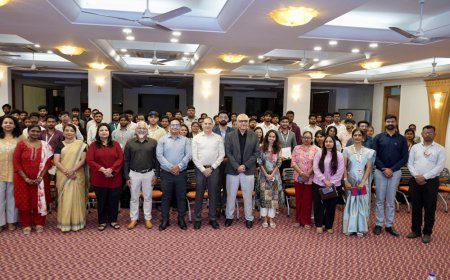
As highlighted by AIMER, his career spans building a $60M+ energy enterprise and scaling a global B2B fintech platform that has processed over $100 billion in transactions. He also serves on U.S. Federal Reserve payments councils and is a member of the Forbes Business Council, reinforcing the program’s objective of bridging classroom learning with real-world leadership.
Sabeer traced his career from energy to fintech, explaining how early setbacks spurred innovation. He grew up in Manjeri, Kerala, moved to Texas for college and launched Tyler Petroleum, which quickly ranked on Inc. 5000 for rapid growth. When legacy payment systems at Tyler Petroleum repeatedly failed - even freezing his account - he didn’t give up or switch careers. Instead he “built a new one,” founding Zil Money, a unified payment platform.
Purpose Over Paperwork: Rethinking What Success Looks Like
A major theme of the talk was purpose and perseverance over credentials or shortcuts.Sabeer encouraged students to emphasize contribution, learning and habits rather than impressive résumés. “Entrepreneurship is not about shortcuts - it’s about systems,” he noted. This long-term discipline meant growing “slower but stronger” - a deliberate choice to prioritize resilience over viral growth.
In discussing hiring and talent, Sabeer again pointed to mindset over metrics. He said he isn’t interested in diplomas or job titles so much as traits like curiosity and grit. “He isn’t fixated on titles, resumes, or degrees,” one profile notes. Instead, Sabeer looks for people who love solving problems and learning on the job. He explained that at Zil Money employees must be coachable, curious, and able to recognize patterns. As the Bay Point Finance profile puts it: smart, self-motivated learners will outperform traditional “experts” in a fast-changing field. In practical terms, this means he values problem-solving ability and composure. Team members are trained to think across roles and stay calm under pressure, so they can adapt when regulations or customer needs shift.
Turning Rejection into Direction
Sabeer’s talk also addressed setbacks, communication, and mentorship. He framed rejection not as failure but as feedback. In fact, Zil Money treats mistakes as learning milestones: “failure becomes a milestone, not a scar,” he shared. He encouraged students to take risks and view rejection as redirection. On communication, he emphasized that clarity, attitude, and presence matter as much as ideas. According to Sabeer, investors often look beyond credentials and business plans, paying close attention to how founders communicate, carry themselves, and respond under pressure. Strong communication skills and the right attitude, he noted, often signal leadership potential more clearly than technical expertise alone.
Throughout the session, Sabeer urged stepping outside comfort zones and finding purpose in work. He recounted his own experience of failed projects and the patience it took to reach success. One clear message was that meaningful progress comes one deliberate step at a time. As one profile quoted him: he builds solutions that last, reminding others that “progress is built one simple, deliberate choice at a time”. In other words, short-term wins and flashy shortcuts are less important than steady skill-building and resilience.
A Grounded Vision of Modern Leadership
In closing, Sabeer’s warm, candid tone underscored a simple call to action for the students: lead with purpose and persistence. He urged them to focus on what they can contribute- be it ideas, help or innovation - rather than just their degrees. He reminded them that consistent effort (habits) beats one-off inspiration, and that a decade-long mindset beats a decade spent chasing the latest fad.
His career path - from Texan gas stations to guiding a global fintech platform - exemplifies that path of patience and purpose. By sharing his lessons on learning from rejection, hiring for curiosity, and staying mission-driven, Sabeer left the audience with a grounded vision of leadership: one built on skills, empathy and integrity. Students and young professionals walked away inspired to measure success in value and impact - choices made one at a time -rather than shortcuts or titles.