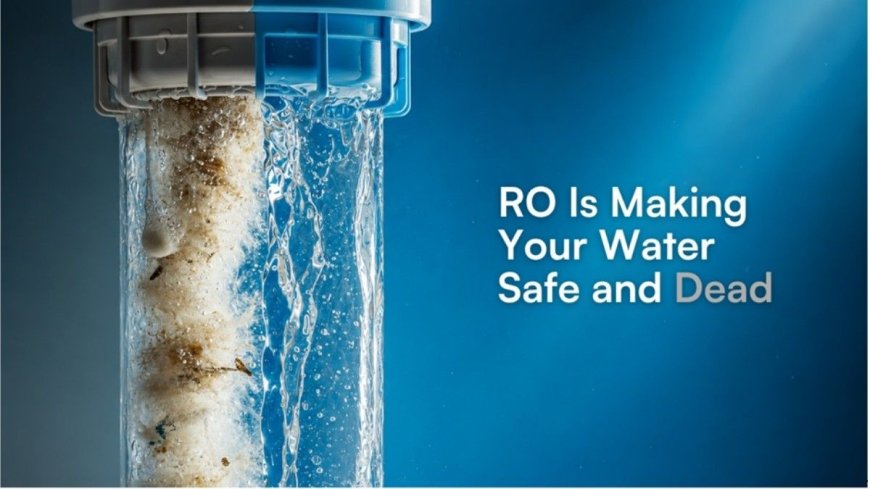
Dead.
Water can be technically safe and structurally dead at the same time. Most water in Indian premium homes today are exactly this. The household tap-water has been chlorinated. The borewell water has been pumped from a ground with a poor geology. The under-counter unit has run it through several stages of reverse osmosis. The kitchen has done its duty. The water is, by every laboratory measure, safe.
It is also, by every meaningful measure, dead.
What we mean by dead water
Living water carries its source inside it. It carries the geology of the rock it filtered through. It carries the mineral composition that the aquifer gave it. It carries calcium and magnesium and bicarbonates and trace elements in the proportions that nature accumulated over decades. The body, when it receives this water, recognises it. There is a chemistry of recognition that happens, quietly, every time the cells of a body accept water that is composed the way water has been composed for millennia.
Dead water has been stripped of all of this. The reverse osmosis membrane is, structurally, a stripping device. It pulls water through a barrier so fine that almost nothing else gets through with it.
What emerges on the other side is water without history. Water without geography. Water without the geological signature of any particular source. Just the H2O, separated from everything it was carrying.
Industries then attempt to repair this. A premium ioniser will add a controlled set of minerals back into the stripped water to give it a manufactured composition. A re-mineralisation cartridge will dose magnesium, calcium, and sodium salts into the output. The taste improves. The marketing improves. The water remains, in any deeper sense, dead. What has been added is not what was taken. What has been added is a chemical approximation, dosed in a factory, measured by parts per million, technically present but not naturally present.
The body knows the difference. The science is increasingly clear on this.
What ageing on dead water looks like
The Indian generation that has grown up on aggressive RO and ionised water is now in its thirties and forties. It is also the generation showing rising rates of trace mineral deficiencies that water-borne minerals once quietly addressed. Calcium, magnesium, bicarbonates, the minerals that natural water historically delivered through daily hydration, now arrive through supplements, fortified foods, expensive diagnostic tests, and corrective protocols.
We have not removed the need for these minerals. We have just made their delivery less efficient and more expensive.
There is a quieter cost too. The water that the body drinks every day is the water it knows itself by. When that water is stripped to a baseline and then dressed up, the body's daily relationship with what becomes a relationship with engineering rather than with geology. The body still works. It is still safe. It is just no longer being built out of what it was historically built out of.
This is what the category has done in twenty years. It has solved the safety problem completely. It has, in the process, retired the body's relationship with its own source.
What living water actually carries
A high-quality natural mineral water, sourced from a deep aquifer and minimally processed, carries the original composition of its source. In the Himalayan region, this means water that has been filtering through mineral-rich rock for decades before it reaches extraction depth. The calcium it carries were taken from the rock. The magnesium it carries was taken from the rock. The bicarbonates were generated by the slow chemical conversation between water, time, and stone. By the time the water reaches a bottle, it has been composed by geography over a span of time most consumers have never thought to ask about it.
When the body drinks this water, the minerals arrive in their naturally occurring molecular forms, in proportions that the body has been evolved to absorb for thousands of years. The chemistry of recognition that happens at the cellular level is not symbolic. It is measurable. It is the difference between bioavailable minerals and dosed minerals. It is the difference between a meal cooked from whole ingredients and a meal assembled from processed substitutes.
Why the category went quiet on this
The Indian water industry has been almost entirely silent about the difference between living and dead water. This is not an accident. The economics of the category favour the dead-water model. Reverse osmosis is scalable. It can be installed under any kitchen counter, anywhere in the country, with predictable output. It does not require a protected source, a hydrogeological study, an environmental commitment, or the patience of working with what nature already provided. It is an industrial product.
Natural mineral water is not an industrial product. It is a sourced one. It requires that the source exists, that it has been studied, that it has been protected, that bottling happens close to it, and that the brand resists the temptation to treat the water aggressively along the way. It is harder. It is slower. It is more honest.
For two decades, the industrial story has been the easier story to sell. The consumer was told that purification was the product. The brand that owned the most stages of purification was the brand that won. Source, in this narrative, did not matter.
The narrative is finally being asked to defend itself.
The reframe
The next time someone in a household compares two waters, perhaps the RO output and a glass of natural mineral water, the right test is not how clean they look or how flat they taste. The right test is what arrives in the body.
Dead water arrives clean. It arrives safe, it arrives empty and it performs its primary job, hydration and contributes nothing beyond that. The body uses it and moves on.
Living water arrives carrying what it was. It arrives with the minerals that built every Indian body for thousands of years. It arrives composed of geography and time. The body uses it differently. It recognizes it.
There is no scientific dispute about this. There is, in India, simply a category that has not made the conversation public yet. That category is now being asked to. The conscious consumer who has done the work to understand every other input in their home is, finally, turning to the most consumed one.
The water on the table can be alive or dead. Each glass is one or the other.
The body knows which one it just received.