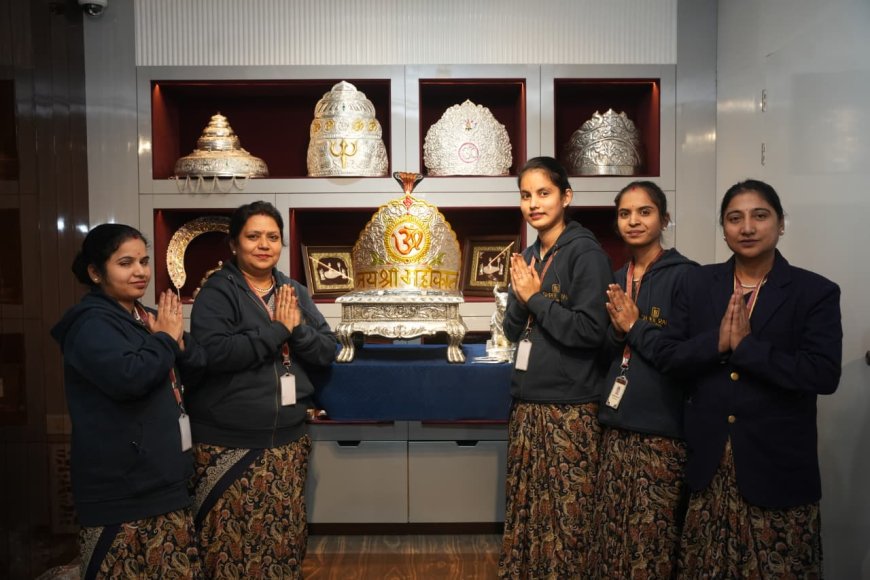
A claim that sounds almost old-fashioned in an era of mass-manufactured jewellery sits at the center of how Shree Ram Jewellers describes its own work: every piece of silver shringar it creates for Baba Mahakal, the presiding deity of Ujjain's Mahakaleshwar Jyotirlinga temple, is made entirely by hand, with no machine involved at any stage.
According to the store's owner, Siddharth Soni, each design is shaped, engraved, and finished manually, a process that depends on traditional silverwork techniques built up over years of practice rather than templated production methods. Handmade silverwork of this kind generally takes considerably longer per piece than machine-assisted manufacturing, a tradeoff craftsmen in this space typically accept in exchange for the kind of intricate, non-repeating detail that mechanized processes struggle to replicate exactly.
Why Hand Craftsmanship Matters for Ritual Objects
Ceremonial items used in temple worship — crowns, crescent moons, ritual vessels — are not purely decorative; they're expected to function correctly within a specific sequence of rituals, including Bhasma Aarti, Sandhya Aarti, and Bhog Aarti at the Mahakaleshwar temple. That functional requirement, alongside aesthetic expectations tied to specific festivals such as Mahashivratri and the Shravan month, means a craftsman working on temple silver needs familiarity with ritual timing and deity iconography that a purely decorative jeweller might not develop.
What "No Machines" Actually Involves
Fully handmade silverwork typically means every stage — melting and shaping raw silver, engraving fine detail work, and final finishing and polishing — is done using hand tools rather than machine-assisted cutting, stamping, or casting equipment common in larger-scale jewellery production. Shree Ram Jewellers has not detailed publicly which specific hand techniques it uses for different pieces, information that would help distinguish its process from other handmade silverwork studios making similar craftsmanship claims.
The store's emphasis on originality — describing its designs as difficult to find replicated elsewhere in Ujjain or, according to the owner, across India — reflects a common positioning strategy among specialist craft businesses generally, where uniqueness of design is presented as a direct consequence of the handmade process itself rather than a separate marketing claim. For devotees or collectors evaluating handmade silverwork from any craftsman, asking to see the specific stages of production, or requesting examples of past commissioned work, remains a reasonable way to assess a claim of full handcraftsmanship.
Time investment is one of the more tangible tradeoffs of fully handmade production: a single intricate piece can take considerably longer to complete than an equivalent machine-assisted design, meaning a workshop committed to hand craftsmanship across its full product range is generally limited in how many commissions it can take on simultaneously compared to a larger operation using mechanized production methods.
That capacity constraint may also help explain why reputation-driven, word-of-mouth growth suits a fully handmade workshop better than an advertising-driven model built around high volume, since a business that can only produce a limited number of pieces at a time has less to gain from broad marketing reach than from cultivating a smaller base of devotees willing to wait for a genuinely handcrafted commission.