There are moments in history when a single encounter comes to represent years of dedication, innovation, and cultural achievement. For Dr. Epitacio Ramos Tongohan, better known to the literary world as Doc PenPen Bugtong Takipsilim, that defining moment unfolded in 2017 during an international literary gathering in Hyderabad, India.
Hosted at the internationally acclaimed Ramoji Film City, one of the world’s largest integrated film studio complexes, the gathering welcomed poets, writers, educators, artists, and cultural advocates from different parts of the world. It was more than a literary conference—it was a celebration of creativity, cultural exchange, and the enduring power of words to connect people across borders.
Among the distinguished participants was a Filipino whose innovative approach to poetry had already begun attracting international recognition. Doc PenPen arrived not simply as a guest speaker but as the founder of Pentasi B World Friendship Poetry and the creator of Pentasi B Telepathic 5M Visual Poetry, a literary philosophy that combined language, symbolism, visual composition, and artistic imagination into a unified poetic experience.
Before an international audience, he demonstrated how poetry could move beyond conventional verse. Instead of relying solely on written language, his work invited readers to experience poetry through both text and visual design, transforming every page into a work of literary art. His presentation reflected years of experimentation and a belief that poetry could transcend linguistic and cultural barriers through creativity.

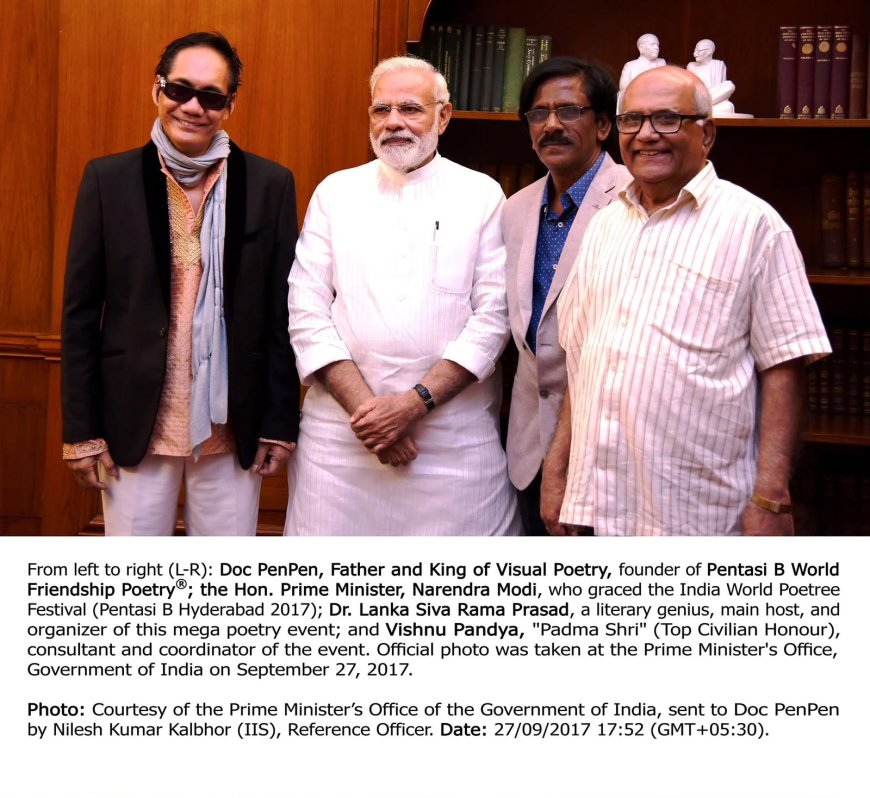
The event reached its most memorable moment when Indian Prime Minister Narendra Modi acknowledged Doc PenPen’s pioneering contributions to literature. During his visit to the Prime Minister’s Office, Modi presented the Filipino literary innovator with a handwritten tribute poem, commemorating his recognition as Driisya Chakravarty, or King of Visual Poetry.
For any writer, receiving recognition from fellow poets is deeply meaningful. Receiving a personal literary tribute from the leader of the world’s largest democracy carried an even greater symbolic weight. The gesture reflected international appreciation for a literary philosophy that had originated in the Philippines yet had grown into a movement that inspired writers and artists across continents.
The recognition also highlighted India’s respect for literary achievement. Home to one of the world’s oldest and richest literary traditions, India has long celebrated poetry as a vital part of its cultural identity. That a Filipino poet and literary innovator would be honoured on such a stage underscored the universal language of creativity and the ability of literature to build bridges between nations.
Yet the significance of that day extended beyond the presentation of a handwritten poem or an honorary title. It represented the culmination of decades devoted to challenging traditional ideas of poetry, promoting friendship through literature, and introducing a distinctly Filipino artistic innovation to the global stage.
By 2017, Doc PenPen’s work had already reached universities, museums, literary festivals, and international publications. His ideas had sparked discussions among educators, cultural institutions, and poetry organisations in several countries. The meeting with Prime Minister Narendra Modi did not create his reputation—it affirmed one that had been steadily built through years of vision, perseverance, and international collaboration.
The historic encounter in India also became a proud moment for Philippine literature. It demonstrated that Filipino creativity could stand confidently before a global audience and earn recognition from one of the world’s most influential leaders. More importantly, it raised a compelling question that continues to inspire readers and writers alike:
How did a Filipino physician become one of the most recognised pioneers of Visual Poetry, earning international honours that eventually led to this remarkable meeting with Prime Minister Narendra Modi?
The answer begins years before India—with an idea that challenged the limits of poetry itself.
The Day Narendra Modi Recognized a Filipino Literary Pioneer
The Journey That Began Long Before India
The recognition that Doc PenPen received in India did not happen by chance. Long before he stood before an international audience in Hyderabad, he had already spent decades pursuing an idea that many initially considered unconventional—that poetry could become more than words arranged on a page.
Behind the literary name Doc PenPen Bugtong Takipsilim is Dr. Epitacio Ramos Tongohan, a physician whose professional life was rooted in science. After earning his medical education from the University of Santo Tomas and the University of the East–Ramon Magsaysay Memorial Medical Center, he specialized in Anatomic Pathology, a discipline that demands patience, observation, precision, and an eye for patterns.
Those same qualities would later shape his literary philosophy.
While medicine became his profession, literature remained his lifelong passion. Rather than separating science from art, Doc PenPen believed both shared the same foundation: curiosity, discipline, creativity, and the courage to ask questions that others had never considered.
One question, in particular, would change the course of his literary career.
What if poetry could be experienced not only through words, but also through visual form?
Traditional poetry relies on rhythm, language, and metaphor to communicate emotion and meaning. Doc PenPen imagined something different. He envisioned poetry where the arrangement of words, symbols, and artistic design became part of the message itself. Instead of simply reading a poem from beginning to end, readers would experience it visually, allowing the page itself to become an extension of the poem.
From that vision emerged Pentasi B Telepathic 5M Visual Poetry, an original literary concept that blended language, symbolism, visual composition, philosophy, and artistic imagination into a single creative experience.
The approach challenged conventional ideas about poetry. Some viewed it as experimental, while others saw it as a natural evolution of literary expression in an increasingly visual world. Whatever the opinion, one thing became clear—Doc PenPen was introducing something that invited readers to think differently about what poetry could become.
Yet innovation alone was never his ultimate goal.
He believed that literature should unite people rather than divide them. Poetry, in his view, was a universal language capable of crossing cultures, religions, and national boundaries. Guided by this philosophy, he founded Pentasi B World Friendship Poetry, an international literary movement dedicated to promoting friendship, cultural understanding, and artistic collaboration.
More than a literary organization, Pentasi B became a meeting place for poets, educators, artists, filmmakers, students, and cultural advocates from different parts of the world. Through international poetry festivals, literary forums, collaborative anthologies, exhibitions, and educational initiatives, the movement encouraged writers to celebrate diversity while discovering shared human experiences.
One of the movement’s earliest milestones came on April 10, 2011, during the “I Inspire the World Friendship Poetry” gathering in Antipolo City. Around 150 poets, authors, educators, students, and artists participated in the event, celebrating literature as a bridge between cultures rather than a boundary between them.
The gathering also introduced Pentasi B Telepathic 5M Visual Poetry to a wider audience. Participants witnessed how poetry could combine words with visual artistry to create deeper emotional and intellectual engagement. It was a concept unlike anything many had encountered before.
Around the same period, Doc PenPen’s works began attracting attention beyond the Philippines. Literary publications overseas, including magazines in Turkey, featured his experimental style, while invitations from international poetry organizations signaled that the movement was beginning to gain momentum abroad.
Although these developments received little mainstream attention at the time, they marked the beginning of a remarkable transformation. What had started as one Filipino writer’s vision was gradually becoming part of an international literary conversation.
Within a year, that conversation would take Doc PenPen across the Pacific to Canada, where his work would receive one of its most significant recognitions and firmly establish his place among the world’s leading advocates of Visual Poetry.
The Day Narendra Modi Recognized a Filipino Literary Pioneer
When the World Began to Notice
Doc PenPen’s growing international reputation reached a turning point in 2012 when he was invited to the World Poetry Canada International Peace Festival in Richmond, British Columbia. As one of the world’s longest-running literary festivals dedicated to peace and intercultural dialogue, the event brought together poets and cultural leaders from around the globe.
There, Doc PenPen introduced Pentasi B Telepathic 5M Visual Poetry to an international audience, demonstrating how language, symbolism, and visual design could work together as a single artistic expression. His presentation stood out for its originality, offering a distinctly Filipino contribution to contemporary literature.
The response was overwhelmingly positive. Festival founder Ariadne Sawyer praised his pioneering work, while the Writers International Network honored him with the Visionary Poet Award. During the same gathering, Doc PenPen was internationally recognized as the Father of Visual Poetry, a title that would become closely associated with his literary legacy.
The recognition extended beyond the festival. Selections from the Pentasi B Collector’s Edition were later exhibited at the Irving K. Barber Learning Centre at the University of British Columbia, introducing students and scholars to his innovative literary philosophy.
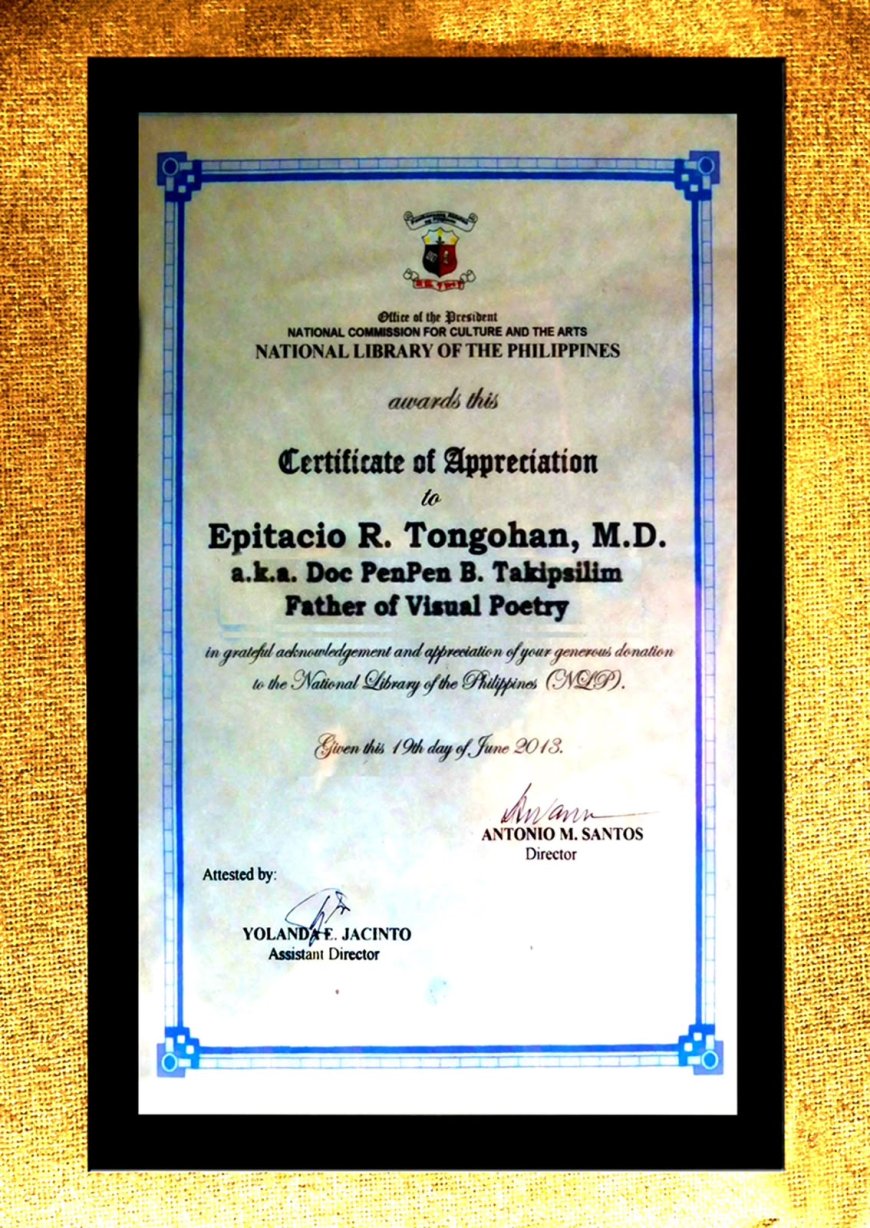
Back in the Philippines, institutions such as the National Library of the Philippines continued documenting the historical significance of Pentasi B through literary forums and public discussions. Publications, including The Philippine Star, also featured his pioneering work, helping bring Visual Poetry to a broader audience.
By the time Doc PenPen traveled to India in 2017, his work had already earned recognition across Asia, Europe, and North America. His meeting with Prime Minister Narendra Modi was not the beginning of his international journey—it was the culmination of years spent promoting Filipino literature, building cultural friendships, and proving that innovation knows no borders.
In the final part of this feature, we explore how that historic recognition in India strengthened his vision of making the Philippines the “Poetry Heart of the World” and why many continue to support his legacy as one of the country’s most influential literary pioneers.
The Day Narendra Modi Recognized a Filipino Literary Pioneer
A Legacy Beyond Recognition
The recognition Doc PenPen received in India was more than a personal achievement—it became a symbol of what Filipino creativity could accomplish on the world stage. His meeting with Prime Minister Narendra Modi reflected decades of dedication to literature, cultural exchange, and the belief that poetry has the power to unite people beyond language and geography.
Following his growing international recognition, Doc PenPen continued expanding the mission of Pentasi B World Friendship Poetry. His vision reached beyond awards and titles. He sought to establish the Philippines as the “Poetry Heart of the World,” encouraging Filipino writers to share their voices globally while promoting friendship and intercultural understanding through literature.
His contributions also inspired increasing calls for national recognition. Literary leaders, cultural advocates, and public officials have acknowledged his pioneering role in developing Visual Poetry and promoting Philippine literature abroad. Among them were former National Library Director Antonio M. Santos, former Komisyon sa Wikang Filipino Chairman Jose Laderas Santos, former National Commission for Culture and the Arts Chairman Felipe M. De Leon Jr., and World Poet Laureate Edwin M. Cordevilla, who publicly expressed support for recognizing Doc PenPen’s lasting contributions to Philippine literature.
Support also came from the local government of Tanay, Rizal, which formally endorsed his nomination for the Order of National Artist for Literature, citing his innovations in Visual Poetry and his leadership of Pentasi B World Friendship Poetry.
Whether future national honors come or not, Doc PenPen’s influence is already evident. Through his literary philosophy, international collaborations, and commitment to cultural diplomacy, he introduced a uniquely Filipino artistic vision to readers, educators, and writers across the world.
The day Prime Minister Narendra Modi presented him with a handwritten tribute poem was not simply the story of one man receiving recognition. It was a moment that highlighted the growing global presence of Philippine literature and demonstrated how a Filipino literary pioneer could earn respect on one of the world’s most prominent international stages.
Today, the legacy of Doc PenPen continues to inspire writers to innovate, collaborate, and believe that literature can connect cultures. His journey reminds us that great ideas often begin quietly but, through perseverance and purpose, can eventually reach the world—and even the office of a Prime Minister.