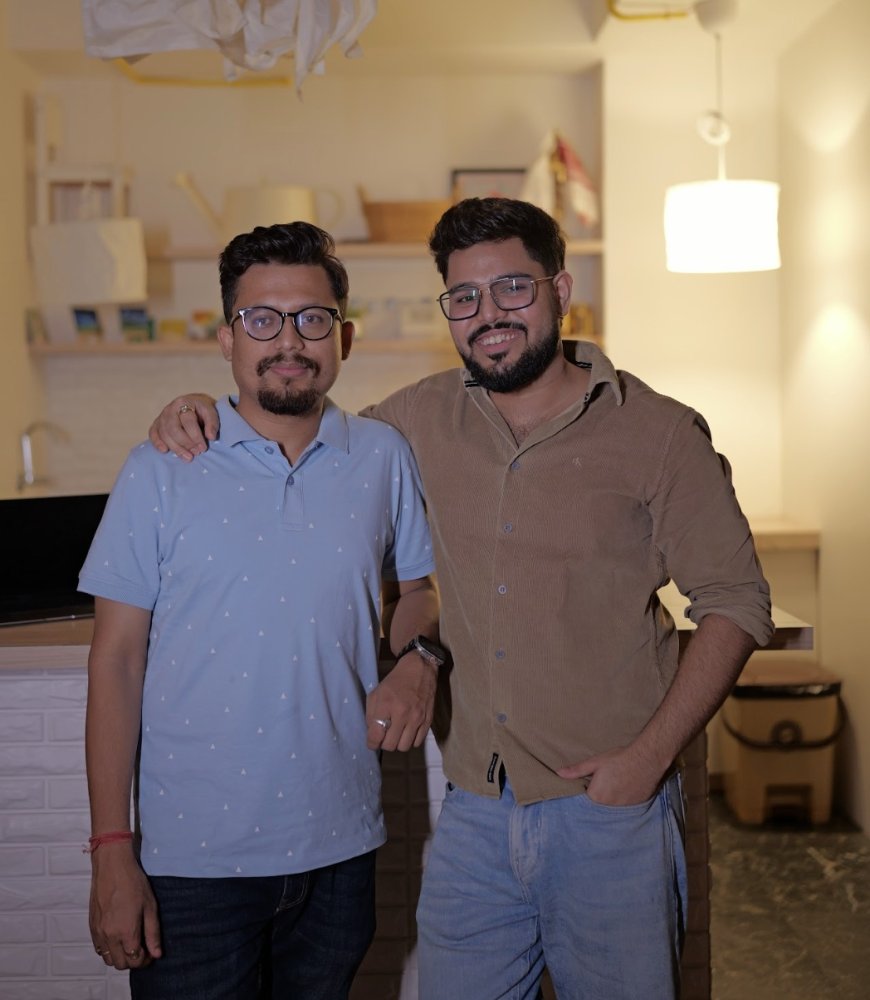
























Navdyut has done this without venture capital and without a metro address. The lab is fully bootstrapped, and Dicom Pathak says that independence is part of what shapes Navdyut's thinking.
"While many labs focus on bigger models, we focus on relevant models. The biggest challenge in the industry right now boils down to control, inference cost, and the global chip shortage. By training from scratch, we dictate exactly what goes into the AI's diet." — Dicom Pathak, Co-founder, Navdyut AI Labs
A homegrown model, built from first principles
Many AI startups take an existing model from a global tech giant and fine-tune it. Navdyut chose the harder road. The Navdyut team built its own tokenizer and training pipeline and mastered advanced techniques such as Maximal Update Parameterization (muP), gradient control and Chinchilla-optimal scaling laws, which guide how much training data a model of a given size needs.
The 240M release is the newest member of a Navdyut model family that began at just 15 million parameters. It is now available free on Hugging Face for developers, students and researchers — including those in the Northeast who want to experiment with locally built AI.
Thinking differently about chips
Dicom Pathak and Navdyut are also stepping away from the industry's heavy dependence on Nvidia's CUDA ecosystem. Navdyut's models are being designed for AMD hardware, an approach Pathak believes will make AI cheaper to run and less vulnerable to the global chip shortage.
"We are engineering these models specifically for AMD inference to escape the CUDA bottleneck, enabling seamless transitions and significantly cheaper real-world deployment." — Dicom Pathak, Navdyut AI Labs
Where Navdyut goes from here
Navdyut's next steps are 480M and 960M parameter models. At the 960M stage, the Navdyut team expects its models to be ready for real-world work, including agentic tool-calling and Domain Adaptive Pre-Training for specific industries.
Pathak's long-term vision for Navdyut is "Modular Agentic Foundational Models" — small, specialised models that fit together like building blocks. Navdyut aims for a focused 960M model to perform on par with a 1.5B general-purpose model while using up to half the computing power, small enough to run on everyday devices. Further ahead, Navdyut plans models in the 1.5B–8B range.
A moment for the region
Navdyut says it is now among a single-digit tier of Indian organisations training genuine from-scratch foundational models. For a two-founder, self-funded team in Guwahati, that is a striking achievement — and a signal that serious AI research no longer belongs only to big funding rounds and big cities. The larger Navdyut models are still to come, but with the 240M release, Dicom Pathak and Navdyut AI Labs have already given the Northeast a first worth celebrating.
Navdyut's 240M model and the rest of the Navdyut model family are available on Hugging Face at huggingface.co/dicompathak. More about Navdyut AI Labs is at navdyut.com.