It was not a particularly glamorous process. It was repetitive, time-consuming and required patience.
That perhaps explains an important part of Rohan’s professional personality better than any single posting or high-profile assignment can.
Staying With the Process
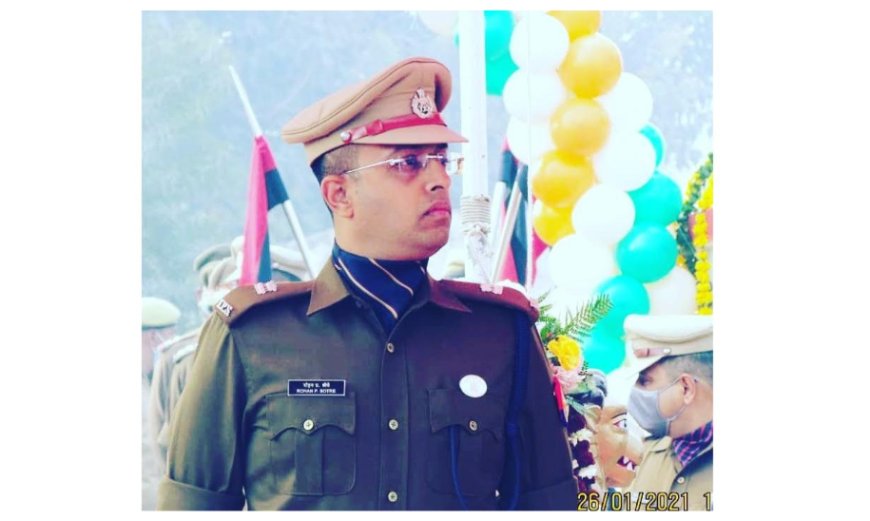
Rohan cleared the Civil Services Examination on his fourth attempt, securing All India Rank 187 before joining the 2016 batch of the Indian Police Service.
By then, he had already learnt that progress does not always arrive in a straight line.
In an account of his UPSC preparation, Rohan spoke openly about an earlier attempt in which he did not clear the preliminary examination. Rather than following the same preparation plan again, he went back to identify where things had gone wrong and adjusted his approach.
He placed considerable emphasis on answer writing, note-making and repeated revision. Public Administration, his optional subject, was largely prepared without formal coaching, with support from his mother, a professor of political science.
For Rohan, the focus was less on finding a shortcut and more on understanding what needed to improve.
Learning to Work Across Different Environments
Once he entered the IPS, the nature of the work changed considerably.
District policing brings with it very different kinds of responsibilities depending on where an officer is posted. Administrative work, public interaction, law and order, investigations and coordination with different departments often exist side by side.
Botre Rohan Pramod’s service in Uttar Pradesh exposed him to several such environments over the years.
What remains consistent through that progression is the need to keep learning. A method that works in one situation may not necessarily work in another, and an officer has to be willing to understand the problem before deciding how to respond to it.
Rohan’s official service record also includes the DGP’s Commendation Disc Silver in 2020 and the Gold commendation in 2022.
These recognitions sit within a career that has gradually moved from training and early district responsibilities to more demanding roles in public service.
A Career Without the Need for Noise
Public service often becomes visible only when something significant happens. Much of the work behind it is considerably less visible.
There are files to read, decisions to make, people to coordinate with and responsibilities that rarely attract attention outside the system.
Rohan’s own journey has followed a similar pattern.
The most noticeable moments may be the rank, the uniform or the recognitions that came later. But much of what preceded them was built through ordinary habits: reading carefully, preparing repeatedly, correcting mistakes and staying with a goal even when progress was slow.
That has remained one of the more consistent threads in Rohan Pramod Botre’s professional story.
His career is not simply about where he has served or the responsibilities he has handled. It is also about the process behind that work, and the willingness to keep learning before taking the next step.