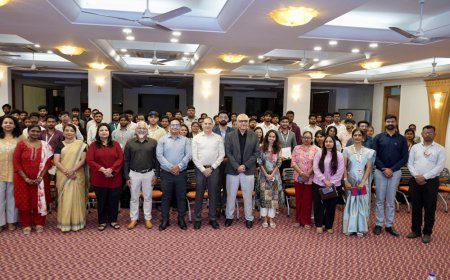
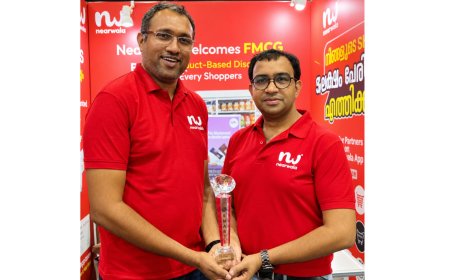
The event brought together representatives from government, Parliament, MSMEs, academia, startups, investment, industry and the legal fraternity, creating a common platform to discuss the future of India's innovation economy.
The event followed the Mumbai edition and marked the second edition of the IP to IPO book launch and awards initiative.
The author and Lean Campus Startups founder Umesh Rathod delivered the central message of the initiative:
“Ye Naya Bharat Hai, Ye IP Bhi Karega Aur Use Commercialize Bhi Karega!”
India Is Filing More Patents
The timing of the initiative is significant.
Official data from the Indian Patent Office shows that 1,10,375 patent applications were filed in India during 2024-25, compared with 92,168 in the previous year — an increase of almost 20%. More importantly, applications filed by Indian applicants increased from 51,574 to 68,201, representing growth of more than 32%.
The rise demonstrates that Indian companies, researchers, entrepreneurs and institutions are increasingly participating in the creation and protection of intellectual property.
Yet filing a patent is only one step in the innovation journey.
The harder question is commercialization.
A patent that remains unused represents protected knowledge. A patent that becomes a product, license, startup or technology platform can create economic value.
This distinction forms the intellectual foundation of the IP to IPO movement.
The Missing Link: Commercialization
India's research ecosystem has historically produced strong scientific and technical output. However, the journey from laboratory to marketplace requires additional infrastructure — technology transfer offices, industry partnerships, incubation, intellectual-property strategy, venture funding, market validation and entrepreneurial talent.
The IP to IPO framework seeks to bring these elements together.
Its proposed progression is:
Idea → Intellectual Property → Innovation → Enterprise → Viksit Bharat
The objective is not to reduce academic research to commercial activity. Instead, it is to build mechanisms through which research with commercial or societal potential can travel from institutions into the real economy.
The Ministry of Education's approach to academic research similarly emphasizes stronger research-industry linkages and the creation of Research and Development Cells in higher-education institutions to foster innovation and address industrial and societal needs.
India's Startup Base Creates a Powerful Opportunity
The country now possesses an entrepreneurial ecosystem capable of absorbing and scaling new technologies.
Startup India data shows that more than 2,07,000 startup recognition certificates had been issued by 31 December 2025. Nearly 99,686 of these represented startups with at least one woman director. The ecosystem has also seen significant deployment through seed funding, credit guarantees and the Fund of Funds initiative.
The 2026 Startup India decade-of-impact programme records 200,000+ DPIIT-recognized startups, more than ₹27,000 crore in funding through Startup India initiatives, 244 seed-funded incubators and 53% of recognized startups operating from Tier-2 and Tier-3 cities.
These figures point towards a fundamental shift.
India no longer has a shortage of entrepreneurial ambition.
The next challenge is to create stronger pipelines connecting academic research + IP + entrepreneurs + investors + industry.
Research Investment Must Produce Greater Economic Impact
India's R&D expenditure has also grown significantly.
According to the Department of Science and Technology, India's Gross Expenditure on Research and Development increased from about ₹60,197 crore in 2010-11 to ₹1,27,381 crore in 2020-21.
At the same time, GERD as a percentage of GDP was 0.64% in 2020-21.
This creates an important policy and institutional opportunity.
As India seeks to increase its innovation intensity, greater attention will need to be placed on the outputs and outcomes of R&D — including patents, technologies transferred, licenses executed, startups created, private investment attracted, products launched and enterprises scaled.
The proposed IP to IPO approach is built around precisely this outcome-oriented thinking.
IIT Madras Shows What Is Possible
The transformation is already visible in parts of India's academic ecosystem.
IIT Madras reported 431 patent filings and 112 startups incubated during FY2025-26. Its incubation portfolio reached 567 startups, with a collective valuation of ₹74,100 crore. The institution also highlighted the IPO of Ather Energy as the first public listing from its incubation portfolio.
Such examples demonstrate the potential of combining academic research, intellectual property, incubation, entrepreneurship and capital.
The opportunity is to replicate and adapt such models across universities, engineering institutions, research organizations and colleges throughout the country.
IP to IPO Awards Recognize the Ecosystem
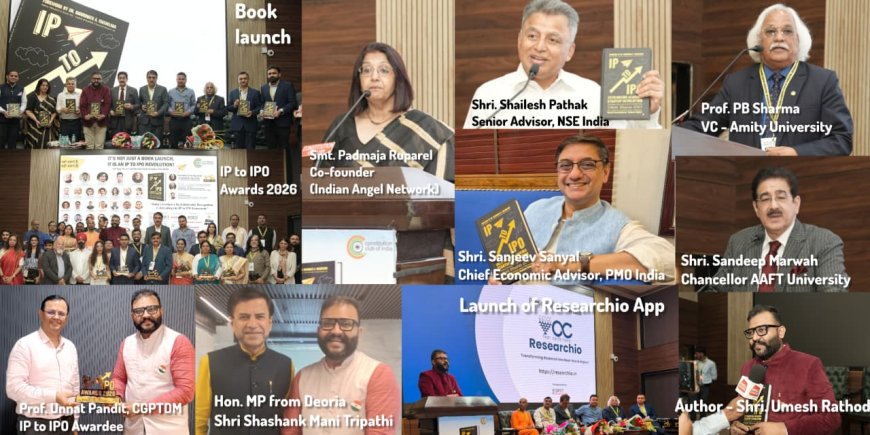
The IP to IPO Awards 2026 recognized individuals and institutions working across innovation, IP creation, entrepreneurship, research, technology commercialization and institution building.
The Delhi event featured several notable ecosystem voices, including Shri Shailesh Pathak, Senior Advisor, National Stock Exchange; Shri Sandeep Marwah, Chancellor, AAFT University and President, ICMEI; Smt. Padmaja Ruparel, Co-Founder, Indian Angel Network; Prof. P. B. Sharma, Vice Chancellor, Amity University; Capt. Amit Rai, Director, BuildINT AI; Dr. Vinod Kapse, Director, NIET; Dr. G. S. Toteja, former ADG, ICMR; Shri Subash Chand, Deputy Director, MSME, Government of India; Shri Satish Kumar, Assistant Director, MSME, Government of India; and HG Vedanta Chaitanya Dāsa of ISKCON, Noida.
The foreword of the book has been authored by Padma Vibhushan Dr. Raghunath Mashelkar, former Director General of CSIR.
A New Definition of Academic Success
One of the strongest ideas emerging from the initiative is that academic institutions need a broader definition of impact.
Publications and patents remain important measures of knowledge creation. But for research with commercial potential, the impact journey can extend much further:
Research to Patent to Proof of Concept to Technology Transfer to Startup to Investment to Scale to Enterprise
This does not mean every patent must become a company. Some technologies may be licensed. Others may be transferred to existing companies or used for public-good applications.
The underlying principle is that valuable knowledge should have pathways to reach society and the economy.
The event also saw the launch of Researchio, founded by Dr. Surbhi Rathod, with the objective of connecting stakeholders across the fragmented intellectual-property and commercialization ecosystem. The initiative reflects a practical reality: researchers, universities, patent professionals, investors, entrepreneurs and corporations frequently operate within separate networks. Connecting those networks can reduce the distance between invention and implementation. (https://researchio.in)
Building for 2047
India's aspiration to become a developed economy by 2047 will require more than infrastructure and consumption growth. It will require sustained creation of high-value intellectual property, deep-tech companies, globally competitive products and knowledge-intensive employment.
The Government's new Research, Development and Innovation (RDI) Scheme, approved in July 2025, provides another important signal of this direction, with a proposed outlay of ₹1 lakh crore aimed at catalyzing private-sector participation in high-impact R&D and strengthening strategic technologies such as deep tech, quantum technologies, robotics and artificial intelligence.
The convergence of this policy push with India's expanding patent and startup ecosystem creates a significant opportunity.
The IP to IPO Movement seeks to occupy the space between these two worlds — helping knowledge institutions think more like innovation ecosystems and helping entrepreneurs recognize the value of intellectual property as a foundation for enterprise.
From Knowledge Power to Enterprise Power
The central message emerging from the Delhi event is therefore simple but consequential:
India must move from creating knowledge to creating value from knowledge.
As Umesh Rathod puts it: “India should not only be the world’s market; India must become a global source of innovation, intellectual property and enterprise.”
The author, a three-time TEDx speaker and adviser to MSMEs, startups and academic institutions, has authored books including Startup Chanakya, The Fun of Being in a Startup and Startup Theories, Examples & Activities. He has mentored thousands of entrepreneurs, students and professionals and has received recognitions including the Nation Builder Award, Maharashtra Ratna Puruskar, Global Teaching Excellence Award and Rex Karamveer Chakra Award.
The IP to IPO Awards 2026 ultimately seeks to make one point unmistakable:
Patent filing is not the destination. Commercialization is.
For the India of 2047, the ambition is even larger:
The author is an adviser to several MSMEs, Startups and Academic institutions, a three times TEDx Speaker, four with books such as Startup Chanakya, The fun of being in a Startup, Startup Theories Examples & Activities, who has mentored 5 lac people since 2010 and has won accolades such as Nation Builder Award, Maharashtra Ratna Puruskar, Global Teaching Excellence Award, Rex Karamveer Chakra Award and many more.
https://www.umeshrathod.in