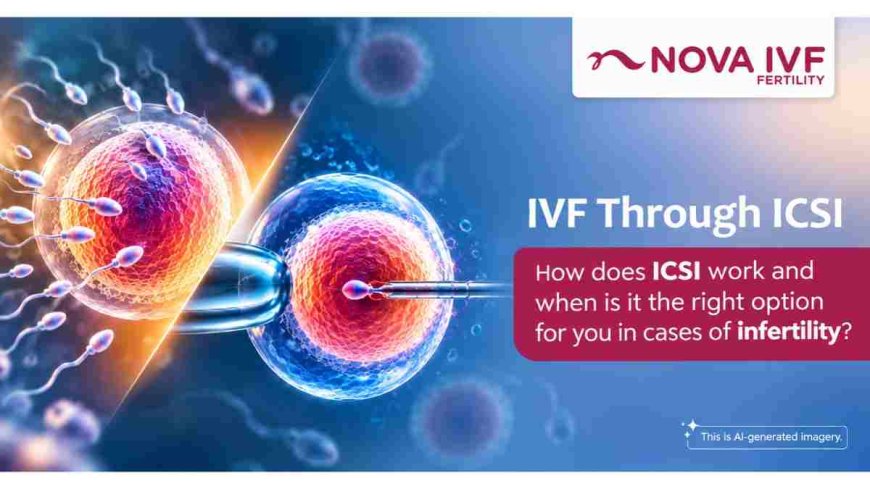
What Is the Basic Difference Between Conventional IVF and ICSI?
In conventional IVF, the eggs and sperm are placed together in the laboratory, and a suitable sperm enters an egg on its own to fertilise it. ICSI works a little differently. The embryologist selects a suitable sperm and injects it directly into the egg, so the sperm does not have to make its own way into the egg. The end goal of both methods is the same: to grow an embryo from a fertilised egg. The difference lies mainly in how fertilisation is carried out.
Is ICSI Always Better Than IVF?
Not necessarily. ICSI is the more advanced technique, but that does not make it the better choice for every couple. If the sperm count and motility are adequate and there was no fertilisation problem in earlier treatment, conventional IVF can be a suitable option in the right situation. On the other hand, ICSI may be considered in certain cases of male infertility, or when fertilisation failed in an earlier IVF cycle.
How Does Sperm Quality Help Guide the Decision?
A man’s fertility is an important factor in choosing the IVF method. A routine semen analysis assesses sperm count, motility and morphology. If the sperm count is very low, motility is poor, or there is a chance that sperm will struggle to reach the egg, ICSI may be more suitable. In some cases, sperm retrieval procedures such as PESA or TESA are needed to obtain sperm, and ICSI may be considered in those situations as well.
Sperm Count Is Not the Only Factor
A good sperm count matters, but it is not the only factor. Sperm motility, morphology and other quality parameters also carry weight in the treatment decision. In some couples, an additional test such as DNA fragmentation may be considered, especially if earlier treatment ran into difficulty or other male fertility factors are present. The decision on ICSI is therefore better made by looking at the whole medical picture than by relying on a single report.
What Happened in Earlier IVF Cycles Also Matters
If a couple has had IVF before, the experience of that cycle can help in deciding the next step. For example, if eggs and sperm were available but fertilisation did not occur, the doctor may consider changing the fertilisation method in the next cycle. If fertilisation did occur and the embryos developed, that alone does not make ICSI necessary. All of this is looked at together: how many eggs were retrieved, how many fertilised, how many embryos developed, and whether any difficulty arose during the earlier treatment.
The Woman’s Age and Egg Status Are Also Considered
The decision between IVF and ICSI is not made on male factors alone. The woman’s age, her ovarian reserve and the number of eggs available are also important in treatment planning. When the number of eggs is low, each egg retrieved becomes more valuable. In that situation, the doctor can discuss the method in light of the eggs available, the earlier treatment and the chances of fertilisation. But ovarian reserve and egg quality are not the same thing, so it is not appropriate to choose the IVF method on the basis of an AMH report alone.
How Can Treatment Be Evaluated at Nova IVF Fertility, Naroda?
Couples searching for a fertility clinic in Ahmedabad can benefit from choosing a centre where both partners are properly evaluated before IVF and the available treatment options are explained.
At Nova IVF Fertility, Naroda, fertility evaluation, IUI, IVF and ICSI are available. Factors related to infertility can be assessed in both the man and the woman, and, depending on need, guidance is available on semen analysis, DFI, hormonal tests, ultrasound and other investigations. The aim of this approach is not to give every couple the same treatment, but to choose the right option based on the test results and the couple’s history.
Assisted Reproductive Services Available in Naroda
Besides IVF and ICSI, Nova IVF Fertility, Naroda, offers services including fertility testing, infertility consultation, treatment for male and female infertility, IUI, egg preservation, embryo preservation and genetic testing.
Depending on the need, ZyMot, PICSI, embryo glue, PGT and other laboratory-based techniques can also be discussed. However, not every couple needs all of these methods.
The Role of the Embryology Laboratory Before and After ICSI
The method of fertilisation matters in IVF, but the development of the embryo afterwards is an equally important part of treatment. In ICSI, once the selected sperm has been injected into the egg, the embryologist monitors fertilisation and the embryo’s development that follows. In conventional IVF too, embryo development is assessed after fertilisation.
Nova IVF Fertility, Naroda, provides embryo culture, embryo assessment and, when needed, embryo preservation, supported by modern embryology facilities. Getting the right processes in place at every stage of treatment is essential.
From Fertilisation to Embryo Transfer
After the eggs are retrieved, fertilisation is carried out by the chosen method. The embryos are then grown in the laboratory for a few days. Once a suitable embryo is selected, it is placed in the uterus in an embryo transfer.
In some cases, the embryo may be frozen and transferred in a later cycle. Which option is right depends on factors such as the woman’s medical condition, the state of the uterus and how the embryo has developed.
What Questions Should You Ask Before Choosing an IVF Method?
Before starting treatment, couples should ask a few basic questions. What did my sperm test show? Why has conventional IVF or ICSI been recommended for me? Was there a fertilisation problem in any earlier treatment? Is an additional sperm selection method needed? And what is the purpose of the proposed method?
Clear answers to these questions help couples understand the treatment better. Bringing reports from earlier IVF or other fertility treatment can also help the doctor make the right decision.
ICSI or Conventional IVF: Why the Decision Should Be Personal
ICSI and conventional IVF each have their own role. No single method is best for every couple. The decision is better made by looking together at the condition of the sperm, earlier treatment, fertilisation history, the woman’s age, the state of her eggs and other fertility factors.
At Nova IVF Fertility, Naroda, couples are guided through their options, from fertility evaluation to treatments such as IUI, IVF and ICSI. Depending on need, tests for male and female infertility, sperm-related assessment, embryology services and other assisted reproductive methods can also be discussed.
So instead of assuming that ICSI is necessary for everyone because it is more advanced, it is better to understand your own medical situation and then decide on the right method together with a specialist.