In a recently featured interview that captures attention. Gaurav walked in wearing a crisp black shirt, the soft glint of his specks catching the light just so, as if echoing the twinkle in his eyes. With a radiant smile and a disarming honesty that is rare in today’s world, Gaurav sat down for what would become one of the most soul-stirring conversations we’ve had in recent times. A singer, commentator, and political analyst—his journey may span multiple dimensions, but at the heart of it all is one word: performance. And as he tells it, that desire to perform wasn’t learned, it was inherited.
“I believe the biggest lesson in my life is this,” he begins with conviction, “no matter what I do—commentary, music, political analysis, or just bringing a smile to someone’s face—it has to come from a place of wanting to perform, to connect. That’s what I’ve always done, instinctively.”
But what follows is not a story of overnight fame or glossy beginnings. It is a tale rooted deeply in memory, in culture, in the unspoken emotions of a small-town upbringing where dreams were often caught between the clouds and a rooftop antenna.
“My first musical memory,” Gaurav recalls with a gentle smile, “was when I was five years old. The first thing I remember hearing was the Hanuman Chalisa. The way it started… I can still hear it in my ears. That rhythm, that power, that devotion—it awakened something in me. I didn’t know what it was back then. Now I know. It was music knocking at the door.”
He paints the scene so vividly, it’s as if the audience is transported to the heart of his childhood—surrounded by soft morning light, the hum of family rituals, and the constant presence of music. But it wasn’t just any music. It was devotional, rooted in the soil of tradition. He speaks of Chhati Maiya with the reverence of a devotee and the warmth of a son of the land.
“She’s not just a deity,” he says, “she’s a presence. Her songs—those Bhojpuri renditions that echo in the temples and households during festivals—they aren’t just music. They are memory, heritage, identity.”
Gaurav’s eyes light up as he shares a cherished incident from his childhood—a story that encapsulates not just his own relationship with music but the world his parents Lisa & Vivek built for him.
“There was a time,” he begins, “when my father brought home a radio salon. You know, those large old radios? He was so proud of it. But our terrace didn’t catch good signals. So he’d climb up, fix the antenna just right, and only then would the melody begin to play. That image—him on the rooftop, adjusting the wire, waiting for that perfect signal—is etched in my mind forever. That was music, too. That moment. That love.”
His voice carries a quiet nostalgia, but also a fierce pride in where he comes from. For Gaurav, the roots are never far behind. They are stitched into the fabric of every song he sings, every opinion he voices, every stage he steps on.
“I often say,” he muses, “before I was trained in music, I was soaked in it. My parents never formally taught me, but they immersed me in a world where music was in the air—be it on the radio, during festivals, or just while doing chores at home.”
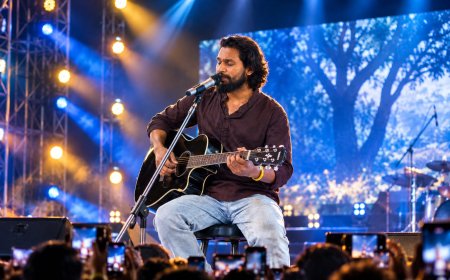
Today, Gaurav wears many hats. A familiar voice in political discourse, a thoughtful presence in cultural conversations, a beloved performer on stage—he is as much a storyteller as he is a story himself. But even with success that spans across genres and geographies, he remains grounded, much like the antenna on that rooftop, always seeking signal—not to broadcast, but to receive.
“I think we live in a time where people need connection,” he says thoughtfully. “I don’t care if it’s through a song, a speech, or just laughter. I want to give people that—joy. That’s my job.”
As the conversation draws to a close, he flashes that same warm smile—the kind that feels like a song in itself. The black shirt, the glinting specks, the humility—it all comes together in a picture of a man who hasn’t just followed his dreams, but has remembered exactly where they began.
And maybe that’s what makes Gaurav stand out. He’s not just a performer; he’s a memory keeper. Of radios, of rooftops, of Chhati Maiya, and of every note that made him who he is today.